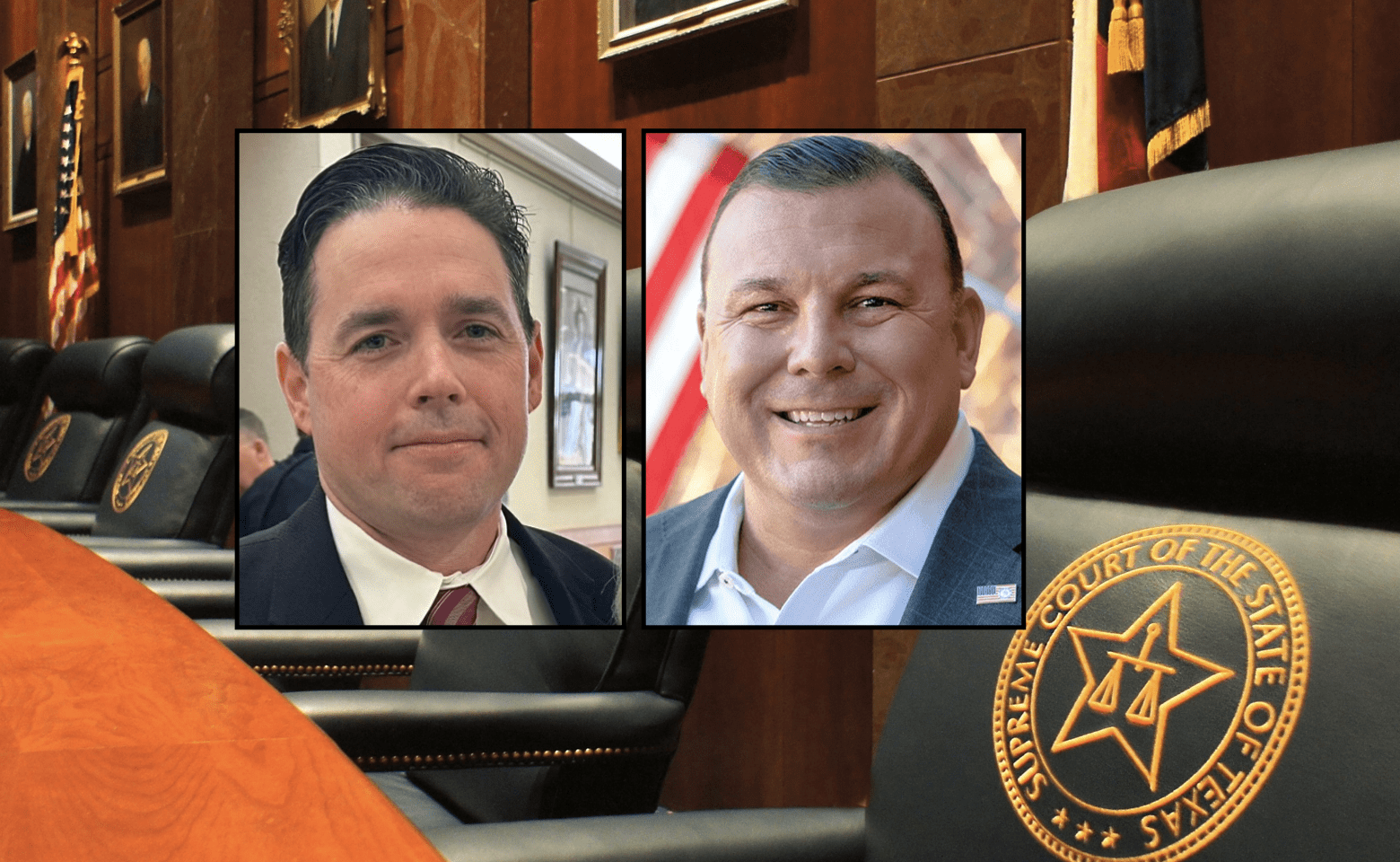
Texas Supreme Court Justices heard oral arguments Wednesday in a case focused on protecting citizens’ rights to exercise political free speech that is critical of elected officials.
The case, Frazier v. Chabot, pits disgraced former State Rep. Frederick Frazier against his 2022 Republican primary rival Paul Chabot over a website Chabot created that was deemed “defamatory” to Frazier.
Background
Frazier (R–McKinney) faced nearly two years of legal battles surrounding a 2022 incident in which he impersonated a code compliance officer and ordered a local business to remove political signs belonging to Chabot.
In December 2023, Frazier pleaded guilty to one count of criminal mischief, a Class C misdemeanor, for vandalizing campaign signs.
He also pleaded no contest to two counts of attempted impersonation of a public servant, a Class A misdemeanor. As part of his plea deal, he was offered deferred adjudication, which meant the charges wouldn’t remain on his criminal record. Frazier was also discharged from his probation.
That same month, Frazier resigned from the Dallas Police Department. Because he also was the subject of an Internal Affairs investigation, his departure was initially classified as a dishonorable discharge. Frazier later reached a confidential settlement to change his status to a general discharge.
During the May 2024 Republican primary runoff election between Frazier and Keresa Richardson, Chabot’s FireFrazier.com website documented Frazier’s criminal behavior. This included statements that Frazier had been “convicted” and “dishonorably discharged.”
Frazier’s attorney sent Chabot a cease-and-desist letter, but Chabot continued publishing similar statements.
The Lawsuit
In June 2024, Frazier sued Chabot for defamation, alleging Chabot’s website made “false claims” about Frazier that caused the freshman lawmaker to lose his re-election bid for Texas House District 61.
Specifically, he argued that because the impersonation charges were later dropped as part of his deferred adjudication deal, Chabot’s statements that he had been convicted were no longer true.
Frazier similarly argued that because his departure from DPD was reclassified as a general discharge, Chabot’s statements that he had been dishonorably discharged were no longer true.
Chabot filed a motion to have the case dismissed under the Texas Citizens Participation Act (TCPA), a law designed to protect Texans from retaliatory lawsuits intended to silence them on matters of public concern.
Judge Jim Pruitt denied Chabot’s motion to dismiss, finding that Frazier had made a sufficient initial showing to support his claims that Chabot published false statements against Frazier with actual malice, and granted Frazier’s request for the recovery of attorney’s fees.
Chabot appealed this decision to the Fifth Court of Appeals in Dallas, where a three-judge panel affirmed Judge Pruitt’s order denying the motion to dismiss, but reversed the award of attorney’s fees.
The Fifth Court denied Chabot’s motion for panel rehearing and en banc reconsideration, in which the full court would have considered the case. Chabot then appealed to the Texas Supreme Court.
Multiple free speech advocacy groups filed amicus briefs in January 2026, urging the Court to take up the case. The effort was ultimately successful, and oral arguments were heard on Wednesday.
Oral Argument
Tony McDonald, Chabot’s attorney, repeatedly emphasized that Frazier carries a “heavy burden” in proving that Chabot actually knew his statements were false, or seriously doubted their truth. He argued that Frazier had not produced evidence showing Chabot knowingly published a falsehood or entertained serious doubts about what he told voters.
McDonald explained that Chabot relied upon information he received from the Dallas Police Department, including a voicemail stating that Frazier had been dishonorably discharged. Once Frazier told Chabot that the classification had been withdrawn, Chabot sought independent confirmation rather than accepting Frazier’s account.
When Chabot contacted the Texas Commission on Law Enforcement, however, he was told the information was confidential.
Regarding the conviction, McDonald pointed out that Chabot’s website provides all of the underlying public records and news reports to support his claim.
McDonald asserted that it is historically accurate and substantially true that Frazier was both convicted and dishonorably discharged, and that the disputed language did not clearly distinguish between Frazier’s past and current status.
Moreover, McDonald questioned whether that distinction would materially change what voters understood about the underlying conduct.
Chris Kratovil, Frazier’s attorney, countered that he has a low burden at the TCPA stage of the case, and that there is a substantial difference between Chabot’s claims and the truth.
Kratovil argued that discharge classifications carry substantial significance and that describing Frazier as dishonorably discharged misrepresented his updated status and is offensive to service members. Chabot is a U.S. Navy veteran.
He argued that Chabot “was aware or should have been aware” that the classification had changed, reasoning that Chabot scans the internet and uploads everything concerning Frazier to his website. Kratovil also pointed to Chabot’s continued statements after the cease-and-desist order.
McDonald responded that Chabot continuing to stand by his characterization of the events after Frazier’s cease and desist letter and lawsuit is not evidence Chabot secretly agrees with Frazier’s version of events.
When asked whether the disputed description was significantly more damaging than the truth, Kratovil stated that it is an “absolute binary” between honorable and dishonorable discharge. McDonald disputed that characterization, pointing out that service members can also receive a general discharge. He noted that this is what Frazier ultimately received.
The attorneys also disagreed over whether Chabot accurately described Frazier as having been convicted.
Kratovil questioned the use of that term for a Class C misdemeanor, saying he had never heard such a low-level offense described that way. Justice Brett Busby suggested that the description could nonetheless be accurate.
McDonald argued that Chabot told voters about Frazier’s crimes and what he knew about them, and that the First Amendment and the TCPA provide space for precisely this type of speech.
“Paul Chabot was the victim of a public official’s misconduct, crimes designed to suppress his political speech. For those crimes, Mr. Frazier was convicted of criminal mischief,” said McDonald. “He pled no contest to attempted impersonation charges, he was sentenced to probation and required to pay a victim restitution. When Mr. Chabot, who is the victim of those crimes, told voters about them, Mr. Frazier responded with this lawsuit.”
“There are numerous doctrines identified in our briefing that are meant to protect speech like this,” he continued.
What Happens Next
Following the Democrats’ sweeping victory of statewide offices on Tuesday, the Texas Supreme Court will shift from 9-0 Republican control to 5-4 Republican control in January. Justice Debra Lehrmann (R) is expected to be the swing vote in many cases.
Although a ruling would not normally be expected until the spring, many active cases may be expedited to ensure they are ruled upon by the same Court that heard them.
This was done in 2024, when former Chief Justice Nathan Hecht was set to retire, though with many more months of advanced notice. It is uncertain what time restraints will allow the current Court to accomplish.
If you or anyone you know has information regarding court cases, please contact our tip line: tips@texasscorecard.com.