A huge coalition of First Amendment advocates is asking the Texas Supreme Court to take up a case focused on protecting citizens’ rights to exercise political free speech that is critical of elected officials.
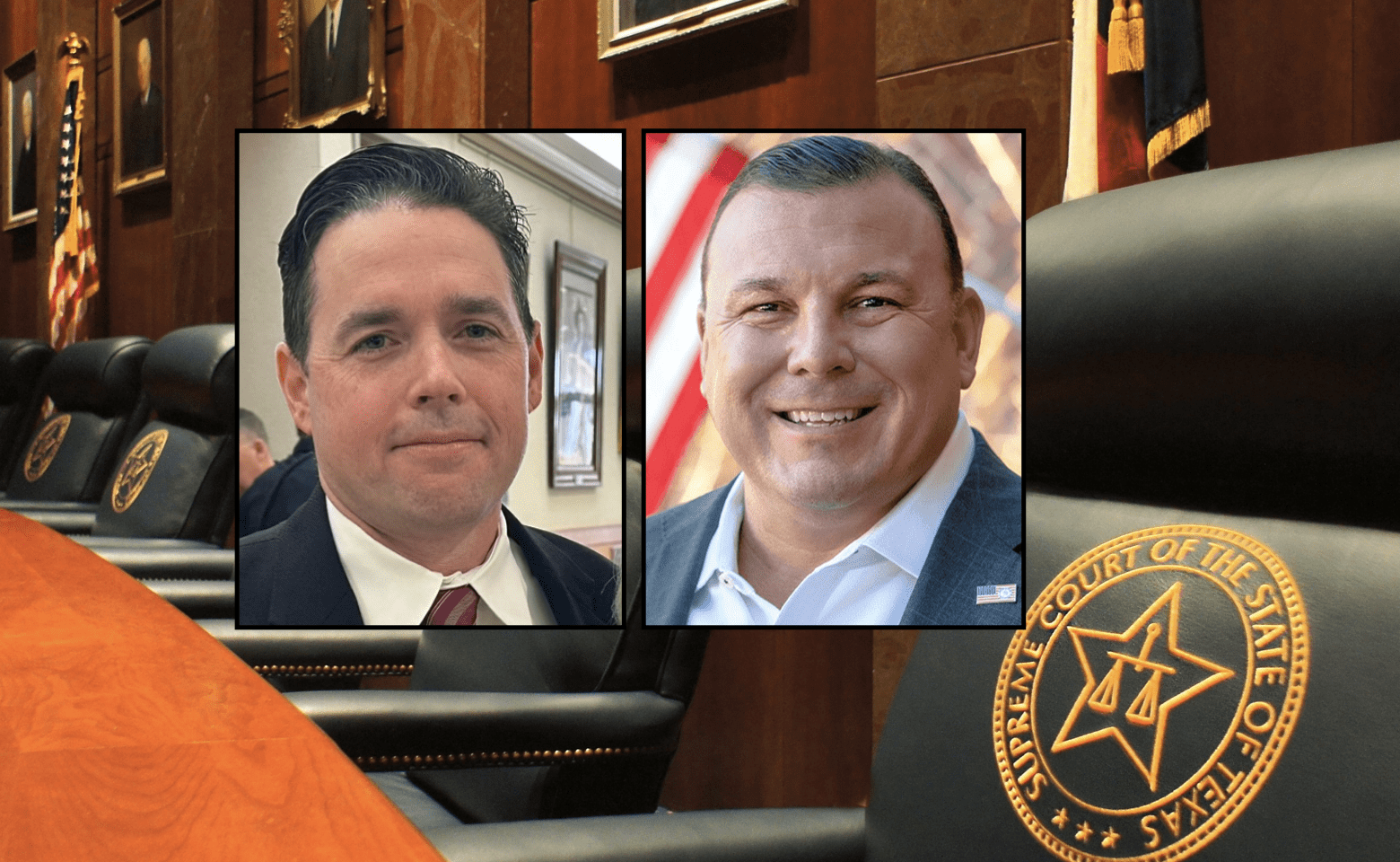
The case, Frazier v. Chabot, pits disgraced former State Rep. Frederick Frazier against his 2022 Republican primary rival Paul Chabot over a website Chabot created that was deemed “defamatory” to Frazier.
Chabot has filed a petition asking the Supreme Court of Texas to review lower court rulings in the case. Free speech advocacy groups are supporting Chabot’s petition with an amicus brief.
Frazier’s attorney, Christopher Kratochvil, has argued that “all [Chabot] needed to do was to shut up” in response to Frazier’s “cease and desist” letters claiming the website’s statements were untrue.
Chabot’s attorney, Tony McDonald, called Frazier’s complaint “the quintessential ‘SLAPP’ suit.”
Strategic Lawsuits Against Public Participation—SLAPP suits for short—are filed to intimidate and silence citizens exercising their First Amendment rights to criticize politicians.
State lawmakers passed the Texas Citizens Participation Act in 2011 to protect against such suits.
The amicus brief filed this week argues that lower court rulings in the defamation case have “narrowed critical First Amendment protections for the public and the press on core political speech and undermined the Texas Citizens Participation Act.”
First Amendment attorney Laura Prather, a TCPA backer and authority on anti-SLAPP laws, is representing the coalition, which includes:
- The Freedom of Information Foundation of Texas
- The Texas Association of Broadcasters
- The Texas Press Association
- The Electronic Frontier Foundation
- The Foundation for Individual Rights and Expression
- The Institute for Free Speech
- The National Coalition Against Censorship
- The Reporters Committee for Freedom of the Press
The coalition’s brief focuses on a number of alleged errors made by the state’s Fifth District Court of Appeals in upholding a lower court decision that allowed Frazier’s defamation lawsuit against Chabot to proceed.
Because of their shared commitment to principles of freedom of speech and the press, amici write to encourage the Court to grant review and explain why requiring a high bar to show falsity and actual malice is vital to ensure that the public and press can freely discuss important issues and serve as a check on power.
Under the Court of Appeals’ flawed reasoning, basic speech freedoms would be chilled, and the public would be prevented from holding the government accountable without an increased risk of defamation liability.
“I’m excited that so many diverse organizations are joining together to urge the court to take up this case,” McDonald told Texas Scorecard.
“Texans must be free to criticize their public officials, particularly when those officials like Frederick Frazier commit crimes while in office,” he said. “The Supreme Court has an opportunity to put an end to the weaponization of our legal system by those who don’t like having their misconduct exposed to the public.”
Background
Frazier sued Chabot for defamation in June 2024, alleging Chabot’s FireFrazier.com website made “false claims” about Frazier that caused the freshman lawmaker to lose his re-election bid in the May 2024 primary runoff for Texas House District 61.
The website documents criminal behavior, which Frazier eventually admitted, involving campaign signs belonging to Chabot during the 2022 election.
In December 2023, Frazier paid restitution to Chabot for vandalizing the signs. He also admitted guilt in a plea bargain that reduced two felony charges of impersonating a code compliance officer to misdemeanor attempted impersonation of a public servant.
In his lawsuit, Frazier argued that because the impersonation charges were later dropped as part of his deferred adjudication deal—months early and just ahead of the May 2024 runoff election—Chabot’s statements that he had committed the offenses were no longer true.
Frazier, a former McKinney City Councilman and Dallas Police Department officer, was also the subject of a DPD Internal Affairs investigation that sustained allegations against him and resulted in a “dishonorable discharge” for retiring while under investigation, although Frazier later reached a confidential settlement to change his status to a “general discharge.”
In September 2024, Chabot moved to dismiss Frazier’s lawsuit, citing TCPA protections.
The motion was argued in October 2024, with Chabot claiming that elected officials like Frazier are subject to public scrutiny and criticism and Frazier countering that the criticism was untrue and therefore not protected.
Retired judge and former Rockwall mayor Jim Pruitt, assigned as a visiting judge in a Collin County district court, denied Chabot’s motion. Pruitt had also presided over Frazier’s December plea bargain.
The Fifth Court of Appeals in Dallas affirmed Pruitt’s order denying Chabot’s TCPA motion to dismiss.
On January 9, Frazier’s attorney sent another letter demanding Chabot “cease any and all efforts” to publicly share his website, issue a “full and complete retraction,” and “clarify” that statements on the website are “false.”
Chabot filed his petition with the Texas Supreme Court on January 16.
Free speech advocacy groups filed their amicus brief with the high court on January 26.
2026 Primary Election
The latest legal actions come as Frazier tries to regain the legislative seat he lost in a May 2024 primary runoff by a 68-32 percent margin to then-challenger Keresa Richardson, who is now the incumbent in the March 2026 primary.
For his 2026 campaign, Frazier has so far raised about $44,000, mostly from police and fire union PACs. About 15 percent, $6,500, has gone to Dykema, the law firm representing him in the suit against Chabot.
In his initial 2022 campaign, Frazier raised $1.4 million, with the biggest contributions coming from then-House Speaker Dade Phelan and Texans for Lawsuit Reform.
For his failed 2024 primary re-election bid, Frazier raked in more than $2 million in total contributions, with half coming from Texans for Lawsuit Reform and a PAC funded solely by casino mogul-lobbyist Miriam Adelson. But he started his current campaign with just $198.
Meanwhile, Frazier is being sued for allegedly failing to pay his former campaign consultant Tom Plunkett $36,950 in agreed-to compensation and bonuses for marketing services during the 2022 election. Frazier has denied Plunkett’s claims.
Early voting in the March 3 Primary Election starts on February 17.