This article has been updated since publication.
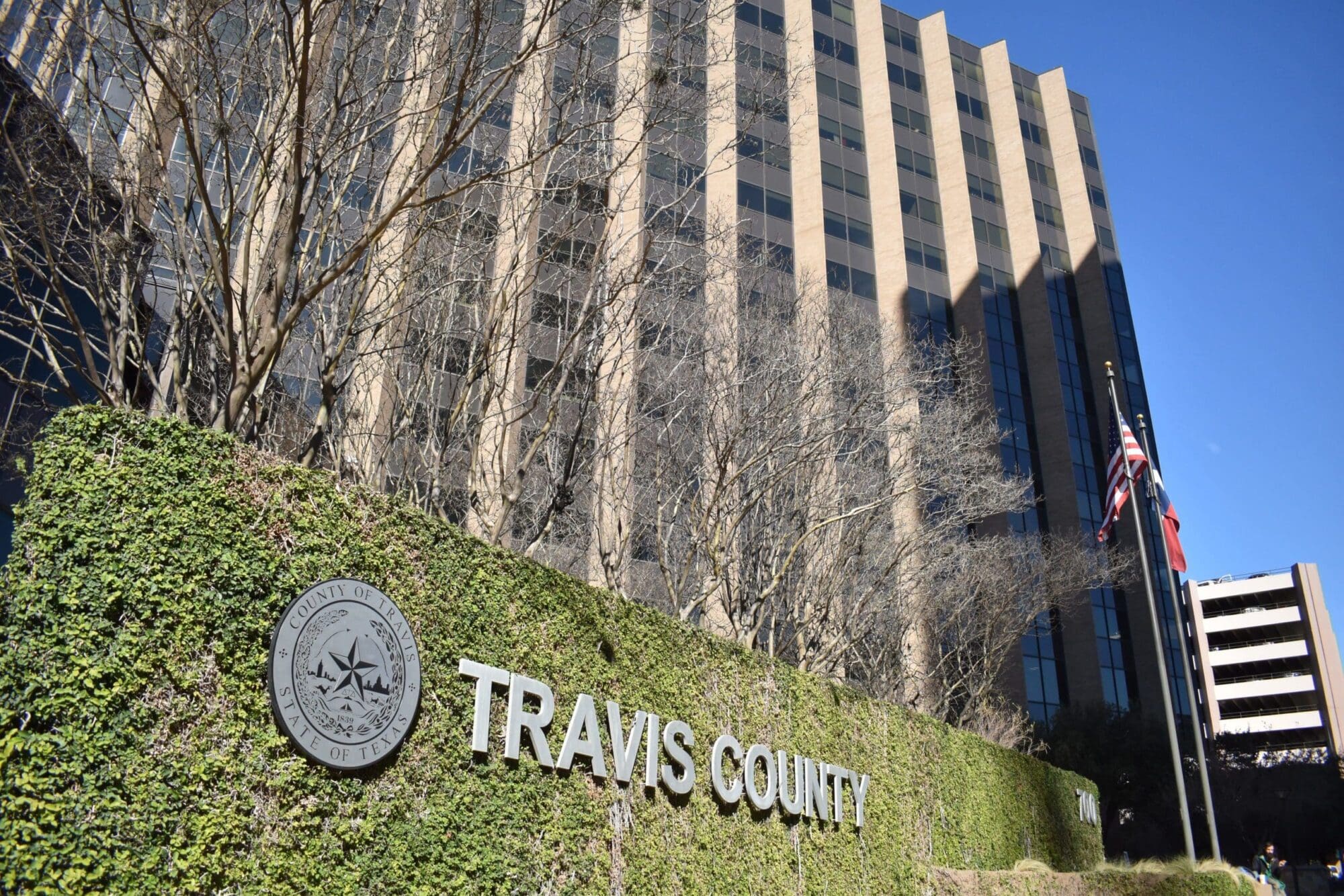
Travis County is taking private land against the owners’ will. The property developer says the county has also blocked his attempts to remediate the former landfill so that it can be utilized for the public’s benefit.
This case is one in a growing number where Texans are facing threats to their private property rights.
The Thursday eminent domain hearing took place at the Travis County Attorney’s Office before a three-member panel of volunteer commissioners. At stake was a more than 140-acre property off U.S. 290 in Austin. Located in a dense urban area, it was a landfill until 1982, and now a flea market is located on a portion of it.
The question before the panel was how much county taxpayers should pay the owners in exchange for the seizure.
The owners want to clean it up, not give it up, as part of a larger redevelopment plan with property off of South Congress Avenue. “We don’t want to be here today. We want to develop the property,” said attorney Brad Bullock, who represents the property owners, during his closing argument.
The former landfill is on a floodplain and is presently impaired with multiple issues. In March 2024, the Texas Commission on Environmental Quality reported leachate draining towards a creek. According to the U.S. Geological Survey, leachate “forms when liquid travels through a solid and removes some components of that solid with it.”
Texas Attorney General Ken Paxton sued Travis County in 2025 for environmental violations at the site.
According to Thursday’s testimony, Moo Moo Meadows LLC bought it in February 2024, with Corbin Graham of Graham Development as the asset manager. Graham and Bullock argued that Travis County failed to properly maintain the landfill for decades, leading to its current state.
Graham put together a remediation plan. It includes flattening the site, adding roughly 400,000 cubic yards of fill to stop water from penetrating the waste mass, and building a water-sealed pipe box to ensure water doesn’t stagnate or flow off-site uncontrolled.
He said the land’s former owners weren’t happy with their property’s current state. “[It] used to be a ranch, and when this never got returned to functional value, it didn’t sit well with the family,” he said.
Michael Miggins, who Graham hired to appraise the property, said the site preparation cost would be $7.4 million, with a 15 percent profit margin built in.
But Graham said Travis County blocked him by not signing a cooperation agreement. “When I applied for that … the county refused to sign the document, so I never [could] go to TCEQ to get my permit,” he testified.
In his closing argument, Sameer Birring of the Travis County Attorney’s Office said that “is really not relevant to today’s point … the owner can apply for permits without the county’s signature. I don’t want to spend a lot of time on that today.”
What ties this land with Graham’s South Congress Avenue redevelopment plan is a salvage yard. Located for more than 60 years on South Congress Avenue, the business would need to be relocated before development could start. Graham said the owners agreed to relocate, but only to the property off U.S. 290.
Once development is completed, Graham said his modeling shows he could resell the South Congress Avenue land for $98 million.
Bullock pointed out that Graham’s proposal isn’t novel. He referenced Hays County commissioners’ March approval of a new H-E-B to be built atop a former landfill in Buda. The project is supported by a $20 million taxpayer-backed package from the city and its economic development corporation, which are working with H-E-B to develop the site.
Graham told commissioners he isn’t seeking taxpayer monies to remediate the landfill. Instead, he wants Travis County to sign the cooperation agreement so his engineers can go to TCEQ. He believes local officials should “lean on the private‑sector solution so that they don’t burden taxpayers” with what the county’s own budget now pegs as at least a roughly $10 million cleanup.
All of these plans are stalled until remediation can move forward.
Graham testified that for that land he’s “in this for over $10 million,” which includes the $4 million purchase price for the property. Miggins found that the land’s highest and best use is industrial, and is worth more than $43 million, after deducting a specific engineering remediation cost which assumes the owner will execute a fully-permitted industrial project.
Chris Hornsby of appraiser Hornsby & Company said on behalf of Travis County that the land’s as-is value sits at roughly $3 million. That includes a 90 percent discount for the site being a former landfill. Hornsby said its highest and best use would be for low-intensity and open space projects like ball fields and golf courses.
Hornsby expressed his belief that the county’s post‑closure maintenance and monitoring regime of the property will go on “for the foreseeable future.” Under cross examination, he admitted he had not personally toured the site, except for when he visited the flea market “a long time ago” for a “baseball-card convention.”
Miggins, on the other hand, stated he had personally visited the site.
Birring told commissioners they weren’t deciding about the future, but the land’s value today, and asked for that amount to be more than $3.6 million. “This is not permitted right now in industrial development, so it’s not legally permissible. It’s not physically possible today,” he said.
Commissioners David Kendall, Bill Smith, and John Yeager decided on an amount of $5,514,000. Graham intends to appeal to a district court.
Bullock called the situation his client faces “unfair.”
“Travis County has refused to sign off on a permit to the TCEQ, and they say … ‘you don’t have a permit, so therefore the value goes way down,’” he said. “Our [State] Constitution requires that the landowner receive just compensation for his property if the government is able to use its power as a sovereign to adjust the value of just compensation, the constitutional protection is rendered meaningless.”
Graham intends to appeal the decision in district court. “The truth is, we did not expect a reasonable number at this hearing because the special commissioners do not have the expertise to review engineering or [know] if it’s illegal for the county to put their thumb on the scale of value,” Graham wrote in a statement to Texas Scorecard.
Graham Development Corporation and Moo Moo Meadows, LLC also sued Travis County in federal court, claiming the county has illegally taken the property without just compensation by restricting its usage on the basis of the county’s own environmental failures.
The court dismissed the lawsuit in March, partially resting on its finding that the plaintiffs hadn’t applied to TCEQ for authorization to change the property’s use. Plaintiffs refuted this finding, filing a motion to reconsider the dismissal.
They also filed a brief that provided evidence of their application to TCEQ. The agency had reportedly directed the plaintiffs to a regulatory pathway that requires Travis County’s participation, though they contend Travis County has refused to participate.
While the eminent domain battle may solve the broader property dispute, plaintiffs could still receive a ruling in their favor should the court find the county’s previous actions to have constituted unlawful taking.
If you are a citizen with information regarding government overreach, please email scorecardtips@protonmail.com.