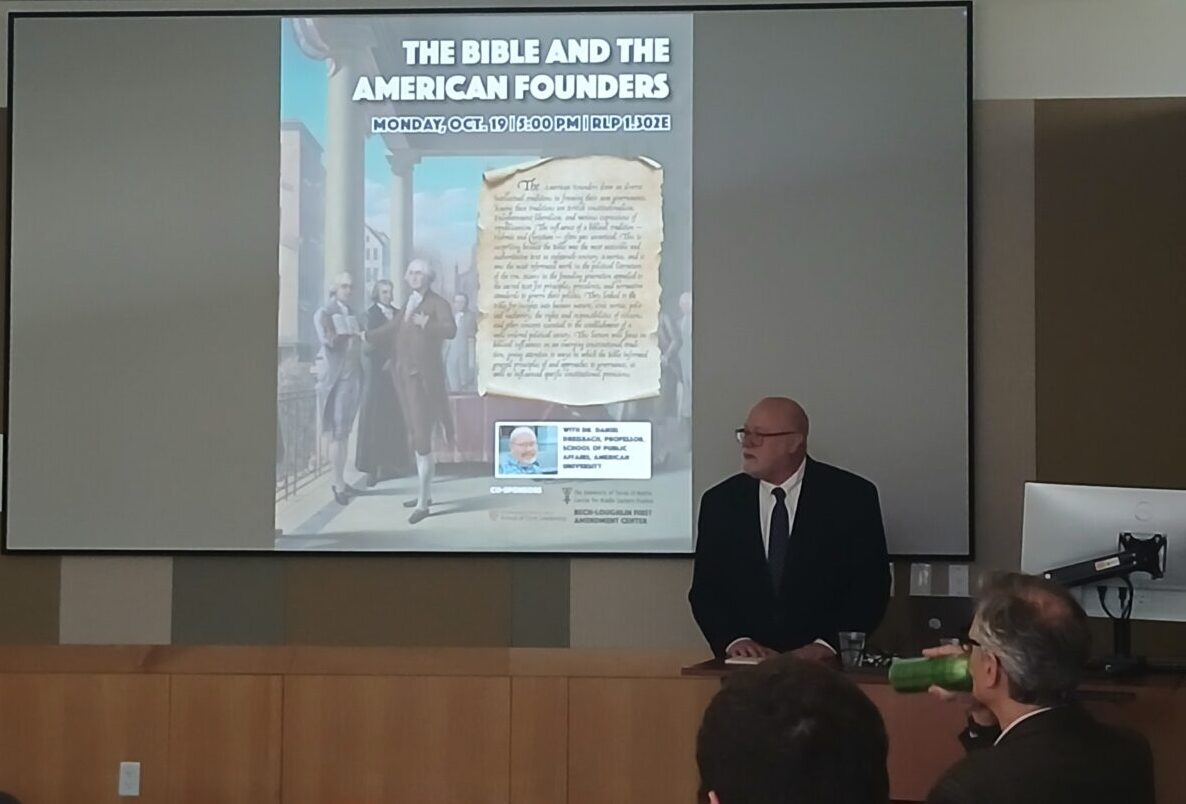
Professor Daniel Dreisbach explored the Bible’s influence on early American history during a Monday evening lecture at the University of Texas at Austin.
Dreisbach, a professor at American University in Washington, D.C., explained that the founders viewed the Bible as the foundation of “republicanism,” which he defined as government by consent of the governed as determined by representatives selected by the governed.
As one example, Dreisbach cited an 1807 quote from John Adams that “the Bible is the most republican book in the world.”
Dreisbach also discussed how the books of Deuteronomy and Exodus were the founders’ two most heavily cited works. Dreisbach cautioned that the Bible was not “the only” influence upon the founders and that they only made limited use of it in designing specific structures of the American government. Nevertheless, he argued, many of its foundational principles influenced the Constitution in “less obvious ways.”
The founders’ belief that humans were fallen and sinful was a general theological view that informed basic conceptions of civil government. Principles such as separation of powers and checks & balances flow from a “negative view of human nature.”
The founders viewed the era between the Israelites departure from Egypt and the coronation of Saul as the time of a “Hebrew Republic.” Principles such as consent of the governed, popular participation in government, and prohibitions on monarchy emerged during this era.
Finally, Dreisbach cited several specific constitutional provisions with direct biblical antecedents, such as uniform standards of weights and measures (Deuteronomy 25:13-15), requiring two witnesses for conviction of treason (Deuteronomy 17:6), the Eighth Amendment (Deuteronomy 25:3), and due process (Exodus 23).
The university’s School of Civic Leadership, in conjunction with the UT-Austin Center for Middle Eastern Studies and the Bech-Loughlin First Amendment Center at the UT School of Law, hosted the lecture.
The School of Civic Leadership, an effort to expand classical education, was originally conceived by Lt. Gov. Dan Patrick. He first proposed it in 2021 and included seed funding in the state budget. From the beginning, it engendered significant pushback.
It opened in 2023 and has hosted events ever since. In 2025, UT System regents committed $100 million to the program.
UT-Austin is a component of the University of Texas System. The UT System is overseen by a Board of Regents that is appointed by the governor and confirmed by the Texas Senate. Kevin Eltife of Tyler is the current board chair.