A legal showdown over Texas’ new congressional map begins Wednesday in an El Paso federal court. The outcome will determine whether the state’s latest congressional boundaries can be used in upcoming elections.
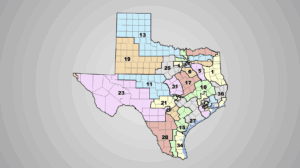
The new congressional map—signed into law by Gov. Greg Abbott in August—added five new Republican-opportunity seats ahead of the 2026 midterm election.
While redistricting usually happens each decade following the census, this mid-decade redistricting followed the intervention of the Department of Justice (DOJ) this summer. Texas Republicans had been pushing for redistricting since 2024.
The DOJ sent a letter to Texas in July which warned that four congressional districts—drawn as part of the state’s 2021 redistricting—were unconstitutional because they impermissibly relied on race.
Specifically, Texas was accused of combining black and Hispanic voters into so-called “coalition districts.” The DOJ threatened legal action against the state if the maps were not redrawn to reconcile this issue.
Section 2 of the Voting Rights Act of 1965 prohibits voting practices or procedures that discriminate on the basis of race.
Several Democrat-aligned groups had been challenging the legality of the 2021 congressional maps since October of that year. They too alleged that race was considered during the 2021 redistricting, but that minority communities were discriminated against—the opposite claim from that of the DOJ.
The State originally argued the 2021 congressional maps did not consider race as a factor. However, the State later agreed with the DOJ when deciding to redistrict in 2025.
The Democrat-aligned groups consolidated their ongoing 2021 dispute into a new legal challenge against the 2025 congressional maps before they were signed into law.
Organizations suing include the League of United Latin American Citizens (LULAC), the National Association for the Advancement of Colored People (NAACP), the Mexican American Legal Defense and Educational Fund (MALDEF), and the Mexican American Legislative Caucus (MALC). A group of Texas residents is also suing.
The State asserts that the new congressional maps only considered party affiliation, which is constitutional.
Plaintiffs are seeking a preliminary injunction, which would prevent the newly drawn maps from being implemented and revert to the 2021 congressional maps.
The Hearing
Due to the urgency, hearings will run each weekday from 9:00 a.m. to 6:00 p.m. from October 1-10. If necessary, court will also be held on Saturday, October 4.
“To conduct the Preliminary Injunction proceedings as efficiently as possible, the Court will not tolerate gaps between each witness’s testimony. Each side should have its next witness ready to testify immediately after the preceding witness’s testimony concludes,” reads a court order.
The court will also forgo opening statements, jumping straight into witness testimony Wednesday morning.
Federal law requires cases challenging the constitutionality of redistricting to be heard by a three-judge panel. Two must be district judges (one being the judge in whose court the case was originally filed) and the third is a circuit court judge.
In this case, the judges are Senior U.S. District Judge David Guaderrama (Western District of Texas, appointed by President Barack Obama), Judge Jerry Smith (U.S. Court of Appeals for the 5th Circuit, appointed by President Ronald Reagan), and Judge Jeffrey Brown (Southern District of Texas, appointed by President Donald Trump).
Judge Brown ruled against Republicans in a 2021 Galveston County redistricting case.
The court is facing a strict deadline, as a decision must be made before the candidate filing period for the 2026 midterms, which begins November 8 and ends December 8.
Regardless of the court’s ruling, the decision is expected to be appealed to the U.S. Supreme Court.
If you or anyone you know has information regarding court cases, please contact our tip line: scorecardtips@protonmail.com.