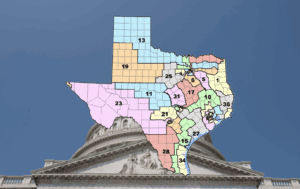
EL PASO—A panel of three federal judges is weighing arguments in a lawsuit challenging Texas’ new congressional districts, with a coalition of left-wing advocacy groups contending the maps are racially discriminatory.
The new districts include five GOP-opportunity seats, which Republicans could pick up in the 2026 midterm elections if the map stands. Organizations suing include the League of United Latin American Citizens (LULAC), the National Association for the Advancement of Colored People (NAACP), the Mexican American Legal Defense and Educational Fund (MALDEF), and the Mexican American Legislative Caucus (MALC).
Wednesday’s opening-day hearing centered on allegations from the left-wing coalition that the new map is racially discriminatory and violates the rights of black and Hispanic voters.
A major focus of the plaintiffs’ argument was the assertion that racial considerations drove the recent redistricting process. They cited as evidence State Rep. Todd Hunter (R–Corpus Christi) having provided data on racial representation when introducing the new map. Plaintiffs spent much of the day attempting to show that the presentation of racial data is itself evidence of racial intent, devoting hours to supplementing this theory.
In response, the state’s legal team countered that State Sen. Joan Huffman (R–Houston) was sharply criticized by Democrats in 2021 for not providing racial impact data when presenting a previous map. This, they argued, made it reasonable and necessary for Hunter to present demographic information proactively, anticipating inevitable incoming claims of “racial discrimination” with any Republican-proposed map.
Hunter had emphasized that the new map actually increases representation for minority voters: four out of five redrawn districts are now Hispanic-majority, and Texas, which previously had no Black-majority districts, will now have two. State attorneys positioned this as compelling evidence that the map was not drawn with racial intent, let alone with racially discriminatory intent.
Another point raised by the plaintiffs involved accusations from State Rep. Joe Moody (D–El Paso) and State Sen. Carol Alvarado (D–Houston) that Republicans were secretive about the “unusual” mid-decade redistricting.
While redistricting typically happens after the release of new census data, states may redistrict at any time. In July, the U.S. Department of Justice accused Texas of combining black and Hispanic voters into so-called “coalition districts” and threatened legal action against the state if the 2021 maps were not redrawn to reconcile this issue.
While the plaintiffs are alleging racial discrimination, Alvarado eventually admitted, “I don’t know if any Republican colleagues voted to approve this map with racial intent,” when cross-examined by the state. The plaintiffs must prove that there was racial intent behind the redistricting effort if they want to block the new maps’ implementation.
The hearing set the stage for days of testimony and debate, as the court weighs whether Texas’ new congressional districts will remain in place for the critical 2026 midterms or be blocked in favor of earlier versions—versions against which the same plaintiffs previously alleged racial discrimination.
The outcome has the potential to reshape the state’s representation in Congress and set new standards for how demographic data can be used—or interpreted—during the redistricting process.