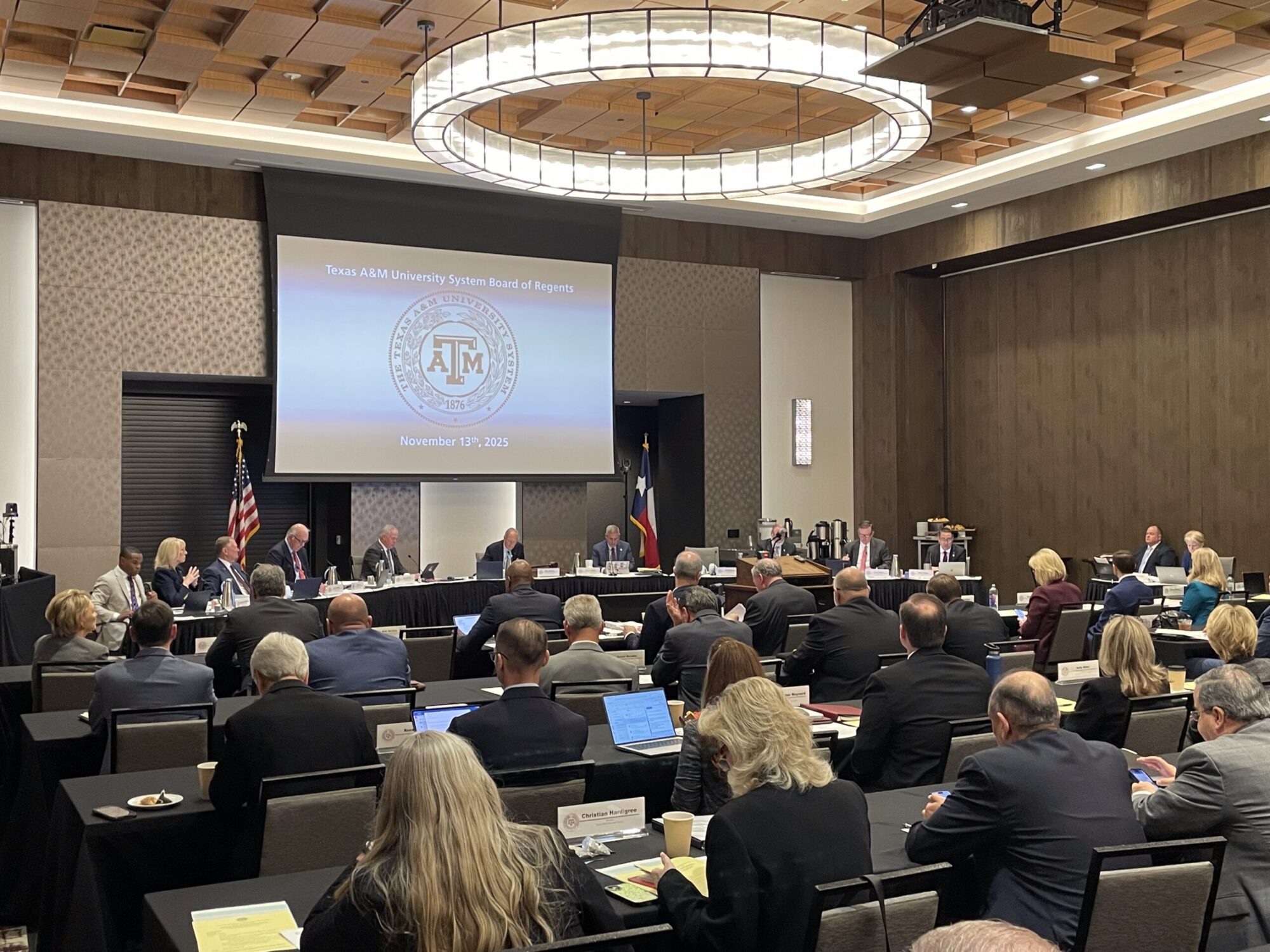
COLLEGE STATION—The Texas A&M Board of Regents revised its policy Thursday to now require campus presidential approval for courses that “advocate” gender or race ideology or topics related to sexual orientation or gender identity. It also restricts faculty from teaching “material that is inconsistent with the approved syllabus for the course” or introducing “a controversial matter” not connected with the class subject.
Regent Sam Torn said the policy change is to “make sure we are educating and not advocating.”
The original proposal, found on page 108 of the regents’ agenda, stated instructors could not “teach” gender or race ideology, and allowed campus presidents to delegate their review and approval authority.
The Foundation for Individual Rights and Expression (FIRE) objected, stating it could “invite unlawful censorship,” and vowed to defend any faculty member disciplined under the proposal. The American Association of University Professors, a trade association for left-wing faculty, called it “a blatant violation of academic freedom.”
On November 12, the proposal was revised. The word “teach” was swapped with “advocate,” and campus presidents would not be able to delegate decision-making authority.
FIRE stated the revision “does nothing to fix our concerns” and the language “still impedes academic freedom.”
Academic Affairs Vice Chancellor James Hallmark argued the policy “does not diminish academic freedom,” but rather sought “balance between academic freedom and academic responsibility.” He also said that it “clarifies that faculty may not introduce material inconsistent with the syllabus.”
The policy change defines gender ideology as “self-assessed gender identity replacing, and disconnected from, the biological category of sex,” and race ideology as a concept that “shames a race, accuses them of oppression, devalues their contributions, or assigns guilt for ancestral actions.” It also bans course content promoting “race or ethnicity activism” over academic instruction or teaching inconsistent with the approved syllabus.
Of the language change in the revision, Dr. Leonard Bright, a Texas A&M political science professor and president of the College Station campus AAUP chapter, said the regents are “thinking carefully about not casting too broad a net,” adding, “But what it misses is that, should we not be advocating for the truth?” he asked. “We should be allowed to advocate for facts, advocate for truth, and certainly don’t advocate for things that are not facts, but are theories.”
In her address to the regents, Miranda Sachs, assistant professor of European history, claimed that “the holocaust would fall under this [policy] as illegal to teach.”
“I think we’re taking it a little too far when we say we’re not going to talk about what happened in world wars,” Regent John Bellinger commented.
“I don’t think any of this policy says none of that history happened. That doesn’t affect this whatsoever,” Regent Chair Robert Albritton replied.
Finance professor Dr. Adam Kolasinski agreed with Albritton. “My colleagues seem to say the policy change says something it doesn’t,” he told the regents. He supports the change, and didn’t think swapping “advocate” for “teach” was necessary. “Today many disciplines have been so corrupted by vacuous and morally bankrupt ideologies…correction from the outside is necessary,” he said. “Academic freedom does not mean you get to teach whatever you want.”
This is only one aspect of Texas A&M University System’s implementation of academic accountability. It is conducting a systemwide review of all curricula. During the meeting, Regent Torn and Chancellor Glenn Hegar announced the TAMUS would go beyond the every five years requirement for such reviews set forth in a new state law.
“This is not symbolic; it is serious and a comprehensive review,” Torn said. “This review will occur regularly every semester … the Texas A&M system is stepping up first, setting up a model.”
Regents passed the new policy change, with none voting no. Regent Torn said the changes take effect immediately, but “will not be held into account until the spring semester.”
Regent Bill Mahomes was not present due to a medical emergency requiring surgery that day. Regent Torn reported the surgery was successful and Mahomes was resting comfortably.
These changes follow the September resignation of former TAMU president Mark Welsh, who stepped down after a controversy over course content in a TAMU children’s literature class that included how to introduce LGBT material to children.
Kolasinski did have one criticism for regents. “None of this will do a lick of good…unless we have a major change of leadership at the university,” he said. “You need a provost willing to fire deans,” and deans willing to replace department heads.
The Texas A&M University System comprises 12 universities across the state. It is governed by a Board of Regents appointed by the state governor and confirmed by the state Senate.