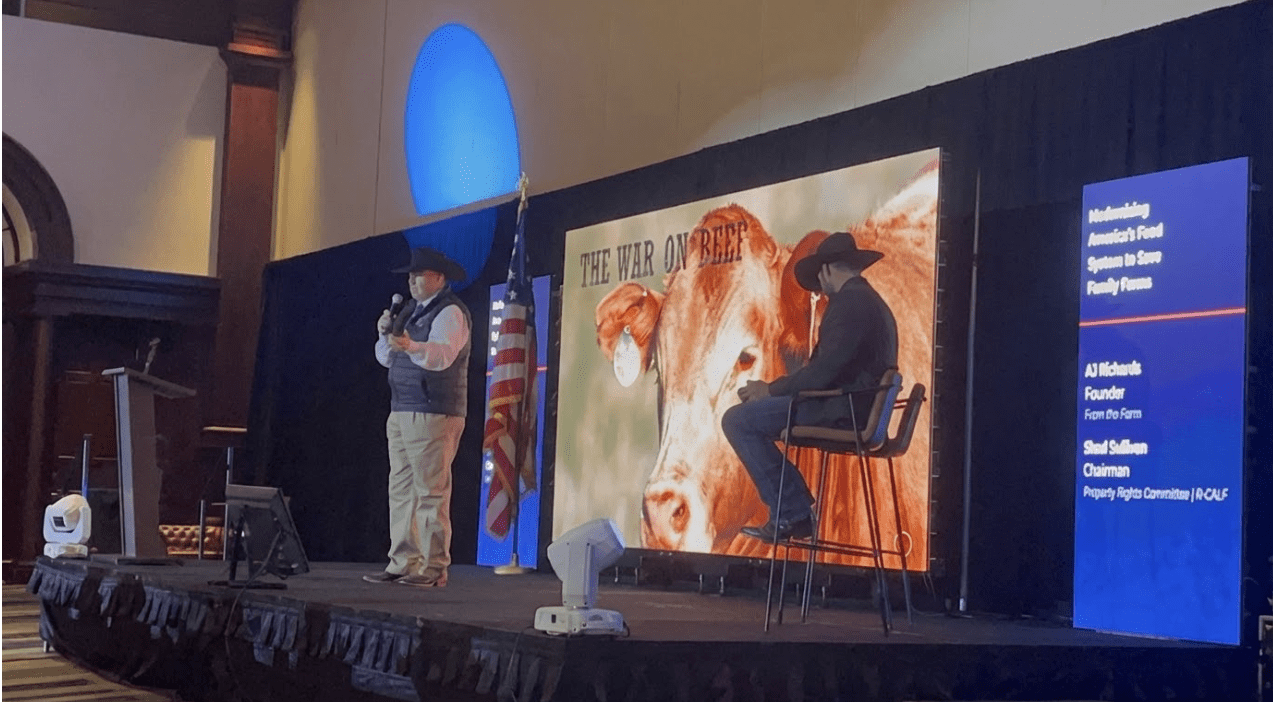
Rancher Shad Sullivan of Texas and AJ Richards of Wyoming promoted the importance of small agricultural producers for the protection of private property rights at the American Stewards of Liberty’s annual conference in Fort Worth.
Richards, who founded “From the Farm,” a website connecting consumers across the country directly to local farmers and ranchers, highlighted that the current wholesale cattle market that small agricultural producers are forced into was never designed for them to survive.
Under the current system, small producers sell into a chain dominated by a few big buyers and processors, rather than direct to consumers. This leaves small operations without any leverage over price, terms, or timing while all the higher-margin cutting, packing, and retail pricing is controlled further up the chain.
This model places immense economic pressure on small, family-run agriculture operations and makes it difficult to pass down those operations to future generations.
“They sell the land, they consolidate, and they disappear. We’ve seen that happen. When farms fail, land doesn’t vanish; it transfers. It moves from families to corporations, from stewards to balance sheets, and from communities to centralized control,” said Richards.
“Economic pressure is the fastest way to separate people from their land and property without ever passing a law. If we care about private land ownership, we must care about the economics that allow our family farms to stay on the land.”
In light of this, Richards has found a different path for small producers, one in which they sell directly to the consumer to capture more of the retail dollar.
“The full retail dollar allows farmers to pay family labor, to maintain infrastructure, avoid predatory debt, and invest in stewardship,” continued Richards. “They can then pass on the operation instead of liquidating it. A farm earning the full retail dollar is less dependent on subsidies, less exposed to federal intervention, and far more resilient.”
Expanding on Richard’s comments, Sullivan told attendees that there is a “war on beef” being waged in America that is ultimately an attack on citizens’ freedoms. Sullivan explained that this war has been justified by globalists who claim beef is ruining the environment.
Sullivan argued this war’s ultimate goal is to replace “the private property with public ownership and communal control of the major means of production and natural resources.”
“I will submit to you today that as long as there’s beef on the land and that we can produce it as we see fit, we will always be a free nation,” said Sullivan. “That’s why you guys have to get involved on the very grassroots level.”
Those warnings about economic warfare on ranchers and private land set the tone for this year’s Land & Liberty Conference in Fort Worth.
The conference covered topics such as strategies to advance the property rights agenda at the local, state, and federal levels, as well as securing the U.S. food supply.
Behind the conference is a Texas-based group with roots in a decades-long battle over grazing rights and federal land control.
The nation’s oldest organization defending property rights, ASL was started in 1992 by E. Wayne Hage, the father of its current executive director Margret Byfield. The Hage family endured attacks from environmentalists and the government over their right to graze cattle and access to water.
The case became known as Hage v. United States and was the first federal land grazing takings’ case in the U.S. Court of Federal Claims. Eventually, after 27 years in court, the court awarded compensation to the Hage’s for the taking of their property under the Fifth Amendment.
“However, it was erased by the D.C. Circuit who overturned the judgment claiming the case was not ripe and the family did not have standing,” ASL explains. “They lost everything. They never received a penny of compensation. They no longer own the ranch.”
Since the founding of the organization, ASL’s mission has been to “strengthen property rights and the liberties they secure by defending the use of our land and restoring local control. We protect our nation’s founding principles of limited government and self-rule by restoring our Constitutionally guaranteed property rights.”
Those experiences with federal agencies and the courts continue to shape the issues highlighted at ASL’s conference.
U.S. Rep. Harriet Hageman (R–WY) discussed conservation easements in a sit down conversation with Byfield.
A nationally recognized property rights attorney before running for Congress, Hageman highlighted the need to get rid of perpetual conservation easements.
“I don’t oppose conservation easements, but I do oppose perpetual conservation easements,” said Hageman.
According to the Texas Land Trust Council, a conservation easement is “a voluntary, written agreement between a landowner and the ‘holder’ of the conservation easement under which a landowner voluntarily restricts certain uses of the property to protect its natural, productive or cultural features.”
Hageman explained that these perpetual easements dictate how future generations have to use the land.
An example of this cited by Hageman is Miracle Mile on the North Platte River in Wyoming, which is known to produce massive trout. In 1962, the conservation easement was sold to the Wyoming Game and Fish Department for a mere $10,000.
“What concerns me is every generation should be able to get the conservation values of those properties,” said Hageman. “They took that $10,000, that one time payment, and no generation after that will ever benefit from the public access to those lands.”
These easements can also decrease property value by at least 50 percent and each of the contracts contains what Hageman called “a poison pill.”
“When you read the contracts, it’ll say the purpose of this contract is to protect the conservation or environmental value of this property, and traditional farming and ranching activities are compatible with the conservation or environmental value of this property at this time,” said Hageman. “Meaning that at some point in the future, if the people who control that conservation easement determine that your farming and ranching activities are no longer compatible with protecting the environmental values of that property, they can stop you from doing it.”
While Hageman focused on legal traps in land contracts, state and local officials highlighted how they are pushing back through legislation and local governance.
Texas’ State Rep. Carrie Isaac (R–Wimberley) shared some of the victories Texas has achieved for private property rights, including banning foreign ownership of land and streamlining the process to evict squatters on personal property. She also highlighted the governor’s veto on legislation that would have allowed a groundwater conservation district to enter private property without a property owner’s consent.
Other panels drilled down on specific flash points in which landowners are already feeling the consequences of federal and environmental policies.
The Blue Ribbon Coalition along with Matt Miller, senior attorney with the Texas Public Policy Foundation, discussed the reopening of federal lands across the country. The closures have followed administrative and regulatory actions from federal agencies, often justified by citing environmental protection.
Secretary of Agriculture Brooke Rollins discussed “agricultural lawfare” and Jason Isaac from the American Energy Institute highlighted how U.S. energy policy should prioritize affordable, reliable, hydrocarbon-based energy over heavily subsidized renewables and EVs.
Across panels and keynotes, speakers returned to the same theme: property rights as the linchpin of food security, energy independence, and self-government.