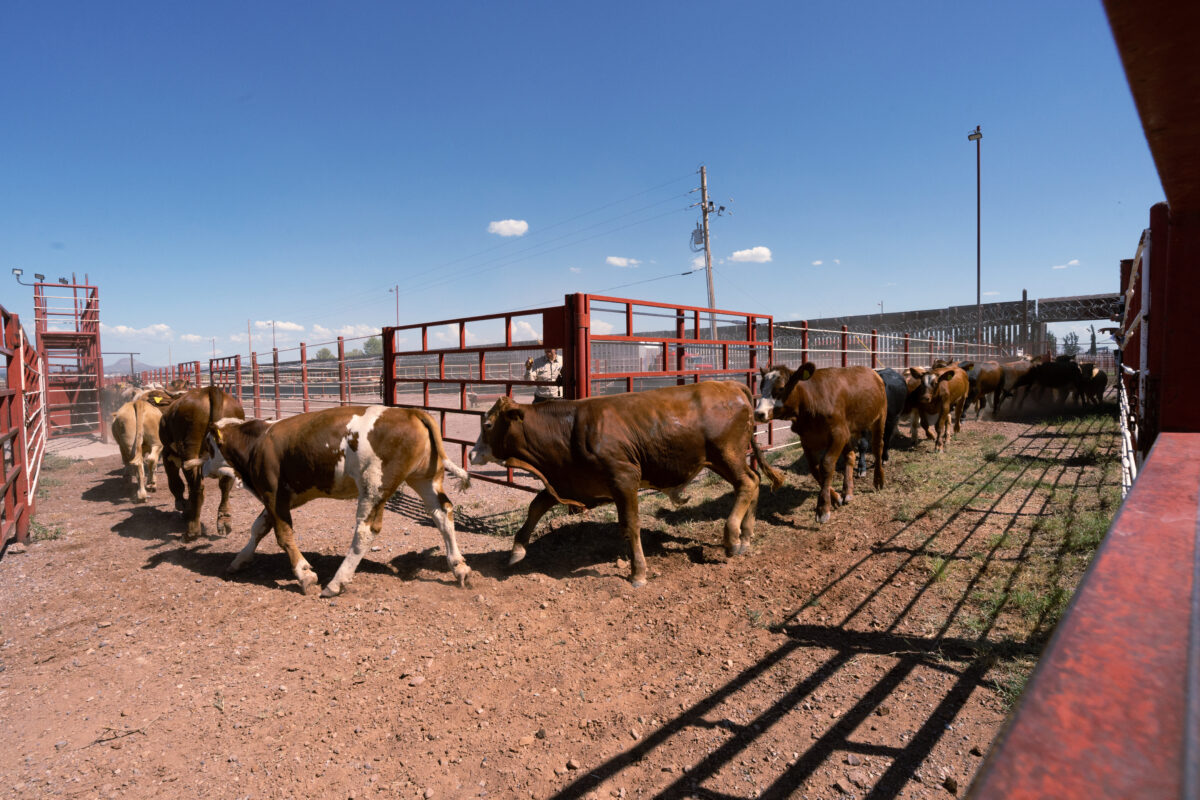
President Donald Trump signed an executive order directing federal agencies to review ways to restore mandatory country-of-origin labeling for beef and expand support for American cattle producers.
The executive order focuses on “Supporting America’s Ranchers” by giving ranchers the ability to protect their livestock from predation by wolves and reinstituting mandatory Country of Origin Labeling (COOL).
COOL is intended to inform consumers of the product’s origin, either from the U.S. or a foreign country, and has been a longtime legislative priority for many independent cattle producers.
Trump’s order does not immediately reinstate COOL but directs the U.S. Department of Agriculture, in consultation with U.S. trade representatives, to review available regulatory and legislative options for requiring clearer beef-origin disclosures.
Federal country-of-origin labeling was mandated in 2002 and fully implemented in 2013. The USDA issued rules implementing COOL requirements for beef, pork, lamb, chicken, goat meat, and certain fish products. Congress later repealed the law and the agency revoked the rule for beef and pork in 2016.
Independent cattle producers have argued the federal repeal of MCOOL is a key factor in the current divergence in live cattle prices and retail beef prices. They suggested that reimplementing COOL will “provide consumers with more choices and pricing options” and “regulate beef prices.”
Trump’s executive order says that consumers deserve transparency and “clear, honest labels,” which COOL delivers.
In Congress there are currently two measures aimed at reinstituting COOL, S.421, sponsored by Sen. John Thune (R–SD) and H.R 5818, sponsored by Rep. Harriet Hageman (R–WY).
In early August, an amendment was approved by the U.S. Senate Committee on Agriculture, Nutrition, and Forestry to include COOL in the Farm Bill.
Several states have passed legislation requiring COOL since its repeal in 2016, including Wyoming, Kansas, North Dakota, and South Dakota.
State Rep. Wes Virdell (R–Brady) filed House Bill 1385 during Texas’ 89th Legislative Session that would have required country of origin labeling on beef and beef products and created a civil penalty for non-compliance. The measure was referred to the House Committee on Trade, Workforce, & Economic Development but did not receive a hearing.
As part of Trump’s directive to support ranchers, the Secretary of the Interior is to determine whether gray and Mexican wolves “meet the criteria for delisting or downlisting” under the Endangered Species Act, and if so, to begin that process.
The Department of the Interior and the Department of Agriculture were also ordered to “update their standards for compensating ranchers for losses due to predators, and to ease authorization for lethal removal when necessary.”
A second executive order signed by Trump on Friday seeks to strengthen fair competition in livestock markets and expand market access for American meat producers.
He directed the USDA to investigate violations of the Packers and Stockyards Act in close coordination with the Department of Justice and report to the president “on current enforcement actions, resource needs, and a plan to strengthen enforcement over the next year.”
The order also seeks to expand the allowance for state-inspected meat to cross state lines and to cut red tape for small meat processors.
Secretary of Agriculture Brooke Rollins stated that “while the Biden administration chose to villainize ranching and the rural way of life under the guise of radical environmental mandates, the Trump Administration continues to focus on rebuilding the Great American Cattle Herd.”
“For the past 19 months, USDA has worked tirelessly to defend and promote our nation’s ranchers,” said Rollins. “Through our Beef Plan and the Ranchers First Initiative we are working to continue increasing our nation’s heifer retention rate.”
“President Trump is focused on delivering an America First agenda and will do that by continuing to put our Ranchers First,” added Rollins.
This action follows last week’s announcement of the Ranchers First Initiative, a package of actions focused on the rebuilding of the American cattle herd.