This article has been updated since publication.
The U.S. Fifth Circuit Court of Appeals ruled against Democrat challenges to Tarrant County’s new Republican-drawn commissioner district boundaries, upholding the lower court’s decision and allowing the map to remain in effect for the 2026 primary elections.
A three-judge panel of the U.S Fifth Circuit Court of Appeals heard oral arguments Monday on whether to reverse a lower court’s ruling that denied Democrats a preliminary injunction while they fight to permanently block the redistricting map.
Tarrant County Commissioners Court voted in June along party lines to approve a new map that increases Republicans’ partisan advantage from 3-2 to 4-1, fulfilling a campaign promise made by County Judge Tim O’Hare.
Several Tarrant County voters represented by Democrat attorneys are challenging the redistricting, claiming Republicans intentionally redrew commissioner precincts mid-cycle to disenfranchise minorities.
County officials are defending the precinct lines, which had not been redrawn since 2011, as partisan gerrymandering that is permissible under current voting rights case law.
On Monday, both sides presented arguments to Fifth Circuit judges Rhesa Barksdale, Don Willett, and Stuart Kyle Duncan.
Danielle Lang with the left-leaning Campaign Legal Center represented the plaintiffs.
Lang asserted that the case is not about partisan gerrymandering and focused on First Amendment claims that were dismissed with prejudice by the district court.
“This appeal is not about vote dilution, but rather about who can vote when,” she said.
Lang argued that minority voters will suffer “unequal disenfranchisement” due to staggered elections for the four county commissioners—two in each even-numbered year. Voters moved from precincts that vote in 2026 to precincts that vote in 2028 will have to wait two extra years.
Lang said she knew of “no other case” that combined staggered elections and mid-cycle redistricting, which she characterized as “unusual,” with “an unabashed political purpose.”
Responding to judges’ questions, Lang said the “best piece of evidence in the record” that Tarrant County’s redistricting was motivated by race, not party, is a comment O’Hare made to the media inviting black voters to stop voting for Democrats and “get on board” with Republicans—a statement the lower court said was “not the smoking gun Plaintiffs think it is.”
J. Christian Adams with the conservative Public Interest Legal Foundation argued on behalf of Tarrant County.
Adams stated that the district court was correct when it found that “any First Amendment attack on redistricting plans are just another way to try to sue over partisan gerrymandering.”
He also said the district court did not abuse its discretion when it found plaintiffs had no likelihood of success, because “there were no facts supporting a finding of racial intent. None.”
“You can’t just get injunctions by filing a complaint,” he added. “That’s effectively what happened here.”
In response to questioning from Judge Willett, Adams called the plaintiffs’ effort to argue the dismissed First Amendment claims “an end around that really flies in the face of the limited jurisdiction as to what can be heard on appeal.”
He told the judges that “race wasn’t considered whatsoever” in the redistricting and noted that the burden is on the plaintiffs to “disentangle race and politics” when permissible political intent and impermissible racial intent overlap.
Adams replied to Willett that Rucho v. Common Cause, the case that opened the door to redistricting based on political party preference, “does not tolerate First Amendment attacks on partisan gerrymandering.”
“Rucho would be gutted if this cause of action were to be allowed to go forward,” said Adams. “The appellants’ position would have federal courts reviewing every legislative redistricting to assess disparate impacts on Democrats after the redistricting, particularly on staggered votes.”
He noted that “the exact same thing happened, but in reverse” in Dallas, Harris, Travis, and Bexar counties, where Democrats cut Republican commissioner districts.
Asked if there are any circumstances in which mid-cycle redistricting might violate equal protection, Adams responded, “Absolutely. But they aren’t circumstances here.”
He said the State of Texas filed an amicus brief in district court supporting Tarrant County’s authority to redraw districts mid-cycle, which the Texas Legislature also did this year with the state’s congressional districts.
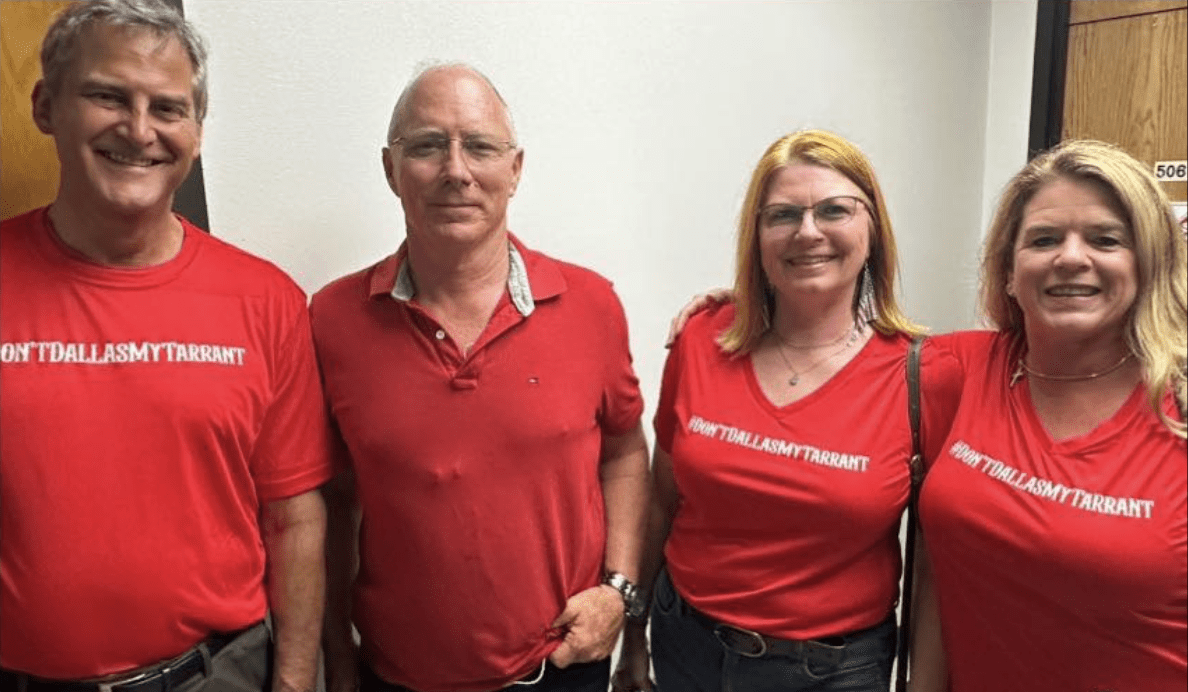
“And more importantly, the voters in Tarrant County in the last election made this a central political issue for the countywide races. The saying was ‘Don’t Dallas My Tarrant.’ That’s what drove this election. There was a promise to go to a 3-1 commissioners court if the Republicans won, and the Republicans kept that promise.”
“Based on the record before the district court, they got it exactly right,” Adams added.
As the judges declined to grant a preliminary injunction, the new commissioner district boundaries will remain in effect for the March 2026 primary elections.
Candidate filing begins November 8.