A Harris County judge on Friday declined to grant an emergency order blocking the state’s Ten Commandments classroom law, leaving the mandate in place as three Houston-area mothers press ahead with a lawsuit under Texas’ religious freedom statute.
Judge Nathan Milliron heard the case Friday afternoon in Harris County’s 165th District Court and denied the mothers’ request for a temporary restraining order against Texas Education Code § 1.0041, the law requiring every public elementary and secondary classroom to display the Ten Commandments on a poster if gifted to the district. The law stems from Senate Bill 10, passed by the Legislature last year.
The lawsuit, Emily Roth, et al. v. The State of Texas, et al., was filed July 30 by Emily Roth, Dr. Audrey Rosa Nath, and Sanjam Kaur Sohal on behalf of their six children, who attend schools in Houston ISD, Cypress-Fairbanks ISD, and Spring Branch ISD. The State of Texas, Attorney General Ken Paxton, Texas Education Commissioner Mike Morath, and the three districts are named as defendants.
Unlike earlier challenges to SB 10 that relied on the U.S. Constitution’s Establishment Clause, this suit is built entirely on state law. The mothers argue the mandate violates the 1999 Texas Religious Freedom Restoration Act, which bars government agencies from substantially burdening a person’s free exercise of religion, as well as the parental rights amendment approved by Texas voters in November 2025.
Roth’s objection to the posters predates the lawsuit.
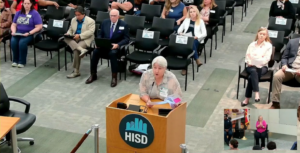
She brought what she described as a final appeal before the Spring Branch ISD board of trustees after two earlier requests to the district had already been denied, and trustees voted 7-0 to dismiss her appeal without discussion. District officials pointed to SB 10 as the basis for their decision, and the district’s outside counsel told trustees that adding other religious texts would conflict with the district’s neutrality policy, since the Ten Commandments posters are treated differently because state law requires them.
Meagan Hassan, lead counsel for the plaintiffs, said Friday’s ruling only addressed the emergency request, not the underlying legal question. “We asked for emergency relief. We did not get it,” Hassan said. “That ruling does not resolve the legal question at the heart of this case.”
Supporters of the law argue the posters carry historical rather than religious weight and don’t require any student to participate in anything. One backer said no student is required to pray, profess faith, or agree with the commandments, arguing that “exposure is not coercion.”
Attorney General Paxton’s office has taken a similar position in past filings, maintaining the posters are displayed rather than taught and therefore don’t meet the legal bar for coercion.
This state court fight follows a separate, unsuccessful federal challenge to SB 10.
In April, the Fifth Circuit Court of Appeals upheld the law in Rabbi Nathan v. Alamo Heights Independent School District, ruling 9-8 that the mandate does not resemble a historical “establishment of religion” under the Constitution. The court applied the “history and tradition” standard from Kennedy v. Bremerton School District rather than the older Lemon test that had underpinned Stone v. Graham, a 1980 Supreme Court ruling that struck down a similar Kentucky law.
Paxton called that decision “a major victory for Texas and our moral values,” and State Sen. Phil King, the bill’s author, said it confirmed the state does not have to “erase our history” to satisfy the Constitution. That case is expected to be appealed and could eventually reach the U.S. Supreme Court.
The Houston mothers’ case is not part of that federal appeal. With the temporary restraining order denied, the law remains in effect as students return to class this month. A hearing on a preliminary injunction, which could still block enforcement while the case proceeds, is scheduled for August 17.
Texas is currently one of four states enforcing a Ten Commandments classroom mandate, along with Louisiana, Alabama, and Arkansas.