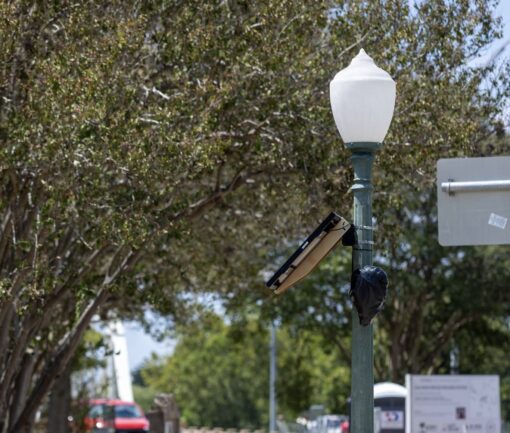
The Rusk County Republican Party has adopted a resolution directing lawmakers to place limitations on surveillance technologies such as Flock automatic license plate readers to protect citizens’ Fourth Amendment rights.
Flock manufactures AI-powered license plate readers that can also record information about vehicles such as make, model, color, cosmetic damage, and aftermarket parts. Citizens are concerned because law enforcement officials do not need a warrant to access the Flock automatic license plate reader (ALPR) database.
The Rusk County GOP resolution mirrors many of the same concerns as the Waller County GOP resolution passed last week. Both county parties cite the recent Chatrie v. United States decision, which held that law enforcement officers must obtain a warrant to access an individual’s location data, along with the Fourth Amendment and Article 1, Section 9, of the Texas Constitution to argue for citizens’ right to privacy.
The Rusk County GOP also highlights the Department of Public Safety’s recently acquired FalcoNet-equipped vehicles, which utilize stingray technology that can search citizens’ cellular data without a warrant.
A stingray device can mimic a cellular signal that nearby phones connect to. Once connected, data is transmitted from the individual’s phone into a server where it is then processed. Texas DPS recently purchased several Chevrolet Tahoes equipped with stingray technology.
The resolution also asks lawmakers to ensure law enforcement cannot warrantlessly access information from the ALPR database provided by local homeowners associations that have installed Flock cameras.
“Our resolution calls on the Texas Legislature and local governments to establish meaningful protections for automatic license plate reader systems, including Flock cameras, while ensuring law enforcement can continue to pursue legitimate criminal investigations,” said Rusk County GOP Chairwoman Rachel Hale.
“Among the proposals are requiring public hearings before new camera installations, deleting data from innocent motorists that does not match a verified law enforcement ‘hot list,’ requiring warrants to access retained records, and increasing public transparency through regular reporting.”
Key policy recommendations in the resolution include:
- Prohibit state funding for unregulated surveillance
- Close the private backdoor loophole
- Mandate real-time scanning and data purges
- Mandate probable cause search warrants for stored records
- Enforce public-facing agency policies
- Require mandatory public input before installation
- Establish comprehensive public monthly accountability audits including:
- Total Scans
- Total Hits
- Total Stops
- Total Convictions
- Categorically prohibit warrantless aerial surveillance and drone tracking
- Ban warrantless cell-site simulators and mobile IMSI catchers
The Texas House Committee on Delivery of Government Efficiency is set to meet on August 19 in order to study data privacy and security.