A taxpayer-funded lobbying organization appears to be preparing for a 2027 casino legalization push, with a focus on building two casinos in North Texas.
While Texans have repeatedly rejected expanding gambling, local governments appear to be using tax dollars to advance such interests. Despite multiple attempts, state lawmakers have yet to ban the practice of taxpayer-funded lobbying.
Texas Scorecard obtained first drafts of academic papers from the North Texas Commission, which Transparency USA has identified as a taxpayer-funded lobbying operation.
Both papers discuss the topic of casino gambling, but from different perspectives.
Bernard Weinstein and Terry Clower drafted a casino impact report promoting alleged economic benefits of casinos. University of Texas at Dallas researchers Natalia Lamberova and Timothy Bray drafted “The Social Impact of Casino Gaming in North Texas,” with the assistance of UT-Dallas students in Fall 2025.
Economics
Weinstein and Clower estimate the gross economic upside of large resort-style casinos, arguing they would likely bring significant new spending, jobs, and tax revenue, including for schools, based on multiple examples.
A 2013 report from the Council on Casinos cautioned against what’s become a typical bait-and-switch from the gambling industry. What exists outside of Las Vegas, Macau, and other higher-end vacation spots are “regional,” not “resort,” casinos that target “middle rollers and low rollers who play slot machines.”
But critics argue that any perceived economic gain must be weighed against these large social costs, and when it is, the net picture may be negative.
Professor Earl L. Grinols found in his 2011 study that 80 percent, sometimes even more, of casino revenues come from slot machines. It also found that slot machines, electronic gaming devices, and video lottery terminals are the “most damaging and quickly addicting form of gambling.”
Weinstein and Clower criticized Grinols and others warnings about gambling in a Texas Association of Business 2013 paper. In the first draft of their new work, they are only estimating one side of Grinols’ ledger (the benefits) using an input‑output model that, by design, does not incorporate external social costs.
Grinols, in his work, asked, “once you subtract the social‑cost side, are we actually better off?”
Social Costs
As previously reported, the work of Grinols and others documented how modern gambling leads to higher crime rates.
In this, Lamberova and Bray have some agreement with casino critics’ societal concerns and even use the work of Grinols and other critics.
In their report, they acknowledged that casinos can build on existing problems and may increase theft or fraud, as well as mental health struggles among vulnerable populations, such as children, seniors, or veterans—especially property and financial crimes and gambling‑related health issues. These effects often grow over several years instead of showing up all at once.
They also question how much new money these casinos would generate. They wrote that some of the revenue would be shifted from other gambling operations and local businesses, and that long‑term social costs could eat into any true gain.
They conclude casinos are “neither a blunt scourge nor a simple boon” and that effects vary by place, time, product mix, and policy. They propose strong design and regulation, including the use of taxpayer funds for statewide harm‑reduction programs that could reduce, though not eliminate, harms—for example, increasing police foot traffic in the casino area. This could be difficult. According to the Dallas Express, Dallas’ consistent refusal to fully staff their police force has led Gov. Greg Abbott to say he would be “looking into” whether the city is in violation of state law. Texas Attorney General Ken Paxton has sued Dallas over its stance on police staffing.
A 2025 analysis by Police1 noted that among Texas’ 10 largest cities, only San Antonio and Arlington saw consistent growth in police staffing from 2022 to 2024, while Houston, Austin, Fort Worth, and others showed little or no growth. In 2024, the Texas State Troopers Association wrote that state “troopers and employees are seriously understaffed, underpaid, and overworked in the field and in the office.”
Additionally, when it comes to regulating vice, Texas failed with their own state-run lottery system. Exposures of corruption and capture led to abolition of the state lottery commission and the transfer of oversight of the lottery to the Texas Department of Licensing and Regulation.
Public Sentiment
Weinstein and Clower claimed in their report that there is majority support among both Republicans and Democrats for resort-style casinos.
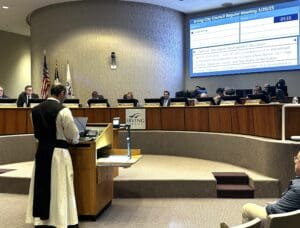
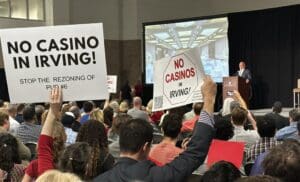
But a recent battle in the metroplex ended in casinos being checked. Irving citizens opposed casino gambling so fiercely that in March 2025, they forced Las Vegas Sands, a casino company owned by billionaire gambling magnate Miriam Adelson, to give up on its casino dreams there.
This claim also runs counter to recent trends in the Republican-dominated state. A 2023 poll revealed Texas Republicans don’t support casino gambling. The practice is opposed in the Texas Republican Party platform, and the party passed a resolution opposing it in 2024.
Notably, Las Vegas Sands has not operated a casino in the U.S. since 2021 and derives more than half of its profits from Sands China.
Who’s Behind This?
The North Texas Commission (NTC) is a taxpayer-funded non-profit that has lobbied state lawmakers. Its board of directors is stacked with business executives and local officials, including Fort Worth Mayor Mattie Parker, Arlington Mayor Jim Ross, and Dallas Mayor Eric Johnson.
According to James Quintero of the Texas Public Policy Foundation, NTC has a history of fighting against taxpayers’ interests. He told Texas Scorecard that in 2025 its taxpayer-funded lobbyists fought proposed measures to create local spending limits (House Bill 5267), protect Texans against green energy schemes (Senate Bill 819), rein in the progressive agenda (SB 2858), and pushed for legislation that would squeeze taxpayers for more (SB 1555 and HB 5265).
“North Texas Commission’s legislative lobbying activities illustrate how public monies are being weaponized against the public interest,” Quintero wrote. “If the average Texan understood the extent to which special interests have weaponized their tax dollars, there would be political upheaval.”
In a request for comment, Texas Scorecard asked NTC about its position on gambling.
“Last session, the NTC’s position was to let the voters decide via a ballot referendum. Our board will be determining our position for the 90th this fall,” wrote DianaLee Enriquez, NTC’s communications and engagement manager. “The two studies are not complete at this time. We are happy to share these findings when finalized.”
The positions of three board members have been widely reported. Parker signaled an openness to casino gambling in 2023. Ross has been more openly supportive of casino gambling. He spoke at a July 2024 forum co-hosted by the NTC and the Texas Association of Business. Las Vegas Sands pitched the idea of casino resorts to business leaders there.
Johnson has been non-committal.
Neither Parker, Johnson, nor Ross replied to a request for comment before publication.
According to communications Texas Scorecard has reviewed, NTC’s gambling committee is scheduled to meet Tuesday, March 31, at 9 am to discuss these first drafts. The completion date for both studies is June 1. The final committee report based on these studies is due December 31.