ROUND ROCK—Gov. Greg Abbott unveiled a slate of housing affordability proposals Friday, including a plan to penalize cities and counties that circumvent state law by imposing costly homebuilding mandates, while also clarifying that his concerns about data center construction extend beyond rural Texas.
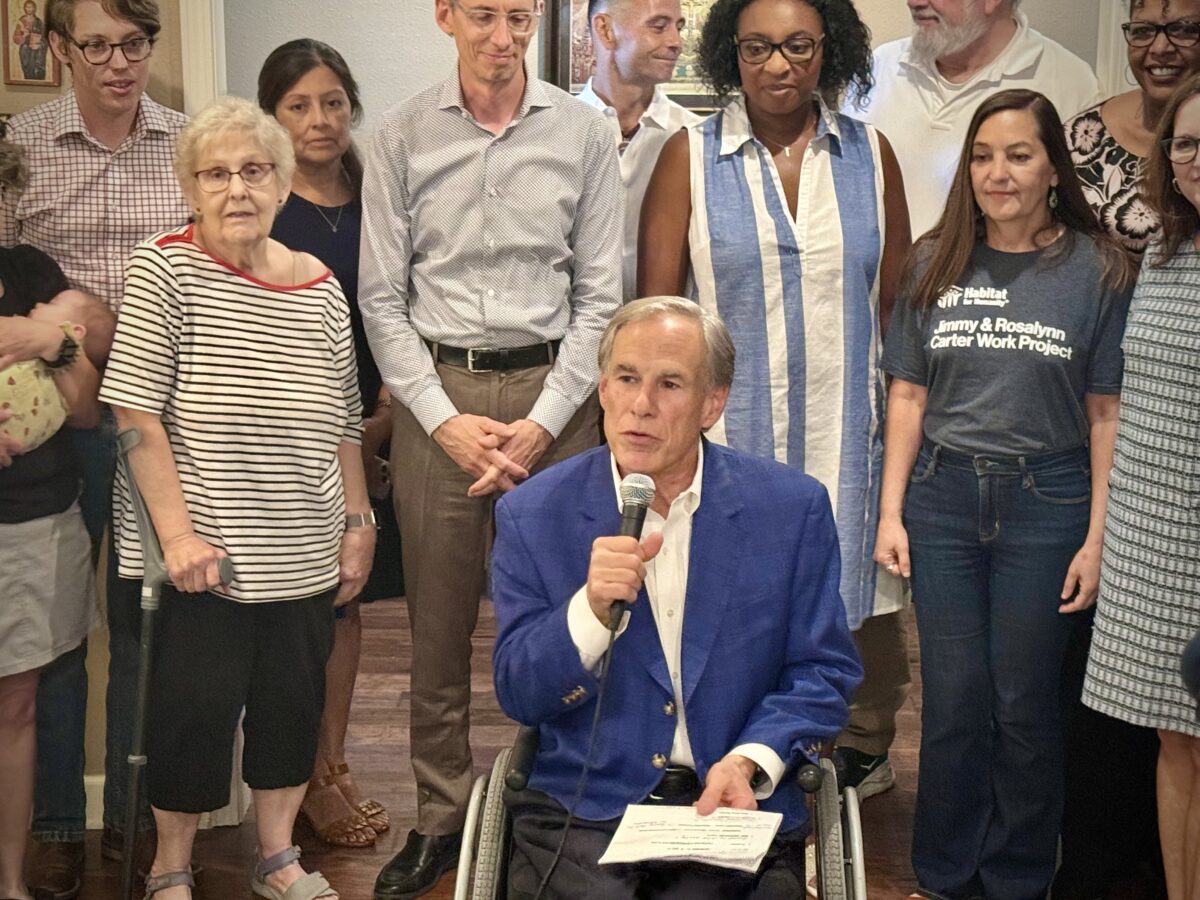
Speaking at a campaign event focused on affordability, Abbott announced a legislative proposal that would withhold sales tax revenue from local governments that violate a new state law—Senate Bill 15—intended to make it easier and less expensive to build homes.
“Already last year, I signed a law to make it easier and cheaper to build homes, but some local governments are skirting the law, imposing costly mandates,” Abbott said. “Going forward, any city or county violating the law will have their sales tax revenue withheld.”
Abbott told Texas Scorecard that some cities are attempting to discourage residential development by piling costly requirements onto new projects.
“They will add very costly amenities to what the requirements are,” Abbott said. “It could be requiring eight stories be built for multifamily housing; it could be adding very large swimming pools. It could be adding dog-walk parks in areas that don’t demand it.”
Abbott said local governments can use such requirements to drive up construction costs until “the project just will not be done.” He added that homeowners and developers should instead be allowed to build within existing rules governing setbacks, height limits, and impervious cover.
Supporters last year argued Senate Bill 15 would lower housing costs by allowing smaller starter homes, while some lawmakers warned that the law could force greater housing density on suburban communities.
The governor also proposed protecting homeowners’ ability to build additions to their homes, saying some local governments have blocked such projects. The housing proposals are part of a broader affordability agenda that also includes property tax relief, insurance reforms, and lower prescription drug costs.
Speaking to the press, Abbott was asked to elaborate on previous comments about preventing data centers from being built in rural neighborhoods. He responded by saying his position applies more broadly.
“I’ve talked about neighborhoods in general. I’ve talked about rural neighborhoods and rural areas,” Abbott said. “We’re not in a rural area right now, but I don’t think a data center should be going up across the street here.”
Abbott reiterated his call for data centers to be required to finance their own infrastructure, provide their own power rather than drawing electricity from the existing grid, lower electricity costs for Texans, and reuse their own water instead of straining local supplies.
“There’s no reason why anybody’s neighborhood or home should be disturbed by a data center,” Abbott said, adding that industrial areas such as parts of the Permian Basin are more appropriate locations for the facilities.