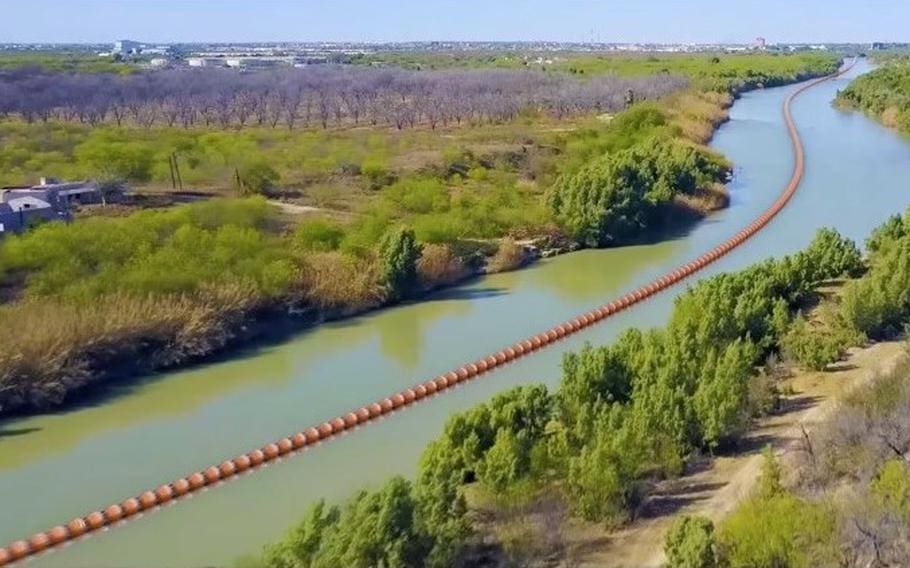
The Department of Homeland Security is rolling out additional buoy barriers in the Rio Grande, expanding on Texas’ floating “wall” strategy to deter illegal crossings and cartel activity along the southern border.
The modular buoy lines are part of President Donald Trump’s “smart wall” approach—combining physical barriers, technology, and patrols to make it harder and more dangerous for smugglers and illegal aliens to cross.
According to DHS, the system uses large, cylindrical floating buoys linked together to form a continuous waterborne obstacle in key crossing corridors of the Rio Grande.
Officials say about 130 miles of these barriers are already under contract and in the process of being installed, with plans to eventually cover roughly 500 miles of river as part of a broader federal border security build-out.
During a visit to the border on Wednesday, Homeland Security Secretary Kristi Noem described the buoys as a water barrier designed to push illegal traffic away from river crossings and toward lawful ports of entry, where agents can better control who comes into the country.
The project builds directly on Texas’ own 1,000‑foot buoy line at Eagle Pass, first installed by Gov. Greg Abbott in 2023 and later expanded after Trump returned to the White House—as a field‑tested model for discouraging illegal crossings.
Officials say they are coordinating with the U.S. International Boundary and Water Commission and the State of Texas to ensure the barrier is placed within U.S. territory and installed in a way that complies with international water management requirements.
The project is being funded with previously appropriated federal border wall money that had gone unused under the Biden administration, rather than requiring new congressional approval.
The buoy strategy has already faced legal and diplomatic challenges, with the Mexican government and left‑wing activists arguing the floating barriers endanger illegal crossers and may violate treaty obligations on use of the Rio Grande.
Under Biden, the U.S. Department of Justice sued Texas over the Eagle Pass buoys, but the U.S. Fifth Circuit Court of Appeals has allowed the state’s barrier to remain in place while litigation continues.
For now, DHS says work is focused on high‑traffic sections of the Rio Grande, including areas near the Rio Grande Valley where illegal crossings and cartel smuggling have historically been heavy. Local officials and landowners along the river are being briefed as segments are designed and installed, and DHS has indicated that further waivers of environmental regulations may be issued to speed construction.
With the Trump administration now backing and funding a large‑scale buoy system of its own, Texas’ Eagle Pass experiment has effectively become the template for a new federal “smart wall” in the water.