This article has been updated since publication.
UVALDE—South Texas counties recovering from recent flooding and fighting illegal immigration now say a proposed extra-high-voltage transmission line will create a “freeway” that will supercharge Mexican cartel activity.
At a Thursday meeting, local officials told utility representatives that the proposed Howard to Solstice 765-kilovolt transmission line could worsen cartel smuggling, threaten fragile aquifers, and devalue multi-generational ranching operations.
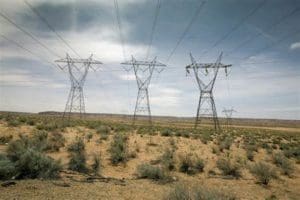
The Howard to Solstice Line—proposed by utility companies’ AEP Texas and CPS Energy—would stretch approximately 370 miles across 14 counties in South and West Texas, from the San Antonio to Fort Stockton areas. It is the southernmost of three 765-kV lines in the Strategic Transmission Expansion Plan (STEP) Permian, a key part of the Permian Basin Reliability Plan (PBRP).
STEP Permian as a whole would span more than 1,200 miles to move power from East Texas to the natural gas-rich Permian Basin at an estimated lifetime cost approaching $100 billion—a project one pro-landowner group likens to “hauling water to the sea.”
The chairman of the Public Utility Commission of Texas (PUCT) has now admitted that state lawmakers did not mandate the 765-kV project and it was PUCT commissioners that chose to move forward with it.
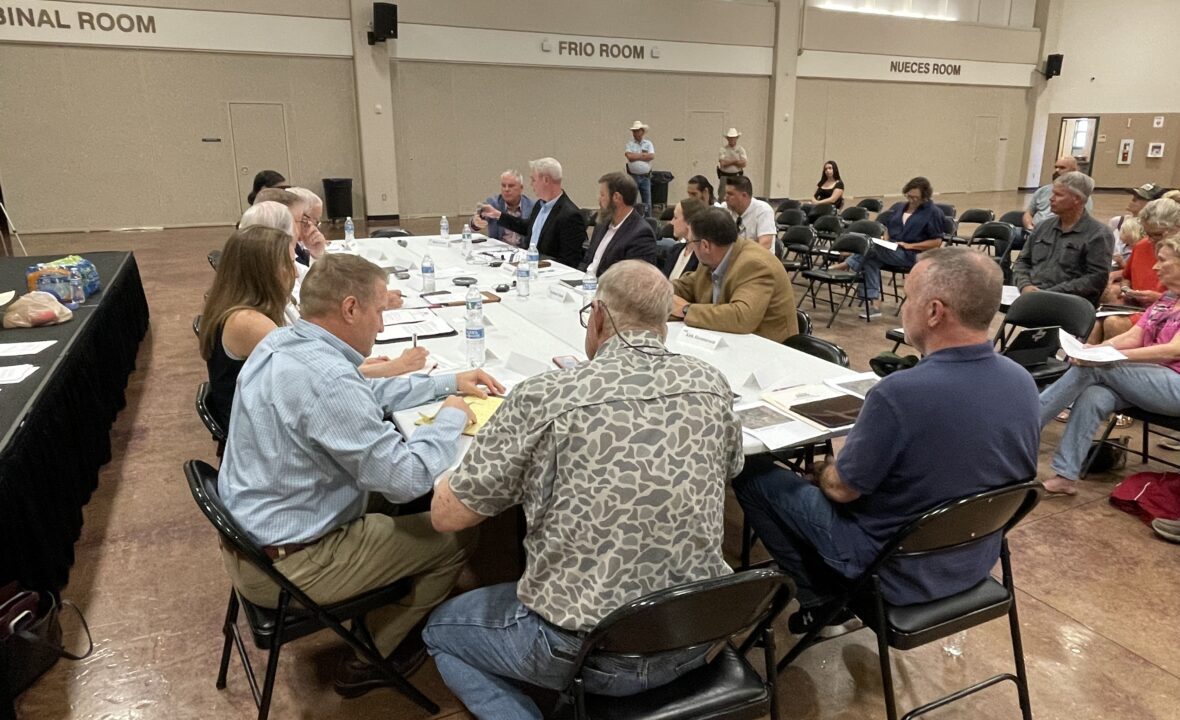
CPS Energy is building the portion of the line that crosses through Uvalde and Kinney Counties. On July 30, approximately 50 miles from the Mexican border, representatives from both companies faced members of the Texas Border Sub-Regional Planning Commission, composed of local officials in those counties.
New Smuggling Corridors
Kinney County Judge John Paul Schuster said that local officials have been dealing with illegal border crossings for about six years and now worry the 765-kV line will give illegal aliens a “freeway” to use.
Sabinal Mayor Erik Gomez warned the extra-high-voltage line would attract illegal activity. “They’re going to see this power line, and they’re going to use it to guide themselves into our country with drugs and smuggling people, trafficking people.”
He asked AEP Texas and CPS Energy what they would do to mitigate this.
“I don’t know that we have anything better than listening to what y’all’s recommendations are about how this corridor could be used and what your concerns are and what your experience is,” replied Kirk Rasmussen, an attorney representing CPS Energy.
He said that the company uses “a selective clearing process” and it was not their intention “to clear cut to the ground,” but that “it’s not like you’re not going to be able to see the towers.” He added that the company does not install gate fencing outside of what it works out with landowners based on their current fencing, but the company would use a locked gate to maintain access to its right of way. He also said that unless a tower is over 200 feet, it typically will not be lit, except when landowners request it for their private airstrip.
Gomez told Texas Scorecard that he wasn’t satisfied. “I feel like there’s no right answer to this thing other than not building the Powerline and not giving the cartels yet another avenue to do illicit activities.”
“Cartels will attempt to use any tactic they can, especially as we gain more operational control of the border. U.S. Border Patrol adjusts its operational posture as needed to deter and disrupt cartel activity, relying on an agile workforce and a combination of infrastructure, technology, and partnerships to ensure the border is secure,” a spokesperson for U.S. Customs and Border Protection wrote.
Neither the Texas Department of Public Safety, the Texas Military Department, nor PUCT responded to a request for comment on border security before publication.
Water
Travis Huey of the Fort Clark Municipal Utility District questioned both companies about an area of the proposed transmission line that would run from RM 334 and Highway 90 to the northeastern boundary of Kinney County. “That is our recharge zone. That is a karst aquifer,” he said. “If you follow anything that’s been going on in Kinney County in regards to water, you know that this has been a hot topic for two decades.”
Huey explained that even after spending millions of dollars and conducting research, the county still does not completely understand how rainwater flows into its aquifer system, or even the system’s size. This known-unknown gave Huey reason for concern about the potential impact 765-kV towers would have on Kinney County’s only water supply.
“When you start to put up towers, if we crush apart that system, that could shut off the recharge to our municipal water systems, which serve 3,000 residents,” he said. “If we were to have to supply water to our residents via truck, which has happened with other systems in this area, we would need 125 10,000 gallon trucks a day.”
“I think we have a lot of experience,” said Kip Giles, Deputy General Counsel for CPS Energy. “This isn’t like the first time we ever had to build in an area that has karst regions.”
Chad Tomanec of AEP Texas said company crews will commonly walk the line on the ground using ground-penetrating radar, but that these steps take place after PUCT selects a route for the line. “We have Edwards Aquifer as our water supply. We have a vast amount of time constructing transmission lines in karst areas, through areas that have a similar water feature,” he said. “I don’t know specifically what we would do until a route is selected.”
Huey countered that this is different from the Edwards Aquifer. “As a rural county and rural conservation district, we don’t have all the money that has been put together to understand the recharge of the Edwards Aquifer,” he said. “We don’t have all the information that others have that you’ve seen in the past, that you worked with in the past, and we only have one shot at this … once they’re crushed, they’re crushed and we don’t have another source.”
County Judge Schuster said Uvalde and Kinney Counties had another concern. He provided two maps: one of Kinney County’s monitored water wells and another of historical wells from 1940. Both maps showed the proposed Howard-to-Solstice line crossing over multiple monitored or abandoned wells. “This is the kind of stuff that makes me a little nervous,” he said.
Kinney County is within the Region J Water Planning Group. Each of Texas’ 16 Regional Water Planning Groups is responsible for its own regional water plan. Tara Bushnoe of the Upper Guadalupe River Authority, which is part of the group, wrote, “I do not recall information about this project being provided to the planning group.”
PUCT did not respond before publication regarding what guardrails it imposed on utilities concerning potential water impacts.
Land
Scott Brown has owned and operated Turkey Mountain Ranch in Kinney County for more than 100 years. He said the Howard-to-Solstice line did not cross into his property until after early open houses that solicited public feedback. Now one of the proposed links crosses “the heart of the ranch” where much of the ranch’s infrastructure—such as homes, livestock operations, and wells—is located. He did not find out until he received a landowner packet less than a month before the intervention deadline.
“While the process might have complied with the letter of the law, many landowners entered in after the most meaningful opportunity to influence the planning had already passed,” he said.
Margaret Byfield of American Stewards of Liberty said that transmission construction on private land will devalue it by 40 percent—a loss she says the companies will not compensate landowners for. “That affects every household,” she said. “So right now they’re going to have all the impact but they’re not going to get any of the electricity directly [from the line].”
County Judge Schuster voiced his concerns about the project devaluing people’s private land. “If for some reason we want to divide that property amongst our kids, who the hell wants this that’s got this power line running through it?” he asked. “Put yourself in our shoes. Have the courtesy to step up in Austin and say ‘guys, we need to pump the brakes on this a little bit.’ We need to make sure we’re doing the right thing so that 20 years from now we don’t have an ‘oh shit’ moment.”
If you are a citizen with information regarding bureaucratic overreach, please email scorecardtips@protonmail.com