An alliance of landowners asked the Public Utility Commission to reverse its decision and pick another route for a 765-kilovolt transmission line. They argued this project failed to provide due process to intervenors or comply with Texas’ Parks & Wildlife Code.
The landowners warned the route regulators chose would cross into land that is controlled by an individual with alleged ties to the Chinese Communist Party.
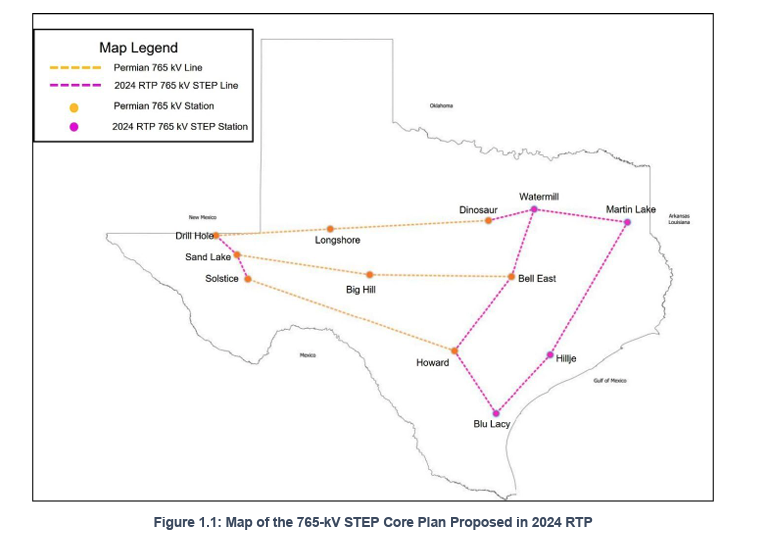
This regards the proposed Howard to Solstice 765-kV transmission line. A project by electric utilities AEP Texas and CPS Energy, this line would span approximately 370 miles in South and West Texas from the San Antonio to Fort Stockton areas.
It is part of the 765-kV Strategic Transmission Expansion Plan (STEP) Permian, a key part of the Permian Basin Reliability Plan (PBRP). STEP-Permian proposes three transmission lines, spanning more than 1,200 miles, to move power from East Texas to the natural gas-rich Permian Basin. The Howard to Solstice line is the southernmost line.
The Public Utility Commission of Texas (PUCT) approved the Howard to Solstice line on September 11. Commissioners’ signed order identified Route 4 Mod 1 as the approved route for the line.
On October 13, the Sabinal and Frio Rivers Alliance, a coalition of regional landowners, filed a motion for rehearing and request for ruling on offer of proof. They want commissioners to reject Route 4 Mod 1 and choose Route 23 instead.
The filing listed multiple concerns with Route 4 Mod 1, and PUCT’s order choosing it. It alluded to the alliance appealing to the courts if PUCT rejects corrections.
The Sabinal and Frio Rivers Alliance wrote that Route 4 Mod 1 crosses the Medina River Natural Area, a San Antonio park, and “portions of the park” that would be “physically altered and occupied” and therefore unavailable “for park uses.”
They alleged commissioners’ adoption of their order violated Texas Parks & Wildlife Code Chapter 26, which governs projects that propose taking public land designated to be used as a wildlife refuge, recreation area, historic site, scientific area, or a park. They wrote that the PUCT order’s findings of fact “conflict with the undisputed facts,” and that its conclusions of law contain “clear errors” concerning Chapter 26.
The alliance wrote that the code requires, before route approval, commissioners to determine “there is no feasible and prudent alternative to the use or taking of such land,” and that the project “includes all reasonable planning to minimize harm to the land.” They believe commissioners did not do this.
“[T]here are literally scores of ‘feasible and prudent’ alternatives to routes that use the Medina River Natural Area,” the filing read.
The Sabinal and Frio Rivers Alliance stated that electric utilities cannot take portions of the Medina River Natural Area unless there has been a Chapter 26 notice, hearing, and findings. They alleged that PUCT, AEP Texas, and CPS Energy failed to notify the San Antonio Parks Department or the public.
The Texas Parks and Wildlife Department echoed the Chapter 26 requirements on notice, hearing, and findings in March 27, 2025, letters to Oncor on their Dinosaur to Drill Hole 765-kV project. Texas Scorecard acquired these through a public information act request.
In these letters, TPWD’s Rick Hanson recommended “avoiding lands owned or managed for conservation or recreation by city, county, state, and federal entities,” and that these entities “should be contacted early in the planning process to determine if the proposed transmission line may impact their property.”
The City of San Antonio owns both CPS Energy and the Medina River Natural Area. Neither CPS Energy, San Antonio Mayor Gina Ortiz Jones’ office, nor the PUCT responded to a request for comment before publication. An AEP Texas spokesperson wrote the company “does not comment on pending litigation.”
The Sabinal and Frio Rivers Alliance outlined more issues.
They alleged the PUCT “acted arbitrarily and capriciously” when it approved the application because no intervening party had “a fair and meaningful opportunity to prove its case,” and the application lacked “due process of law.”
“Specifically, the substantial rights of Movants and hundreds of other intervenors were prejudiced by the truncation of the time to conduct discovery, prepare testimony, cross-examine witnesses, and brief their cases, leaving them at risk of eminent domain proceedings to take their lands for the use of the project,” reads the filing.
National Security
According to the alliance’s motion, Route 4 Mod 1 also has links that “are owned or controlled by individuals who are citizens of China or are owned or controlled by citizens of or are directly controlled by the government of China.”
As previously reported, multiple parties have warned about the intersection of proposed Howard to Solstice line routes and land owned by entities “controlled by Sun Guangxin, an individual tied to Chinese national interests and the Chinese Communist Party.”
These entities, Brazos Highland Properties L.P. and Harvest Texas LLC, called “categorically false” any suggestion that they or Guangxin are “part of or acting for the” CCP or the Chinese government.
Neither company opposes the project. Harvest Texas had asked the PUCT to take “residence safety and health issues” into account when considering a route that used Link 238 “because of its proximity to a residence and the resulting site-specific land-use and property impacts.”
Route 4 Mod 1 uses Link 238.
The Sabinal and Frio Rivers Alliance wrote “there is credible evidence in the record that certain routes, including Route 4 Mod 1, may require violations of [the Lone Star Infrastructure Protection Act] by routing construction of critical infrastructure through land owned by individuals, citizens, or business entities owned or controlled by citizens of or directly controlled by the government of China (or other statutorily designated country).”
Passed in 2021, LSIPA prohibits agreements that give an entity owned or controlled by individuals from Russia, Iran, North Korea, or China direct or remote access to, or control of, critical infrastructure.
If AEP Texas and CPS Energy are allowed to continue along Route 4 Mod 1, the Sabinal and Frio Rivers Alliance asserts that the applicants “will acquire easements and pay compensation to” Brazos Highland Properties L.P., and Harvest Texas LLC to use the land. Thus, “Chinese Communist Party-affiliated entities or persons-will be the servient estate and have complete access to the easement holding project.”
According to the filing, the PUCT effectively concluded that AEP Texas’ and CPS Energy’s application does not violate LSIPA because the applicants “produced no evidence that their proposed routes-and in particular, Route 4 Mod 1-would potentially require, if chosen, rights of way through land where a Texas business may not build critical infrastructure.”
The alliance argued that the PUCT’s order determined, “it is the absence of evidence, not evidence in the record,” that foreclosed applying LSIPA to its “decision-making process.”
The U.S. Office of the Director of National Intelligence identified China as a national security competitor to the United States in its 2026 Annual Threat Assessment.
State Armor’s Michael Lucci warned that “Texas is America’s energy powerhouse, and in the event of Communist China starting a conflict, they want to be able to shut down Texas as a way to shut down America’s ability to fuel our defense and counter-attack.”
Other parties have filed rehearing motions. On November 5, the PUCT will vote on extending time to consider these motions.
State law requires that if commissioners do not act within 55 days from the date of a PUCT order, rehearing motions are overruled. Commissioners may, in a written order, extend the deadline as much as 100 days after the PUCT order.
On October 15, they extended time to consider rehearing motions in both segments that make up Oncor’s Dinosaur to Drill Hole 765-kV project “to the maximum extent allowed by law.”
Critics have argued that the best way to address Permian Basin needs is by reforming the electric market, not building 765-kV lines. The Texas Public Policy Foundation estimates the lifetime cost of all STEP projects ERCOT approved through December 2025 at approaching $100 billion to be borne by ratepayers.