This article has been updated since publication.
For the first time, the chairman of the Public Utility Commission of Texas has directly said that state lawmakers did not explicitly mandate a statewide 765‑kilovolt transmission line project in a law passed in 2023. For those who have been following this issue, Thomas Gleeson’s remarks in a marathon Senate hearing raised eyebrows.
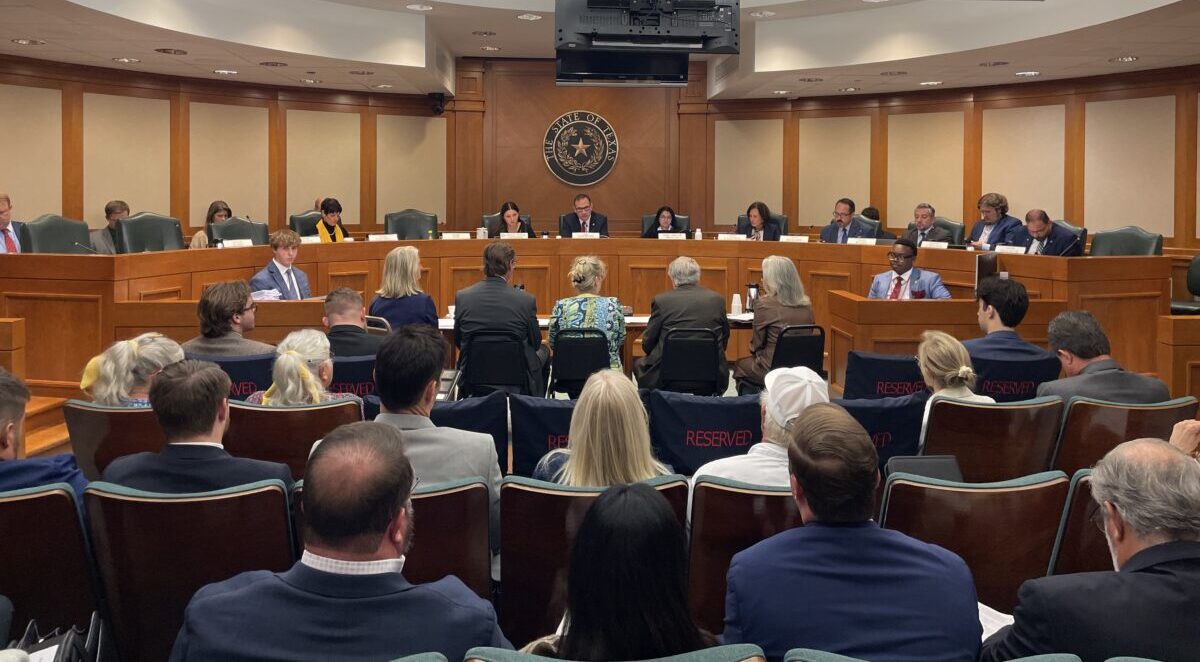
Gleeson’s comments came during a meeting of the Senate Committee on Business and Commerce this week that included a discussion of how that 2023 law reduced the timetable for transmission projects from one year to 180 days and required state bureaucrats to rely on data from transmission companies.
Lawmakers raised concerns that the state’s market construct and federal incentives have flooded the power grid with unreliable wind and solar generation, and that these proposed transmission lines may worsen the issue.
BACKGROUND
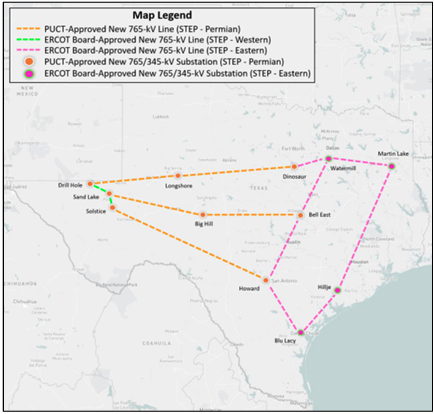
This debate centers on the 765‑kV Strategic Transmission Expansion Plan (STEP) Permian, a key part of the Permian Basin Reliability Plan (PBRP). STEP Permian proposes three transmission lines spanning more than 1,200 miles to move power from East Texas to the natural gas‑rich Permian Basin, with lifetime costs reportedly approaching $100 billion to be borne by ratepayers. A pro‑landowner group likened this project “to hauling water to the sea.”
The three proposed lines are split into five interconnected segments that would cross North, Central, and South Texas. The Public Utility Commission of Texas (PUCT) must approve each segment. Critics have argued that PUCT, the Electric Reliability Council of Texas (ERCOT), and electricity delivery company Oncor transformed a regional reliability directive in 2023 law House Bill 5066 into a de facto statewide 765‑kV grid plan without an explicit vote by state lawmakers.
Before the Senate Business & Commerce Committee, Gleeson admitted that it was PUCT commissioners who decided to pursue the extra‑high‑voltage lines.
“House Bill 5066, what it did is it required ERCOT to submit to the PUC a plan for how to provide electricity to customers in the Permian. What it did not do is require that to be done on a 765‑kV system,” said Gleeson. “ERCOT did its analysis and then provided us with options in the middle of 2024.”
Upon review of the transmission options, he said PUCT chose the 765‑kV lines because, “in totality,” the 765-kV lines would take less right of way compared with lower‑voltage 345‑kV lines. He said the latter option would have resulted in “basically a spider web of 345 lines in basically the same area.”
State Sen. Donna Campbell (R–Bulverde) asked how a regional directive transformed into a statewide project.
“Another portion of House Bill 5066 has ERCOT looking at other areas of the state that may have been underinvested in for transmission to get electricity to those customers, so they created what they call the STEP plans,” Gleeson replied. “They have made that recommendation that you basically close that loop. Do not just the west but also the eastern loop, to have basically a highway of extra‑high voltage.”
The ERCOT board endorsed STEP’s two other phases in December 2025. These are the STEP Western and STEP Eastern 765‑kV lines.
Gleeson said that even without HB 5066, transmission companies would have still filed applications for the STEP-Permian 765‑kV lines. However, that 2023 law shortened the timeline for these types of projects from one year to 180 days.
“When I voted in favor of the reliability study on House Bill 5066, in my wildest imagination I couldn’t believe that this is where we would be without any other involvement of the state legislature,” said State Sen. Kevin Sparks (R–Midland).
180-DAY DEADLINE
Committee Chairman Charles Schwertner (R–Georgetown) said he had voted for HB 5066 and now wanted to roll back the 180‑day deadline.
Luther King, whose family assembled more than 100,000 acres over decades, told senators during public testimony that the new routing process “reminded me of somebody sitting at a breakfast table with an Exxon road map and a Crayola, and just drew some lines,” cutting across bluffs, creeks, and view corridors with little regard for terrain.
Landowners, he said, were given just 48 days to respond to roughly 3,000 pages of filings, arguing the 180‑day schedule “is not long enough” for Texans to defend multi‑generational ranches against eminent domain.
The law did more.
According to ERCOT’s COO, Woody Rickerson, it effectively forced the grid operator to rely on forecasted loads from transmission service providers (TSPs) in its Permian Basin plan. He confirmed to State Sen. Lois Kolkhorst (R–Brenham) that “basically” the law required ERCOT to use TSP attestation data for how much generation is forecasted to come online.
“Could y’all compare that to what your internal forecasts have delineated?” Schwertner asked. Rickerson said the TSP‑driven forecast was “substantially higher.”
He thought HB 5066‑linked studies showed forecasted load growth of “around 150” gigawatts, while ERCOT’s internal numbers projected normal load growth up to roughly 110 GW “if you take everything we have today.”
Rickerson said that looking at expected Permian Basin load and all known and future generation in West Texas, the result was a load that could not be served without overloading existing transmission.
“If the forecast the TSPs have given us measure out, then we could start seeing periods of shortage as early as next year,” he said.
TRANSMISSION OF UNRELIABLE ENERGY OR LOCAL GENERATION?
Gleeson also raised transmission congestion as another reason for the 765‑kV lines, stating that the draw to the Permian Basin is greater than the current infrastructure can handle, resulting in “some instances” of investment in localized generation.
“One of the reasons we’re seeing this is because of the proliferation of renewables in that area, that there are times of the day, overnight, where we have to take power from other areas of the state to move it into the Permian,” Gleeson said. “That is just going to get exacerbated as these new load numbers come to fruition, going from 11 GW now, as you said, from electrification and other issues to upwards of 25, 27 GW in the next 10 to 12 years. We have to find a way to meet that demand.”
Sparks questioned how helpful transmission will be in solving the demand problem in the natural gas‑rich Permian Basin. “It looks like we’re overlooking the obvious of building natural gas‑fired power generation out there, and making sure we’ve got the regional infrastructure to move those electrons around,” he said. “We don’t even have … new generation, reliable, 24‑hours‑a‑day generation going in on the east side” of the proposed lines.
During public testimony, several landowners echoed Sparks’ call for local generation instead of long‑distance lines.
Pecan farmer Mark Friesenhahn described STEP Permian as “a multi‑billion‑dollar extension cord without a generator to plug it in,” arguing the need studies never fully assessed on‑site power options.
Coy Mark Collinsworth, who runs a thoroughbred operation in Bluff Dale, said a 765‑kV line would “render the homes uninhabitable” and “totally forever ruin the land,” and urged lawmakers to tap the Permian’s abundant natural gas for “local electrical generation for local use” rather than dropping huge towers across family ranches.
Kolkhorst shared Sparks’ concern about relying on unreliable wind and solar.
She noted that Dr. Jeff McDonald of Potomac Economics said “we ended up lopsided because of the federal government stepping in and putting in an incentive [for wind and solar].” Kolkhorst also pointed to Chapter 313, a now‑expired school district property tax exemption program that heavily benefited wind and solar.
“My number one concern is making the grid more vulnerable, because no one has said to me in the days leading up to this hearing or today, ‘no, we’re not going to have more renewables,’” she said. “The tax credits don’t run out till 2033.” She asked Rickerson about when the 765‑kV lines will be built. “I think the very first ones show up in 2031,” he said.
Kolkhorst quipped back, “still in time for those credits.”
As previously reported, transmission service providers admitted that reliance on wind and solar power is driving Permian Basin energy issues.
On the other hand, Kolkhorst pointed to state data showing growth in natural gas generation has remained flat despite lawmakers passing the Texas Energy Fund.
Sparks expressed his concern that wind and solar would be the power source that floods the new 765‑kV lines. He said the state doesn’t have the right market construct to incentivize natural gas. “Without a change in the market structure, we will see more of what we’re currently seeing, which is mostly intermittent power, which our oil and gas companies can’t run their operation off of,” Sparks said.
Another concern is the lifetime cost of the project, which Texas Public Policy Foundation estimated at approaching $100 billion, and roughly $150 more per year for ERCOT‑grid ratepayers. For Campbell, this is not a project that should be sped through. “Haste makes waste,” she said. “We’re going to have residents, Texans, bear the burden of the cost of these transmission lines.”
Schwertner, the committee chair, stated that 765‑kV lines “are a proven technology in the United States and other areas, other countries too.”
However, that fact did not impress attorney Donald Grissom, who represents intervenors in one of the proposed STEP Permian lines. “Those are Yankees, this is Texas,” he said at a June 8 administrative law hearing on the Bell County East to Big Hill segment after hearing a similar argument.
WHAT DO LANDOWNERS SAY?
Public testimony at Wednesday’s hearing underscored how those policy choices are colliding with private property rights on the ground.
Property rights advocates told the committee the compressed timeline under HB 5066 has left rural Texans without meaningful due process.
Margaret Byfield of American Stewards of Liberty argued that landowners and local officials were not “meaningfully included” before regulators began pursuing transmission at “this unprecedented scale,” and that ranchers are being asked to surrender property rights and accept permanent consequences “without independent, transparent evidence” that the lines are necessary or that less damaging alternatives have been fully vetted.
She urged lawmakers to pause the current 765‑kV proceedings so the legislature can rewrite the process in the next session.
In her view, the fact that state officials now concede the 180‑day process was too short and unfair should be enough to “nullify” the existing dockets and start over under reformed rules.
Jim Scott, an environmental planner who helped develop a national routing model, told senators that Texas law has “never prescribed any defensible planning methodology,” leaving utilities to draw lines first and ask landowners questions later.
“Today’s landowners are locked out until the lines are already drawn,” Scott said. He urged lawmakers to require front‑end corridor planning with public input and transparent modeling so routes can be shaped around communities instead of forcing ranchers to “make their land someone else’s problem” after the fact.
Country music artist Tanya Tucker, born in Seminole, now lives on a ranch in Burnet County near Briggs. She told senators she wasn’t in Austin “to sing” but to speak “Texan to Texan” about what the 765‑kV build‑out would do to her family’s land. She described the ranch as “our little piece of Texas heaven” with horses, wildlife, and sunsets so iconic that the property has been featured in Texas Monthly and on Times Square billboards.
Tucker warned that one preferred route would cut directly through the same pasture where those photos were taken. “Those 765 kilovolt lines would run right through that exact spot. The landscape would be changed forever,” she said, adding, “This isn’t the way we do things in Texas. You don’t rush in and turn someone’s life upside down.”
While she said she wants a strong Texas grid and remembers melting snow to flush toilets during the 2021 winter storm, Tucker urged lawmakers to “take a longer look at the other options” before “disrupt[ing] so many lives.”