Texans can expect more transparency and accountability when it comes to school employees who harm students, according to the man now in charge of enforcing educator misconduct rules.
The Texas Education Agency’s first Inspector General for Educator Misconduct, Levi Fuller, started his new job in February.
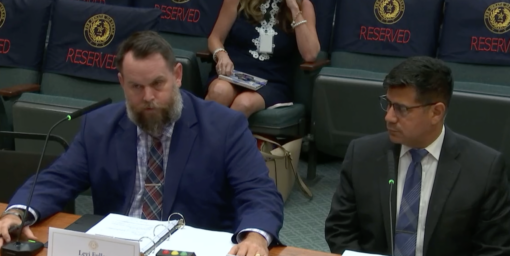
Tuesday night, Fuller spoke with Abraham George, chairman of the Republican Party of Texas, about the challenges his office is tackling.
Fuller credited Texas Education 911’s State-Sponsored Child Abuse report and “a lot of moms” for bringing the misconduct issue—especially sexual and physical abuse of students in taxpayer-funded schools—to the legislature’s attention and prompting creation of the inspector general position.
Before taking the job, Fuller said he asked himself, “What do I need to do here to be successful, to protect everybody’s kids—my kids included?”
He came up with a “three-part plan” that includes transparency, accountability, and proactive prevention.
“We need to identify the bad things that are occurring in our schools,” said Fuller. “What that means is boosting transparency from the TEA but also making sure that we are holding administrators accountable if they fail to report. We are well underway with that.”
“Part two is accountability, bringing the absolute hammer down on everybody that violates our Educator Code of Ethics or, God forbid, violates the law,” he said.
“If you are trying to obfuscate and hide for whatever ridiculous reason, I have zero sympathy. We will absolutely come down on you with the full force of the state.”
“And then part three is … what do we do to get proactive?” said Fuller.
“By the time the TEA gets involved with these cases, the damage has already been done—to the child, to the family, to the community. We need to figure out what we can do to keep these people from getting into schools in the first place.”
Transparency
Transparency is essential for parents to make informed decisions that impact the safety of their students and for maintaining trust within school communities.
Fuller has already made public reporting of disciplinary actions issued by the State Board for Educator Certification more transparent by adding information about the allegations against sanctioned educators and where they worked.
Those improved SBEC quarterly reports, which Fuller said he wants to make monthly, will soon be complemented by a new Educator Misconduct Reporting Dashboard that he previewed on Tuesday.
The interactive dashboard displays publicly available data on the number and types of misconduct reports submitted to TEA, cases under review, SBEC disciplinary actions, and the number of individuals placed on the Do Not Hire Registry.
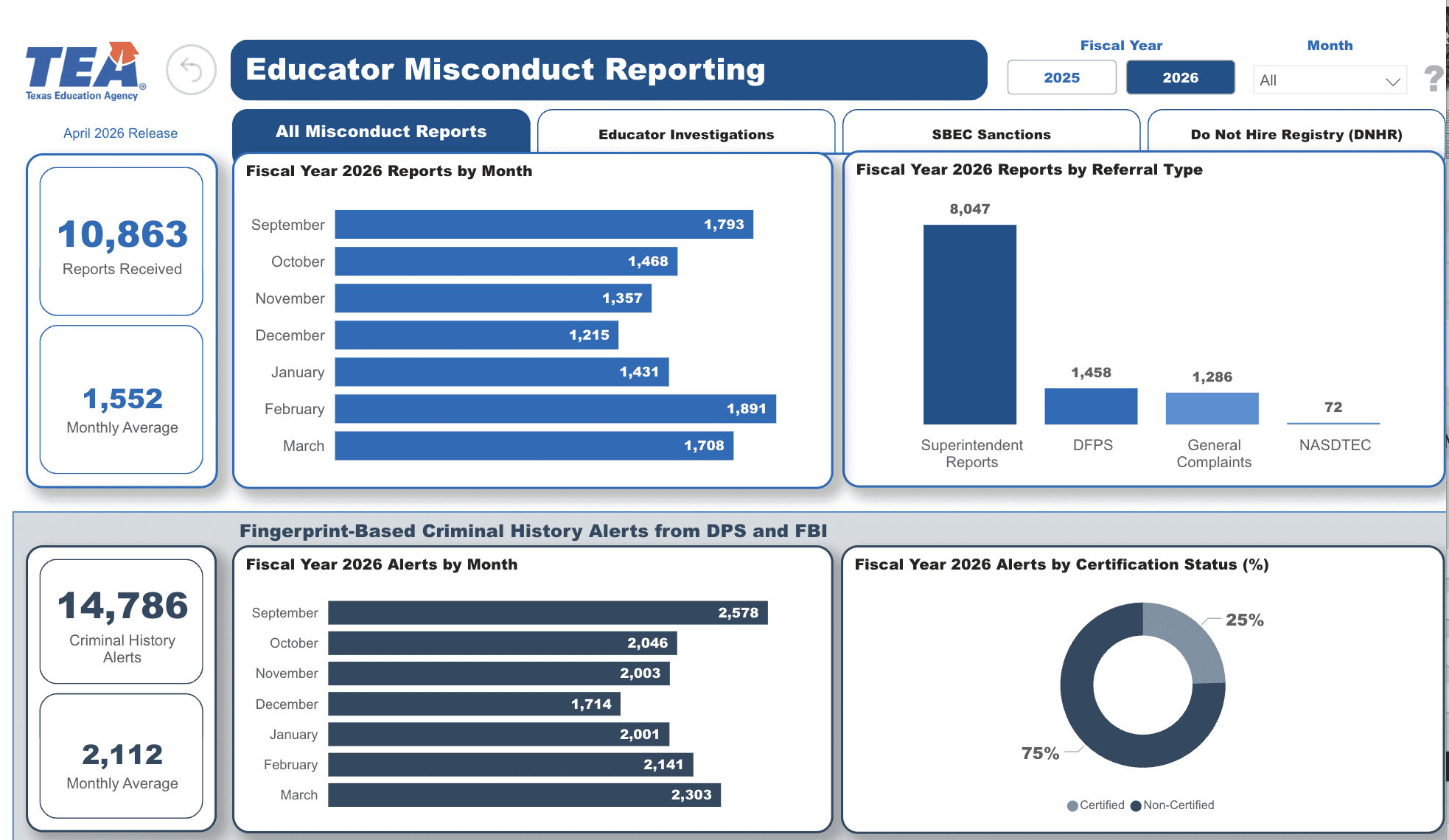
“It’s one of the big projects that we’re doing to increase transparency,” said Fuller. “We want parents to know what it looks like. We want educators, and we want administrators, we want everybody to know.”
“We don’t want to hide anything, and we don’t want anyone to think that we are.”
Dashboard data shows the volume of misconduct complaints this year is already much higher than last year, at around 1,500 a month.
Even with the rise in complaints, Fuller noted that his office is going after a very small number of the 355,000 certified educators and 200,000 non-certified employees in Texas public schools.
“But one bad actor can completely upend a community,” he said.
Accountability
Fuller told George two of his main mandates are working with the investigators who gather evidence in educator misconduct cases and overseeing the enforcement team that litigates contested cases before administrative judges.
“Parents need to know that I view these cases as: What would I want as a parent to come out of this? How would I want to be treated by the TEA? How do I expect to be treated by my school district?”
Fuller said some of the biggest problems he’s seen are school officials not reporting something or thinking something doesn’t have to be reported.
The worst thing that I’ve seen in any of these investigations are whenever they do a subjective evaluation of an allegation, and they come to the conclusion of, well this is either a false allegation, or it’s not a good student, or we need to confirm this because the teacher is a good person. Or one of them that I was just shocked by was, I know how to investigate.
“It’s a human element where there’s sort of this natural instinct to protect, and I cannot encourage against that any stronger than I possibly am right now,” he said. “Do not do that. You don’t know what’s going on under the surface. Let the experts get in and figure it out.”
Senate Bill 571, comprehensive educator misconduct legislation enacted in 2025 that Fuller called “absolutely phenomenal,” strengthened misconduct reporting requirements for administrators and added more reportable offenses including boundary violations and inappropriate communications.
Fuller told George that school officials must now report suspected child abuse to the Texas Department of Family and Protective Services or law enforcement within 24 hours (all Texas adults are mandatory reporters), and must report misconduct allegations to the TEA and SBEC within 48 hours.
“What if one of the ISDs decides they’re not going to do it?” asked George.
“That would be not recommended, because the penalties are steep,” answered Fuller. Penalties for failure to report include fines and jail time.
“I have no problem calling a DA on that … and a lot of the DAs that I’ve worked with have no problem with taking that case,” he said. “They violated the law, and so there is zero tolerance for that.”
He said superintendents could also lose their certification or be placed on the Do Not Hire Registry for violating the Texas Educators’ Code of Ethics.
George asked Fuller about “independent” third-party investigations commissioned by school districts.
“That’s kind of like the old adage of ‘We investigated ourselves and concluded we did nothing wrong,’ right?” said Fuller.
He said administrators may find such investigations useful to figure out what went wrong and improve processes. “But a third-party investigation doesn’t come close to supplanting what we’re going to do.”
George also asked Fuller about House Bill 4623, which removes immunity from civil liability in certain cases of educators sexually abusing students.
“This is not a tool that is used by TEA, but it promotes accountability by shifting the incentive structure for school districts,” said Fuller.
Another new accountability resource is the Child Abuse Reporting Response Team.
“The commissioner, as he is known to do, poached some really good guys from DFPS,” said Fuller. “So we have some very experienced DFPS investigators that are going to be looking at child abuse reporting and issues out of schools.”
Proactive Prevention
Another part of Fuller’s job is providing regular policy and process guidance and recommendations to the TEA commissioner, SBEC, the State Board of Education, the governor’s office, and members of the legislature.
He’s already helping put in place new administrative rules and policies that implement legislation from 2025. His office is also optimizing existing authority—as TEA did when creating the inspector general position.
Fuller told George he’s not ready to divulge policy goals for the 90th Legislative Session in 2027, but he wants to hear from Texas parents.
“Just let us know where we can improve,” concluded Fuller. “We’re here to fix it. We’re here to fix the problem.”