As energy prices continue to increase, Texans will shoulder the additional burden of a statewide infrastructure project for many years ahead.
Since its passage in 2023, Texas lawmakers’ solution for the Permian Basin’s energy shortage has morphed—thanks to state agency maneuvering—into a $33 billion statewide transmission plan that shifts long-term costs onto ratepayers.
Lawmakers passed House Bill 5066 in 2023 to bypass renewable energy requirements and extend transmission service in which existing or projected electrical loads will be underserved.
Legislative Intent
The original intent was for the state to build transmission lines to serve growth that has not kept up with demand, specifically in the Permian Basin. The region is an area of the state with heavy oil and gas development, cryptocurrency mining operations, data centers, and hydrogen electrolysis facilities.
Now the plan has expanded into a statewide project.
Brent Bennett from the Texas Public Policy Foundation told Texas Scorecard that the estimated total cost of the project is $80 billion after financing and maintenance, with an annual cost of $3 billion.
The Transmission Line Plan Changes
The Electric Reliability Council of Texas (ERCOT) is a nonprofit corporation, governed by a board of directors and subject to oversight by the Public Utility Commission of Texas (PUCT) and the Texas Legislature.
In July 2024, ERCOT recommended that the Public Utilities Commission of Texas consider building transmission lines from other regions of the state—called import paths—instead of only the local transmission upgrades outlined in the legislation.
In September 2024, State Rep. Charlie Geren (R–Fort Worth) sent a letter to ERCOT expressing concerns with the plan.
“My legislative intent is that HB 5066 be implemented without delay,” he wrote. “The Permian Basin Reliability Plan should be kept separated from the larger state plan and should not be the trigger for such a state plan without robust stakeholder and legislative input.”
Six days later, ERCOT responded to Geren.
“We thought it was important for all stakeholders to begin contemplating building a more robust system to serve the projected growth we see happening across the State of Texas,” said the council.
In October 2024, the PUCT approved the reliability plan submitted by ERCOT.
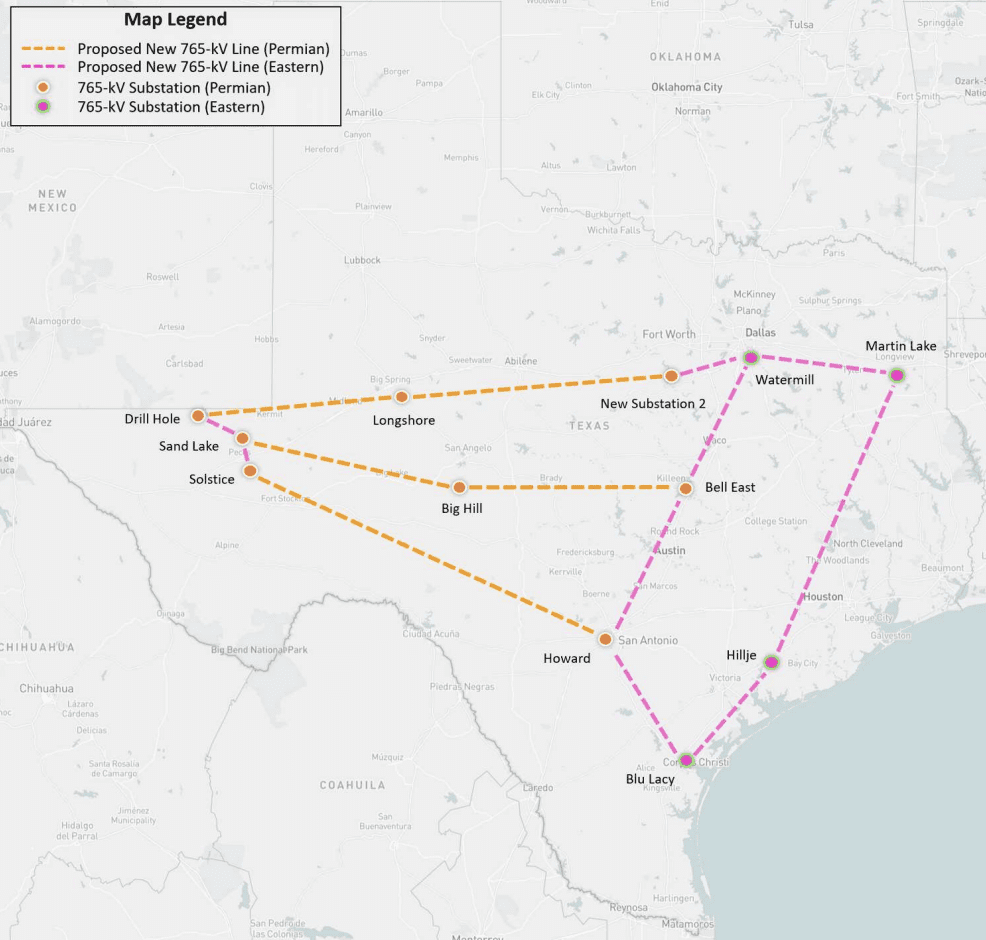
The plan added transmission lines throughout the state: three extra high voltage (EHV) 765-kilovolt (kV) import paths and five 345-kV import paths.
These transmission lines will be built through a private-public partnership with authorized transmission service providers (TSPs), which will prepare certificates of convenience and necessity applications for all eight import paths.
TSPs have the legal right to seize land under eminent domain to build infrastructure for public use.
In January, ERCOT released the cost estimates of the two voltage options for the plan.
The 345-kV option was estimated at $30.75 billion, and the cost of the TX 765-kV Strategic Transmission Expansion Plan Comparison (STEP) at $32.99 billion—a difference of $2.24 billion.
Most Recent Plan
In August, ERCOT released the updated plans for the project—opting for the TX 765-kV STEP plan, to “address the current and future transmission needs in the ERCOT Region.”
This plan now calls for three 765-kV Extra-High Voltage electric transmission lines into the Permian Basin area, approved in April by the PUCT.
Additionally, the plan adds two 765-kV EHV transmission line projects to connect the western and eastern loop point-to-point electrical connections elsewhere in the state.
Additional Problems
Wind and solar have oversaturated the market in the Permian Basin with intermittent supply to the grid and contributed to the market problem HB 5066 aimed to fix, according to the Texas Public Policy Foundation.
These renewable energy sources supply the grid with large amounts of power when they generate it during optimal conditions, not when the demand requires it, causing congestion.
Congestion happens when power lines hit capacity limits and can’t move any more electricity, forcing the use of higher-cost generators over cheaper alternatives.
Lawmakers passed HB 5066 in response to a demand forecast performed by S&P Global, showing the growing demand in the Permian Basin by the oil and gas industry, cryptocurrency mining operations, data centers, and hydrogen electrolysis facilities.
Texas statutes establish that a qualifying facility, such as oil and gas drilling sites in the Permian Basin, may enter into a purchase power agreement for a long-term contract of energy purchasing at a set price directly from the supplier. These agreements save costs—such as transmission line expenses—that would otherwise be imposed by retail electric providers and can sometimes help avoid congestion.
Retail electric providers buy wholesale electricity, delivery and related services, set prices for customers, and seek customers to buy electricity at retail. They are required to buy a certain amount of renewable energy to meet state standards, using renewable energy credits to track compliance.
This red tape was bypassed by the legislation to build more interconnections to strengthen grid reliability in the Permian Basin, reducing congestion by supplying on-demand electricity with natural gas power plants.
However, with the expansion of the regional project into a statewide one—against the original intent of lawmakers—renewable energy companies are using the opportunity to increase operations.
Research published in 2023 by Lawrence Berkeley National Laboratory, funded by the U.S. Department of Energy, described the role wind and solar play in the current electricity market.
The interconnection process for the electricity grid is designed for fewer, larger, centralized power plants, such as natural gas facilities.
Solar and wind power facilities vary in their contribution to the grid and provide less capacity than natural gas.
Renewables and storage often face higher interconnection costs than natural gas, including in rural areas. These prices can be attributed to weaker transmission systems—commonly found in rural areas—that have higher network upgrade costs necessary for wind and solar interconnections, which is not a necessity for natural gas plants.
Rural regions of Texas offer lower prices for the large parcels of land needed for the wind and solar operations, making the Permian Basin an ideal location for operations.
With smaller power capacity contributions and higher prices, wind and solar have largely contributed to the backlog—from stretching ERCOT staff thin with interconnection requests—to being granted interconnection.
ERCOT mentioned one of the benefits of the TX 765-kV STEP plan is that “higher transfer capability could also provide a greater range of siting options for both Generation Resources and large loads.”
Large loads include data centers, which at one West Texas site have the potential to consume enough energy to power over 1 million homes in 2025.