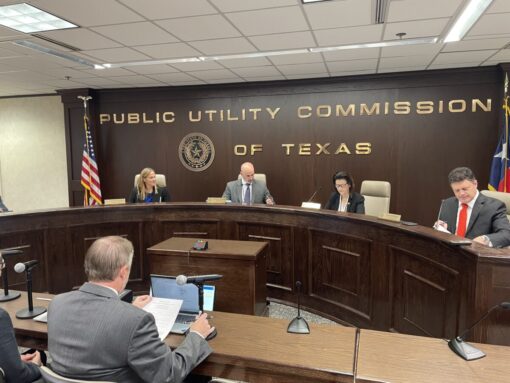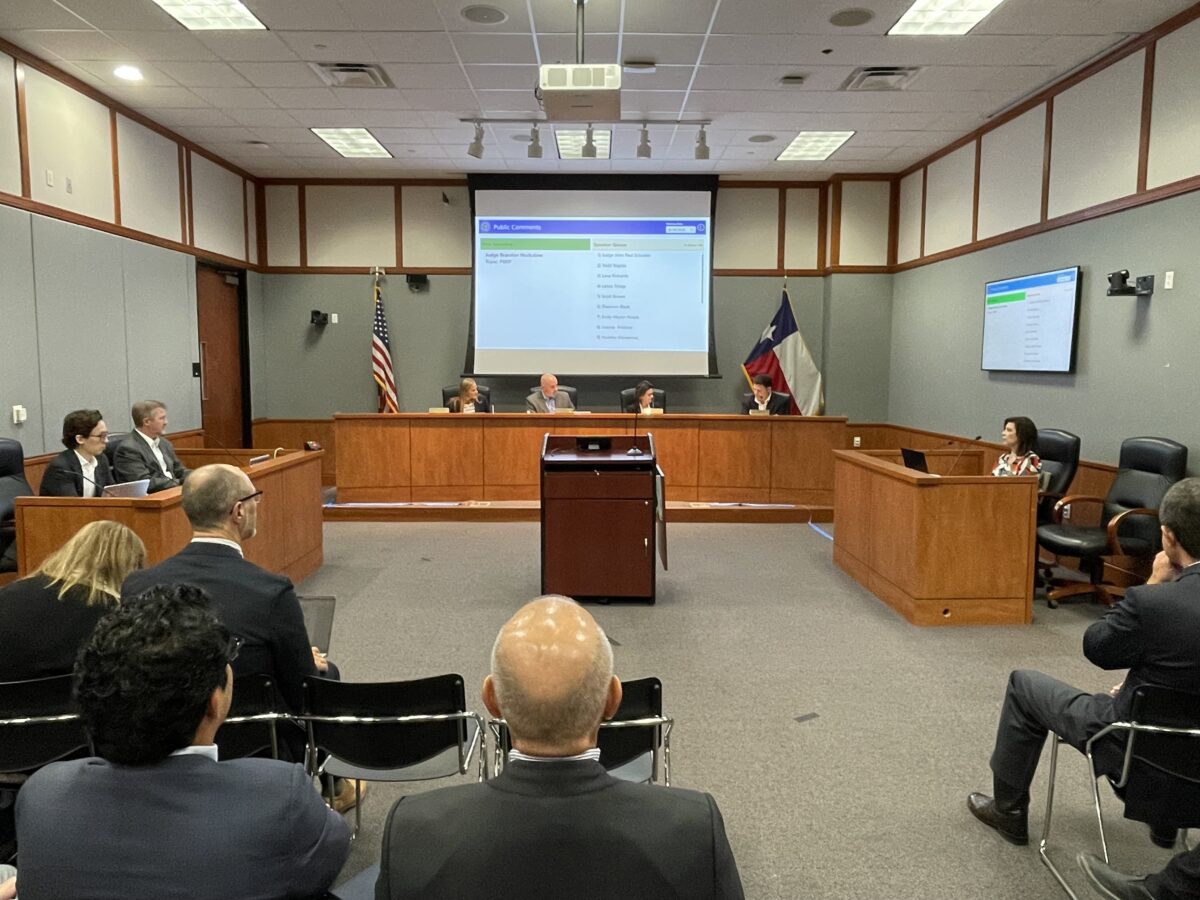
AUSTIN—Texas’ Public Utility Commissioners voted to move forward on the first of three controversial extra-high-voltage transmission lines. They did this despite calls from landowners and lawmakers to pause the project until after the 2027 legislative session.
The day before, Commission Chairman Thomas Gleeson filed a memo on a segment of the first line. He disagreed with administrative law judges’ finding that electricity delivery company Oncor “failed to notify more than 1,600 impacted landowners of a public meeting.” These are meetings where a transmission service provider presents information about the proposed project and collects feedback from impacted landowners.
“Understanding that folks are not happy with the process,” he said, “I think, on the law, the ALJ was wrong here.”
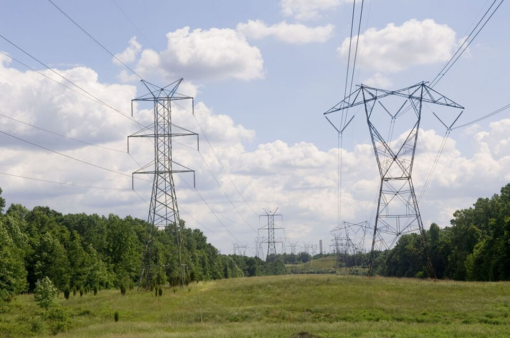
This is in regards to Oncor’s proposed Dinosaur to Drill Hole 765-kilovolt transmission line. This line would span approximately 390 miles from near Glen Rose to near the Culberson–Reeves county line.
It is composed of two segments—the Dinosaur to Longshore and Longshore to Drill Hole lines. Gleeson’s memo addressed the administrative law judges’ Proposal for Decision in the Dinosaur to Longshore line.
Dinosaur to Drill Hole is part of the 765-kV Strategic Transmission Expansion Plan (STEP) Permian, a key part of the Permian Basin Reliability Plan (PBRP). STEP Permian proposes three transmission lines spanning more than 1,200 miles to move electricity from East Texas to the natural gas-rich Permian Basin. A pro-landowner group likened the project “to hauling water to the sea.”
Landowner complaints of not being “meaningfully included” in the process have helped elevate this project to the attention of state officials. Lt. Gov. Dan Patrick and members of the state House and Senate called for PUCT to deny all pending 765-kV projects until the legislature can reform the approval process in 2027.
American Stewards of Liberty (ASL) and a more than 30-member coalition that includes the Texas Public Policy Foundation requested that PUCT abate all five segments.
The PUCT commissioners, appointees of Gov. Greg Abbott, adopted the proposals for decisions with modifications from Gleeson’s memos.
Shortly afterwards, Texas Attorney General Ken Paxton filed an amicus brief with PUCT in support of ASL’s motion to abate.
“Here, the Commission has approved a Plan that appears to reach beyond the Legislature’s clear direction,” the brief read. “The Legislature must be afforded the time to review the Plan and its potential impacts so it can then enact additional legislation to provide whatever additional guidance it deems fit.”
“We need to ensure that a project of this size is being carried out in a way that is best for the people of Texas,” Paxton wrote in a statement. “There must be clear guardrails from the Legislature for this scale of buildout. I will always act to put Texans first.”
Elena Folgueras, an attorney for American Stewards of Liberty, questioned the wisdom of PUCT moving forward with lawmakers asking questions. “They have raised serious concerns about the treatment of landowners. They are actively considering whether the statutory framework governing these projects needs to change,” she told commissioners.
Erath County Judge Brandon Huckabee told commissioners about what he’s heard from his constituents. “They look towards Austin and see a regulatory system that’s complicated, expensive, nearly impossible for an ordinary landowner to navigate, and standing in the middle of all that is a family just trying to protect the place they call home,” he said. “I don’t question the need. Texas needs more power, but surely we can meet that need without making Texas believe their government is simply something else they have to defend their property from.”
Consistent with his memos, Gleeson told commissioners that bisecting properties should be avoided, and they should authorize Oncor to work with landowners on route siting and “make reasonable accommodations where they can to accomplish this goal.”
He called on attorney Jaren Taylor, representing Oncor, about landowner complaints.
“Regardless whether landowners want [the transmission line] on their property, which I know they don’t, what we can’t have happen is all these landowners coming here and telling us that they don’t feel on board, negotiated, or had discussions in good faith,” he said. “The expectation is we will not hear this going forward, that you all need to meaningfully engage with these landowners in this process. Is that understood?”
“Understood,” Taylor replied. Commissioner Courtney Hjaltman said, “Landowners, if they’re not doing that, come back and let us know, because the expectation is on them.”
Folgueras explained what impacted landowners can expect after PUCT’s final decision.
She said that the transmission service provider, in this case Oncor, will approach landowners to negotiate easement terms and compensation. “If a landowner chooses to not accept that compensation amount, Oncor can file a condemnation petition,” she continued. “[That] outlines their ability to take the land and that they offered a fair price for the property. A landowner can then obviously contest that compensation amount.”
What follows is a special commissioners hearing to determine if the amount the company offered is “just and reasonable.” Whatever amount they decide is deposited into the registry of the court. “If a landowner chooses to withdraw that money from the registry of the court, they have waived their right to take claim,” she said. “Right to take essentially is you contesting whether or not the [Transmission Service Provider] has authority to condemn and take your land.”
PUCT spokesman Rich Parsons confirmed in a statement that Texas Utilities Code § 181.004 and PURA § 37.053(d) authorizes electric utilities to condemn property.
“However, Chairman Gleeson’s memo established that the integrity of property along the transmission line’s path should be respected whenever possible. The adopted order, along with commissioners’ statements today, make clear the Commission’s expectation that the electric utility must work closely with affected landowners,” he wrote. “Chapter 21 of the Texas Property Code governs the condemnation process. Before initiating a condemnation proceeding, an electric utility must make a bona fide offer that complies with Texas Property Code § 21.0113. If the parties cannot agree on damages, the electric utility may file a condemnation petition under Texas Property Code § 21.012.”
When asked if they would pledge not to resort to eminent domain, Oncor replied in a statement that it “is committed to treating impacted landowners with respect and working collaboratively with them throughout the easement process. This includes evaluating landowner requests for route deviations consistent with the ordering language expected to be used by the Commission, which can help minimize potential impacts while meeting engineering, reliability, and safety requirements.” The full statement is available here.
In her address to the commissioners, Folgueras questioned the claimed need for the project. “ERCOT has revised its load forecasting methodology. New generation has been announced in and around the Permian Basin,” she said.
Todd Staples, president of the Texas Oil & Gas Association, disagreed. “West Texas operations, West Texas homes, schools, businesses are all threatened today because it lacks access to dependable, reliable, affordable interconnection into the ERCOT grid,” he said, advocating for the 765-kV project. “There are six gigawatts of unmet, unconnected load demand in West Texas now.”
However, Will McAdams, a former PUCT commissioner, previously told Texas Scorecard that “yes, it is possible” that temporary power generation could be deployed to buy more time to consider the 765-kV project. Staples had complained this is “exorbitantly expensive.”
The Texas Public Policy Foundation estimates the lifetime cost of all STEP projects ERCOT approved through December 2025 at nearly $100 billion. The foundation’s Dr. Brent Bennett has advocated that the solution to Permian Basin energy demand is for lawmakers to reform the electricity market, enabling the development of reliable energy generation where it is needed.
With Texas attempting to conserve and expand its water supply, concerns about the project’s impact on groundwater have also been raised.
In his memo for the Dinosaur to Longshore segment, Gleeson wrote the commission should “require Oncor to comply with applicable groundwater laws in the event Oncor discovers any plugged or abandoned wells.”
After these decisions, PUCT then heard oral arguments for the proposed Howard to Solstice segment, which would make up the southern line, but took no further action. There are two more segments in the queue for PUCT commissioners to consider.
Commissioner Morgan Johnson was not present.