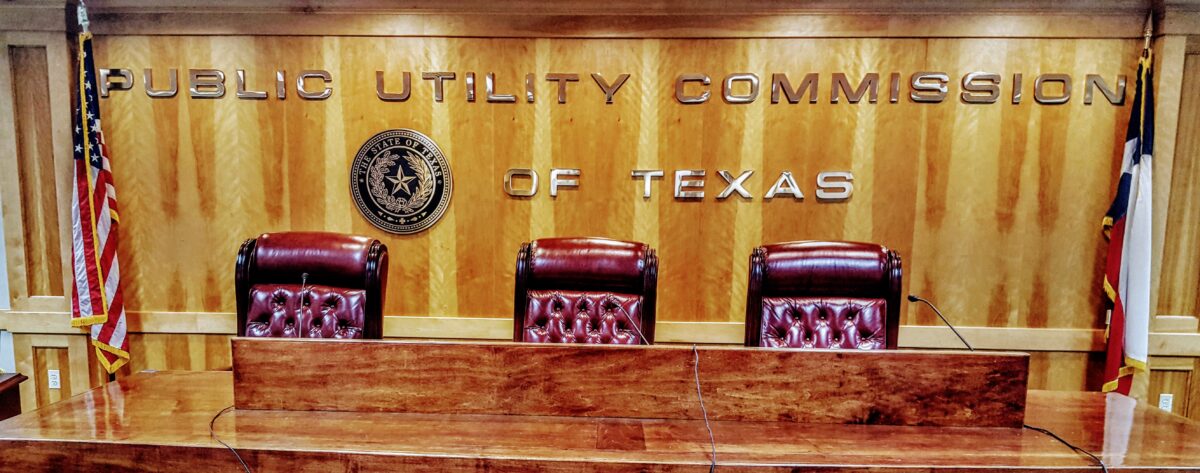
Texas’ Public Utility Commission will hear an appeal of administrative law judges’ decision to deny a hearing on whether electricity transmission service providers have proposed enough adequate routes for a 765-kV transmission line. After the commission’s decision, landowners asked the judges for a pause on this week’s hearing, but the request was denied.
The deliberation for the pause highlighted the bias against landowners in the timeline state lawmakers put in place for these types of projects.
This is in regard to the administrative law hearing this week on the proposed Bell County East to Big Hill extra‑high‑voltage transmission project, named for the substations it would connect. Spanning about 199 miles, this segment covers the area from just north of Austin to south of San Angelo. This line, together with the Big Hill to Sand Lake segment from south of San Angelo to Pecos, forms the central 765‑kV import path—one of three proposed extra‑high‑voltage import paths designed to move large amounts of power across Texas into the energy-rich Permian Basin.
Critics have argued that the Public Utility Commission of Texas (PUCT), the Electric Reliability Council of Texas (ERCOT), and electricity delivery company Oncor transformed a regional reliability directive into a de facto statewide 765‑kV grid plan without state lawmakers’ authorization.
Hours before the June 5 preliminary hearing, Save the Lampasas 25, whose members “own property that may be impacted by one or more of the proposed routes” of the line, and many other intervenors filed a motion seeking a stay of this week’s hearing.
They filed this after the Public Utility Commission’s June 4 decision to hear the group’s appeal of administrative law judges’ May 15 denial of a route adequacy hearing request. The filers argued that utility companies Oncor and Lower Colorado River Authority have not provided enough proposed routes for the transmission line.
PUCT’s record reports that the commission voted to add it to their June 18 agenda, but does not show who voted. When asked who chose to add it to the agenda, PUCT Chief Press Officer Ellie Breed wrote to Texas Scorecard that “PUCT staff does not receive notice of which commissioner or commissioners vote to add an appeal to an open meeting agenda.”
Landowners affected by proposed routes for this section of the transmission line, or attorneys for them, argued for a pause to administrative law judges Cassandra Quinn, Linda Burgess, and Linda Brite during the preliminary hearing.
“We did not find out until the end of May,” Lonnie R. Lehman, representing herself, told the judges. “I strongly think we need to hit pause and get caught up. I cannot afford to hire lawyers.”
“Applicants have the ability to get every penny reimbursed in these cases,” attorney David Brown said. “My clients are spending this money … in a way that they’ll never see again.”
After a time of private discussion, Judge Quinn announced that the judges had denied the stay request.
Referencing counter arguments from Oncor and the Lower Colorado River Authority attorneys, Judge Quinn said, “The commission has ordered [State Office of Administrative Hearings] to provide a proposal for decision to the commission at least 35 days before that deadline. In deciding to take up the appeal in a couple of weeks, the commission is aware of the dates of the hearing and did not indicate there should be any pause in the hearing.”
She referenced the deadline in state law under which PUCT must decide to approve or deny an application for a new transmission facility 180 days after the application is filed. In 2023, state lawmakers shortened the deadline to this, originally one year long, with House Bill 5066.
Attorney Rob Johnson, representing the Meyer E11 intervenors, told judges that it is not “a doomsday deadline.”
“The application is not automatically granted or denied at 180 days nor is the PUC divested of jurisdiction at 180 days,” he said. “The statute itself says that if there is not a decision in 180 days, the remedy is to seek a mandamus order ordering the commissioners to go ahead and decide.”
Before that decision, Judge Quinn had asked Oncor and LCRA’s attorneys if they would be opposed to waiving their right to do that. They refused.
“We’re not in a place where we can agree to waive the 180 deadline in this case,” said LCRA attorney Kirk Rasmussen. Oncor attorney Jaren Taylor concurred.
Connor Ellington, an attorney at the Law Offices of Tony McDonald in Fort Worth, reviewed the timeline in state law and found that it’s “a one-sided clock” for applicants and PUCT.
“Citizens opposing the line get a hard 180 days with no continuances, while the only thing the Commission faces for running past that same deadline is a potential lawsuit to make it decide, and even that can’t dictate how it rules,” he wrote. “In practice, the statute is far more lenient to the state than to the public.”
Before their decision, attorney Ben Mathews, representing the U3 Landowners group, quoted to the judges PUCT Commissioner Thomas Gleeson’s testimony before the Texas Senate Business & Commerce Committee a month ago.
I view the 180 days as a signal from the legislature that they would like us to get this done as quickly as possible, but we are never going to make a decision that is not fully informed just to meet a 180-day deadline.
Section 25.101(b)(3)(D) of Title 16 of the state administrative code states that “the commission will render a decision approving or denying an application … within 180 days of the date of filing a complete application … unless good cause is shown for extending that period.”
Citizens may watch the livestream of the Bell County East to Big Hill hearing this week through the SOAH YouTube channel.
Administrative law judges will make recommendations from these hearings to the five commissioners of the Public Utility Commission—all Gov. Greg Abbott appointees—who will make the final decision.