This article has been updated since publication with statements from State Rep. Brad Buckley, Oncor, and Texans for Responsible Infrastructure Investment.
A new study published by the Texas Public Policy Foundation calls for a pause on a proposed buildout of three extra-high-voltage transmission lines. The reasons given include bureaucrats defying state lawmakers and that the lines help industrial companies meet “net zero” goals while driving up costs for ratepayers.
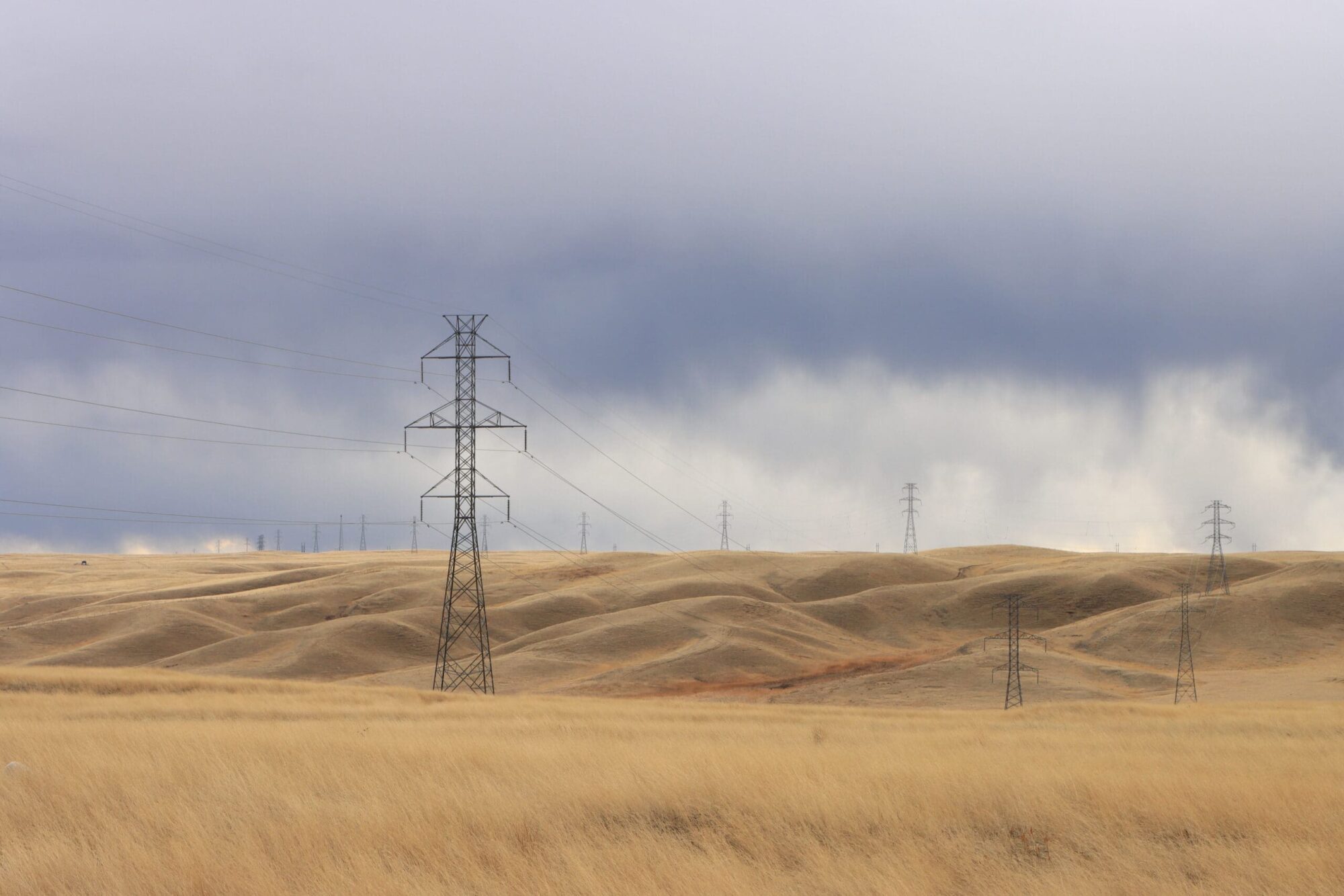
At issue are three proposed 765-kV transmission lines that are supposed to bring power from East Texas to the energy-rich Permian Basin, which critics have equated to “hauling water to the ocean.” These extra‑high‑voltage lines form part of ERCOT’s 765‑kV Strategic Transmission Expansion Plan (STEP), which is part of the Permian Basin Reliability Plan (PBRP).
In the study, TPPF’s Brent Bennett estimates the capital cost for the 765‑kV STEP projects approved through December 2025 at about $33 billion, with lifetime costs approaching $100 billion.
According to Bennett, the Public Utility Commission of Texas (PUCT) and the Energy Reliability Council of Texas (ERCOT) transformed a regional reliability directive into a de facto statewide 765‑kV grid plan without state lawmakers’ authorization.
He noted that neither ERCOT’s studies nor PUCT’s actions truly met a state law requirement to “increase available capacity to meet forecasted load,” because both relied on assumed new generation elsewhere rather than adding substantial reliable generation in West Texas.
ERCOT’s criteria for adding generation in the model restricted both the amount and location of new capacity, especially in West Texas. That, he wrote, forced “ERCOT to rely more on transmission to balance the system.”
This is not the only indicator this project has gone beyond lawmakers’ intentions. In a social media post, State Rep. Brad Buckley (R–Salado) wrote that “what should have been a plan to keep natural gas fueling thermal-generated dispatchable power has been transformed into a ‘green new deal’ giveaway by @oncor to large industrial retail customers. ONCOR bends the knee to big business and sends the bill to rural Texans.”
Buckley’s post was a response to a now-deleted one from Texans for Responsible Infrastructure Investment (TRII), which electricity delivery company Oncor is the founding member of, stating that the state law that authorized the Permian Basin Reliability Plan, House Bill 5066, led to STEP and the proposed 765-kV lines.
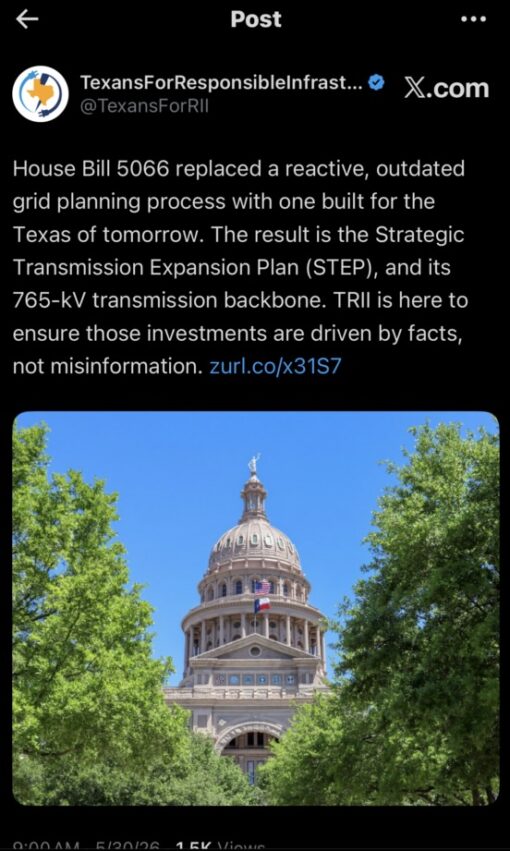
TRII stated to Texas Scorecard that they are “revising our post that you have referenced to better highlight our website materials and took it down while that work is underway.”
PUCT approved the PBRP in April 2025. According to Bennett, a December 2022 S&P Global study is its foundation. As previously reported, the study features environmental, social, and governance (ESG) guidance, which one critic called a “political agenda,” and emissions‑reduction goals as key motivations for electrification.
Chevron, ConocoPhillips, Devon Energy, Diamondback Energy, ExxonMobil, and Pioneer Natural Resources commissioned the S&P study. Bennett tied industrial support for the 765‑kV lines to net‑zero and sustainability targets, arguing that many large customers now prioritize accessing wind and solar through the grid to meet corporate sustainability or “net‑zero” objectives.
“This multi-billion dollar project is misguided and reckless,” Buckley told Texas Scorecard. “This massive transmission line project is being driven by an industry-led study. In effect, ERCOT googled the study that agreed with their preconceived goals. That’s not science–it’s a rigged game. Fake scientists doing the bidding of big business on the backs of rural Texans.”
“The need for the 765-kV STEP is driven by an overbuilding of wind and solar across Texas, particularly in West Texas and South Texas, and the plan does not address the need to increase the supply of reliable generation,” Bennett wrote. “If one examines the body of literature prior to the PBRP, it is hard to avoid concluding that the 765-kV lines in the PBRP are designed as much to integrate more wind and solar across the entire ERCOT grid as they are to import power into West Texas.”
While transmission companies, developers, and industrial consumers stand to benefit, Bennett wrote that residential and small commercial customers will be the ones paying the higher transmission costs. He also found that there will be “irreversible property losses for thousands of landowners across the state.”
Buckley highlighted that issue, writing, “Landowners with generational property and families who have worked hard to own a piece of Texas are now staring down a mammoth project, without adequate legal representation, that threatens their property rights and way of life. Rural Texas is the backbone of this state and they deserve to have a fair and well-thought out process.”
As an alternative to STEP, Bennett suggested that building 4-5 gigawatts of new gas generation in West Texas, in conjunction with shifting some generation across other ERCOT grid regions, “could eliminate the need” for the 765-kV lines.
In a statement, Oncor spokesman Andrew Clark wrote that “Oncor has an obligation to serve all of the retail electric customers in our service territory and agrees that the Permian Basin urgently needs substantial new transmission investment – including the 765 kV transmission lines to import more power to the region – in light of insufficient amounts of dispatchable generation being planned for the region in the foreseeable future.” He provided links to Texas for Responsible Infrastructure Investment pages.
Clark also stated that Oncor is the founding member of the Texas Electric Delivery Alliance, which also “started” TRII.
TRII stated that “Texas Energy Delivery Alliance (TEDA) and its founding member, Dallas-based Oncor Electric Delivery, started TRII to act on the pressing need for a substantial expansion and a more reliable grid in Texas. We will soon announce new members from a wide cross-section of Texas industries.”
Neither PUCT nor ERCOT responded to a request for comment before publication.
If you are a citizen with information regarding bureaucratic overreach, please email scorecardtips@protonmail.com.