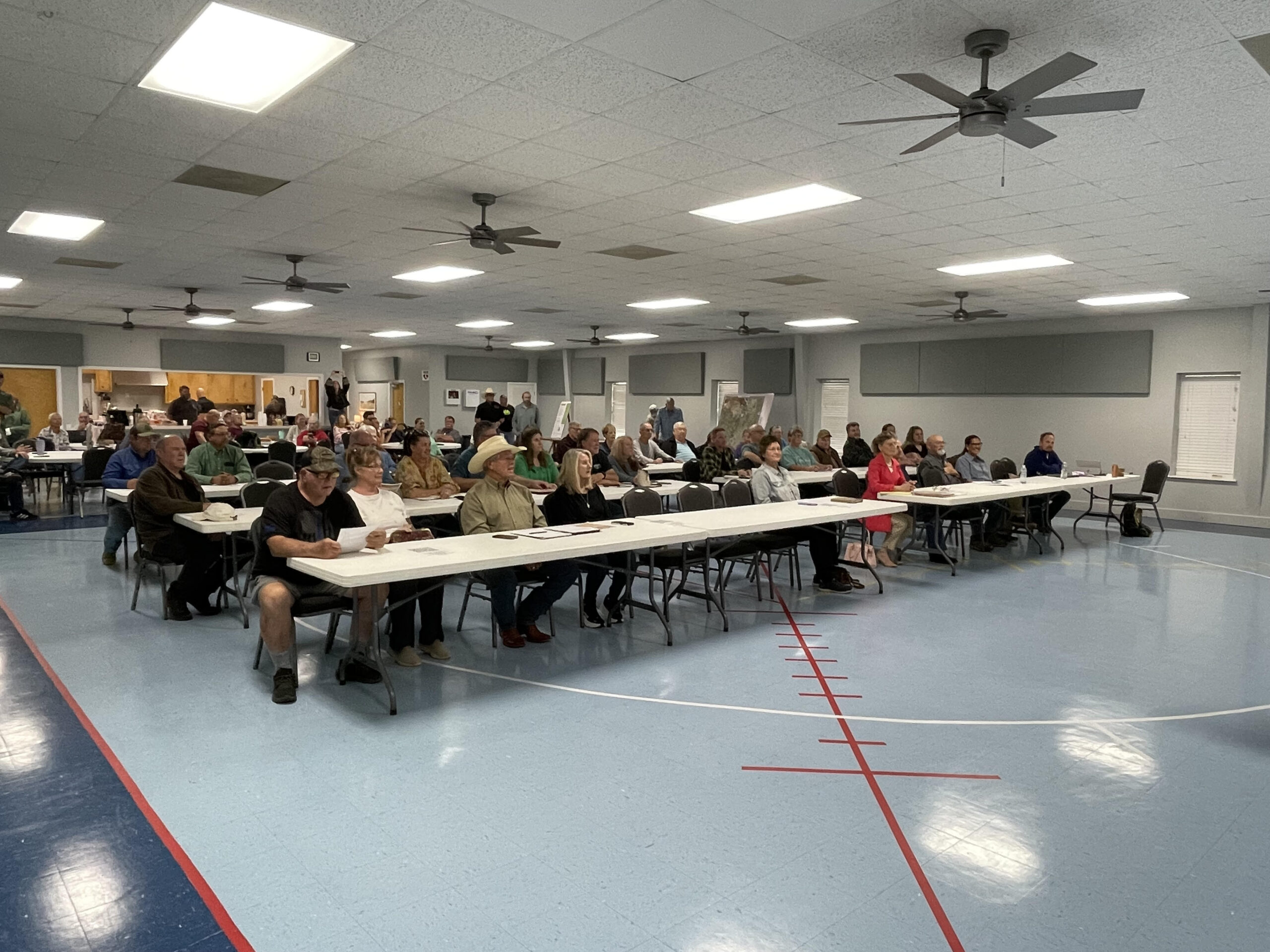
Texans opposing the construction of extra-high-voltage transmission lines through or near their property organized Thursday evening to learn about the next step to complete by May 13.
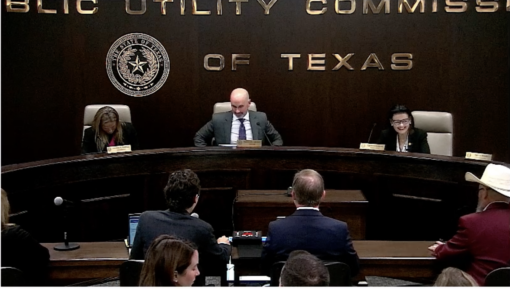
They came to specifically respond to the proposed Bell County East-Big Hill line, one of three 765-kV lines. These are part of the Permian Basin Reliability Plan, which lawmakers originally authorized as a limited fix for the energy-rich Permian Basin. Critics argue that the Public Utility Commission of Texas (PUCT), ERCOT, and Oncor have expanded it into a much broader transmission buildout with minimal public input.
Brent Bennett of the Texas Public Policy Foundation estimates the project will cost $90–100 billion over its lifetime. Beyond higher costs, critics warn this expansion sets a precedent for bureaucrats to pursue other large-scale projects with little accountability.
Roughly 50 people gathered at Andice Baptist Church in Florence on Thursday evening and shouted, “Governor Abbott, stop this line!”
Robert Noland and his daughter Christa were among the attendees. They’re concerned about how the proposed line will affect rare grasses and livestock on their family’s roughly 1,000 acres of land.
Their family has had strong ties to this land for almost 200 years. “My mother was born on the parcel that this line is proposed to be passing through … and she died on it,” Christa Noland said, adding that family members are buried on the land.
They’re not alone. Daniel and Kelly Berg, landowners with four kids and eight grandkids, are concerned about the proposed transmission line route that would run “right down the west side” of their own property.
“The pond won’t be there anymore when this comes through,” Daniel Berg said, noting that their livestock drink from it. Kelly Berg added that “all of our kids were coming back to build on our land, and now none of them can, because of this.” She said three out of her four kids are serving in the U.S. Military, and have expressed that they want the land to stay in the family.
Both Nolands and the Bergs found the packets that notified them of the proposed line lacked clarity. They had to figure out for themselves what it meant.
“The maps were confusing … It was utterly overwhelming, and many people didn’t act just simply because they didn’t even understand what they were being mailed,” Christa Noland said. Her family was notified last summer. The Bergs said they didn’t receive notification until early April of this year. “It was very ambiguous on how you could even figure out where the lines were,” Daniel Berg said.
Jay Bradley, who is defending his 100-year-old family ranch, told attendees that the process is set up to incentivize people not to fight. But he encouraged them to stay in it and eat this elephant “one bite at a time.”
The first stage in fighting back was to file as an intervenor for the upcoming administrative law hearing. That process was explained in an earlier April town hall. This night was about teaching intervenors about what needs to be filed by May 13.
“The most critical part [is] to stay as an intervenor, and it’s the most difficult,” Bradley said. He noted that if someone doesn’t submit by May 13, there will be a motion to have that person removed as an intervenor.
Bradley said intervenors can choose between filing a statement of position or direct testimony, but it’s unconfirmed whether both can be filed. He’s chosen to file direct testimony himself and have family members file statements of position. A key difference between the two, he said, was that direct testimony must comply with the Texas Rules of Evidence and requires exhibits.
Hiring an attorney to navigate these options is tough. The Bergs, for example, are retired and said they can’t afford one. Then there’s the question if any are still available. As previously reported, a local activist said all the attorneys who specialize in this field have already been hired.
Texans are having to help each other. Erik Gulbranson, one of the town hall’s organizers, pointed to StopThisLine.com as a resource for learning how to create a statement of position or direct testimony. But the user should make sure to personalize it to his or her specific situation.
Bradley encouraged using AI, such as ChatGPT, for fine tuning. He recommended instructing it to review your direct testimony and ensure it follows Texas evidentiary rules, and remove all speculative, unqualified, or emotionally charged language. He also said you can ask AI to create for you a “prayer for relief,” consistent with Texas evidentiary rules, at the end.
He warned attendees not to make the mistake of only uploading the statement of position or direct testimony to the Public Utilities Commission of Texas interchange, but to also upload it the same day to the State Office of Administrative Hearings (SOAH), through Kiteworks, so the administrative law judge can review it.
Christa Noland knows some who feel overwhelmed by this process. “I had many family members who chose not to be intervenors … just because it was so overwhelming and defeating,” she said. “I thought the greatest challenge was going to be getting kids back from the city to love this land and continue to be a steward and take care of it. I never pictured this could be what changed it forever.”
Robert Noland, who has been an electrical engineer since he graduated in 1967, isn’t even sure why constructing these transmission lines is necessary. “The people who are pushing this are transmission line people. The problem is generation of electricity, not transmission lines,” he said. “It reminds me of the guy that only has a hammer. Everything looks like a nail.”
The Bergs want Abbott to call a special session and for Oncor to be made to do its due diligence.
Christa Noland wants him to stop the line altogether. “Landowners need the right and the time to effectively deal with this threat to their land, the fact that the attorneys were scooped up very early, and the common person cannot afford to hire an attorney to fight this is unacceptable,” she said. “The governor needs to ensure the rural voters of the state which supported him are taken care of.”
Gov. Abbott appointed the PUCT commissioners and the Chief Administrative Law Judge at SOAH.
Abbott’s press secretary Andrew Mahaleris stated that, “As our state grows, we must invest in generation and transmission infrastructure to ensure access to reliable, affordable power for Texans. The needs and concerns of Texans are the Governor’s top priority, and the Governor encourages the public to submit feedback to the PUC. Governor Abbott will continue working with the legislature to build a grid with enough energy to power Texas for the next century.”
The administrative law hearing for the Bell County East Switch to Big Hill line is scheduled for the week of June 8. As previously reported, once the hearings are completed, the PUCT commissioners will be responsible for making the final decision.
If you are a citizen with information regarding bureaucratic overreach, please email scorecardtips@protonmail.com.