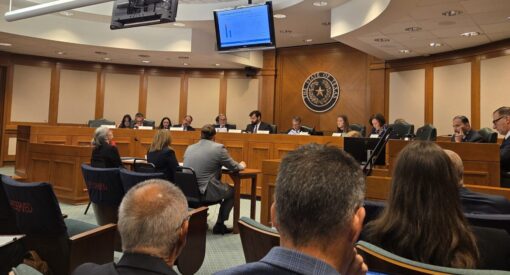
Data center construction and resource use in Texas dominated the discussion during a Tuesday House committee hearing, which drew testimony from government agencies and private corporations.
As a slew of data centers come to Texas, the question of whether the state can support such expansion—particularly due to the data centers’ consumption of water and energy—has been raised by citizens and officials alike.
Data center builders Diode Ventures and Calypso LLC were invited to give testimony but declined, despite facing criticism for failing to engage with their neighbors about resource-use concerns.
“They declined to give testimony because they did not want to answer hard questions,” said State Rep. Cody Harris (R–Palestine), chair of the House Natural Resources Committee.
In addressing water concerns, lawmakers repeatedly complained about the lack of information in regards to how much water data centers are actually consuming.
Temple McKinnon, the water supply planning director at the Texas Water Development Board, revealed that although the board requires large industrial facilities to complete a water usage survey, only 17 percent of data centers responded. Failure to complete the survey only results in a fine.
The Public Utility Commission also sent an optional survey to data centers to study water usage at industrial properties, but only eight percent of queried data centers responded.
Committee members criticized the PUC survey for using inadequate channels to reach data centers, including physical mail.
“We’re making huge decisions on bad data,” said State Rep. Brad Buckley (R–Salado).
Robert Sadler of the Texas Commission on Environmental Quality noted that the commission monitors water discharge from closed-loop systems for additional contaminants not originally listed in the initial discharge contract.
Dan Diorio, Vice President of State Policy at the Data Center Coalition, said community transparency is critical to the continued construction of data center infrastructure and that the DCC is ready to engage with citizens.
However, State Rep. Mary Gonzalez (D–San Elizario) pointed out that Meta is a DCC member and has been unresponsive to requests for information or meetings from local officials or citizens.
“County officials are an afterthought,” said State Rep. Jeff Barry (R–Pearland).
Of the 28 companies that responded to both the PUC and TWDB surveys, 10 were DCC members.
Beau Schilz, representing Amazon Web Services, testified that it aims to be a good steward and a responsible consumer by primarily using recycled water and responding to the TWDB and PUC surveys.
He also noted that 0.9 liters of water are consumed to produce a single kilowatt-hour on the ERCOT grid. Without water cooling, data centers would consume 14 percent more energy, leading to increased water use at energy production facilities.
Ben Townsend, representing Google, reiterated the company’s five commitments to communities regarding water usage and noted the company completed all requested surveys.
Misty Allen of Vantage Data Centers said the company is committed to replacing more water than its data centers use in communities. Allen said Vantage’s data centers rely strictly on air cooling and closed-loop water cooling systems. She also said it uses significantly less water in energy production by utilizing natural gas engines instead of traditional turbines.
Data center construction is also a national security concern, according to State Armor CEO Michael Lucci. Lucci explained that certain entities with ties to the Chinese Communist Party are furthering division in the data center debate as China seeks to dominate the AI space.
Lucci said AI is a powerful tool, citing national security reports that Anthropic’s new model could crack government encryption in hours rather than weeks. He also said that, while there is an export restriction on those models, other common resources, such as ChatGPT, have been used in pro-China disinformation campaigns.
Additionally, Lucci stated that Chinese AI models such as Deepseek produced code with up to 130 percent more security vulnerabilities and backdoors when they believed the user was working for the U.S. government or mentioned anti-CCP rhetoric, such as the Tiananmen Square massacre.
Lucci highlighted that both the U.S. and China have determined that domination of AI technology is key to winning the information wars of the 21st century.
While the House committee appeared receptive overall to data center expansion, members highlighted the need for transparency with local communities and responsible growth.
Citizens from all around the state came to testify in front of the committee, many of whom called for moratoriums on data center construction until the effects the facilities have on the consumption of water and the environment are fully understood.
Shawn Nanny, Commissioner of Precinct 4 in Tom Green County, stated that Beacon AI informed him of its center’s construction in his precinct, but he was “absolutely helpless” to the people he was supposed to protect.
County officials responding to a survey put out by Texas Alliance of Groundwater Districts cited concerns of little to no authority over data center construction and the draining of groundwater from local aquifers.
Ultimately, most local pushback demanded that the effects of data centers be studied before more are built and that corporations effectively communicate with the community.
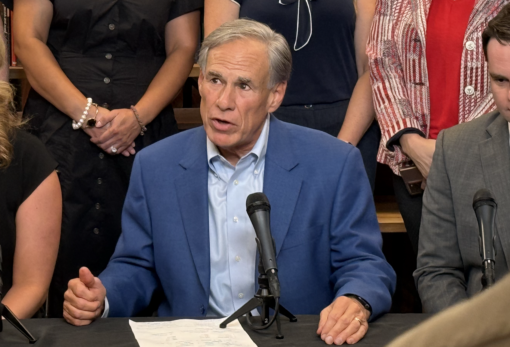
Gov. Greg Abbott recently directed PUC to ensure data centers are paying for grid connections, rather than passing the burden onto ratepayers.
The Republican Party of Texas has made securing Texas’ natural resources a priority ahead of the next legislative session, which comes as recent polling indicates low support for data centers from Texans.