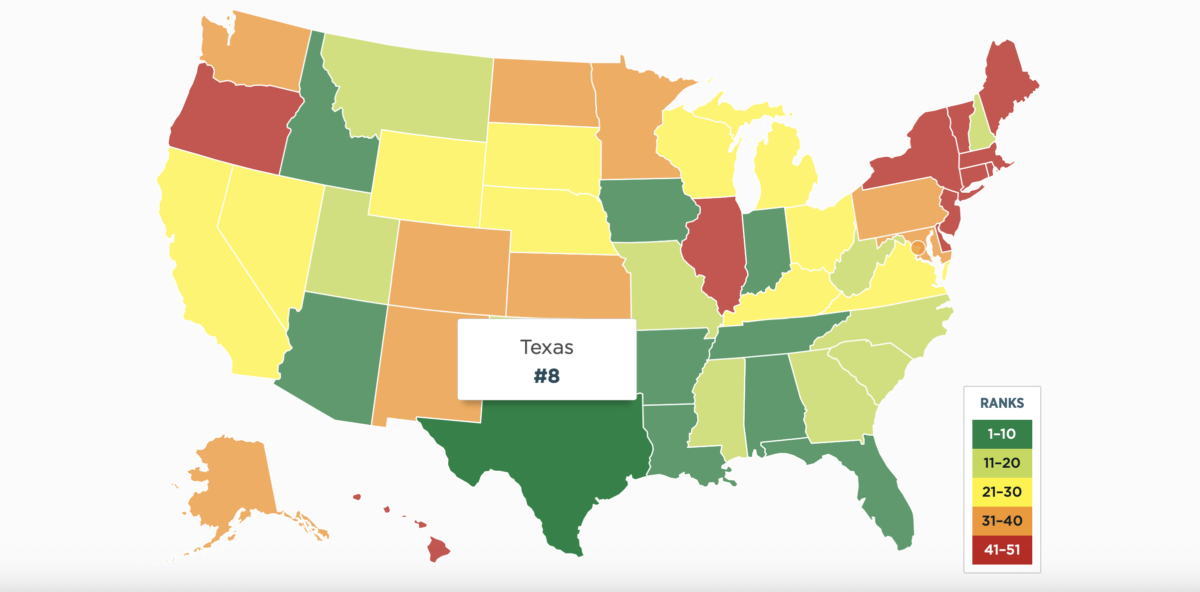
Texas ranked eighth overall in The Heritage Foundation’s 2026 Education Freedom Report Card, down from seventh last year. The state places near the top nationally for academic transparency but received lower rankings for education choice, civic education, and student outcomes relative to spending.
The report grades states’ education freedom by five categories: education choice, transparency, teacher freedom, return on investment, and civic education.
Texas placed second for academic transparency, which The Heritage Foundation attributed to legislation protecting parental rights, including:
- Education Code Chapter 26, which provides parents the right to access teaching materials.
- Family Code 151.001, which protects families from rules or policies that interfere with parents’ decisions about education.
- Senate Bill 12, dubbed the “Parental Bill of Rights,” which provides additional transparency requirements.
Texas scored twelfth in education choice for the second year in a row.
Texas currently has robust homeschooling protections and, as of this school year, provides education savings accounts (ESAs) to a limited number of students. The Heritage Foundation suggested Texas further improve its ranking by easing the requirements for charter school operation and other choices beyond assigned public schools.
Texas’ civic education ranking dropped 11 spots from 2025, landing at 20th. While Texas has classical education schools and requires a half-year civics course, it does not use the Classic Learning Test (CLT) that gauges civil education topics.
The Heritage Foundation noted Texas should include more college-entrance exams such as the CLT to improve its ranking. Texas has already begun making strides towards authorizing the CLT.
Texas ranked fourth in teacher freedom in light of its alternative certification routes. The Heritage Foundation noted Texas could improve its standing through full reciprocity of teacher licensure or eliminating teacher certification requirements and ending the Praxis test.
The state placed eleventh on return on investment. According to the report, Texas needs to improve its NAEP fourth-grade and eighth-grade math and reading scores, discontinue non-teaching staff growth, and address its unfunded teacher pension liabilities.
Florida ranked first overall, with the governor’s office citing its expansion of school choice and support of parental rights as key to its high ranking.
“In Florida, we are committed to ensuring parents have the power to make the education decisions that are best for their child,” said Gov. Ron DeSantis. “Florida offers a robust array of educational choices, which has solidified our state as a national leader in education freedom, parental power, and overall K-12 education.”
Texas’ drastic ranking change in 2025 followed a similar course of increased educational choices.
The 2025 Heritage Foundation Education Freedom report noted that Texas improved by eight spots due to the new ESA program, called Texas Education Freedom Accounts (TEFA).
TEFA is currently seeking a doubled budget of $2 billion for the next biennium as requested by comptroller Don Huffines, who cited a long waiting list as reason for the request.
Gov. Greg Abbott has expressed his desire to keep improving Texas’ educational ranking.
“School choice funds being distributed to Texas families paves the way for Texas to become the No. 1 state for education,” said Abbott. “These accounts will give parents the freedom to choose the best learning environment for their children, regardless of their income or location.”