Texas teacher misconduct reports tripled this year, and the number of school employees added to the state’s Do Not Hire Registry hit an all-time high. The increases are due in part to bipartisan legislation passed last year to protect students from sexual abuse by educators.
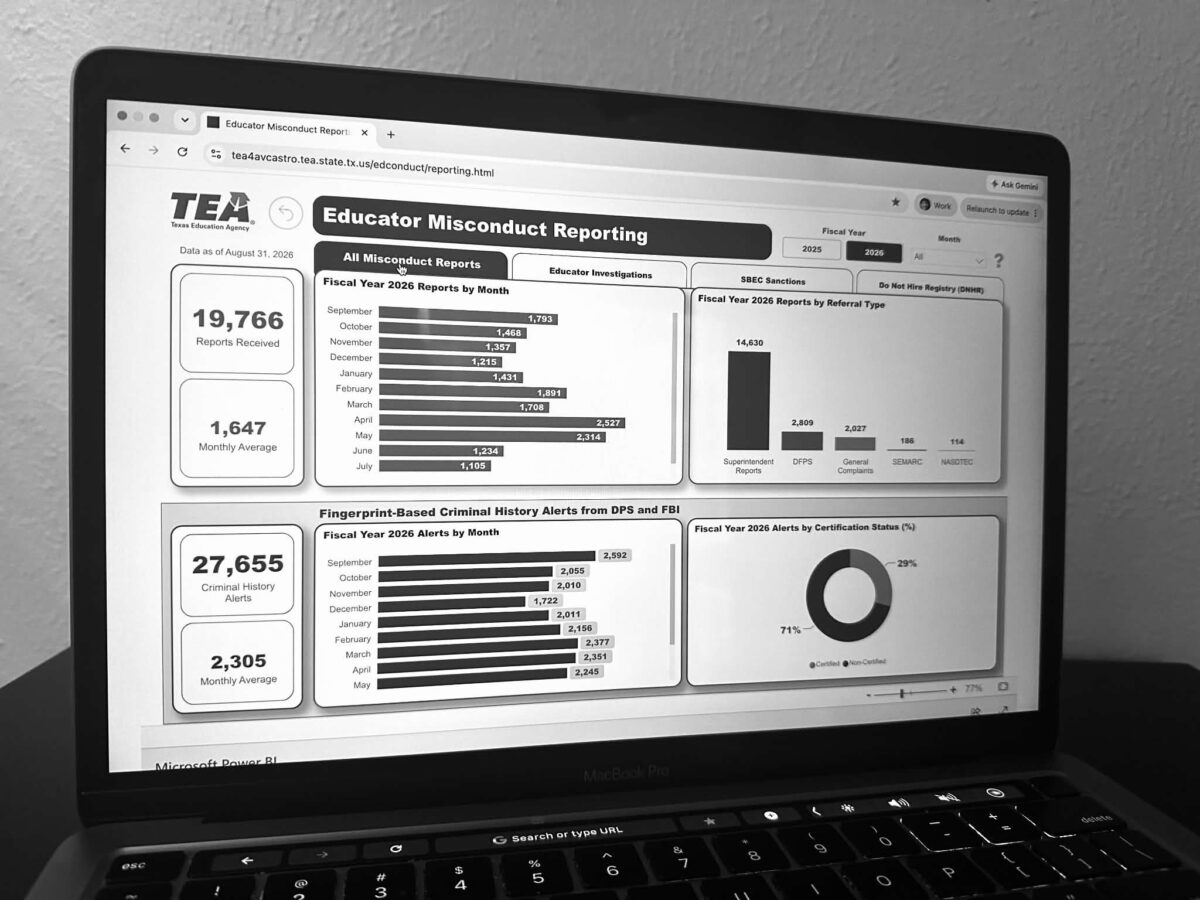
According to the Texas Education Agency’s Educator Misconduct Reporting Dashboard, 19,766 complaints were submitted in the 2026 fiscal year ending August 31, an average of 1,647 reports a month.
This year’s total is three times the 6,456 educator misconduct reports submitted in Fiscal Year 2025.
Most FY 2026 misconduct reports came from school superintendents, with 14 percent of referrals coming from the Department of Family and Protective Services and 10 percent from general complaints.
In FY 2025, DFPS reports plus general complaints outnumbered misconduct reports from superintendents.
Placements on the state’s Do Not Hire Registry of people ineligible to work in public schools also hit all-time highs of 1,070 for the year and 199 for the month of August 2026.
This year’s DNHR placements, the highest since the registry was established in 2020, included 624 permanent placements plus 455 temporary placements, a new category this year.
In FY 2025, 589 certified and non-certified school employees were permanently placed on the registry.
More Dashboard Data
The educator misconduct dashboard also shows the TEA received 27,655 fingerprint-based criminal history alerts in FY 2026, up from 23,369 alerts received last year. The alerts are generated by school employees’ interactions with the Texas Department of Public Safety or Federal Bureau of Investigation.
Yet despite increases in other categories, the number of certification sanctions imposed by the State Board for Educator Certification fell slightly, from 1,173 in FY 2025 to 1,114 in FY 2026.
SBEC is the governor-appointed body tasked with enforcing professional standards for Texas school teachers and administrators.
On average, 16 educator misconduct reports were submitted for each of the state’s 1,200 public school districts, while less than one certified educator per district was sanctioned by SBEC.
While the dashboard data does not reveal the districts or types of alleged misconduct tied to the complaints, it does track the number of open TEA investigations for each type of misconduct allegation.
Educator Investigations
As of August 31, the TEA’s Educator Investigations Division was reviewing 13,688 misconduct cases and opening an average of 1,141 new investigations a month, compared to 5,045 open investigations in August 2025.
In-school violence accounts for more than half of all educator misconduct investigations, with 7,288 cases currently under review. Another 600 cases involve educators accused of non-school related violence.
Sexual misconduct allegations are the focus of 3,040 open investigations: 2,094 involving educators’ “improper” sexual conduct with students, 692 cases of school-related sexual abuse, and 254 cases of non-school related abuse of children.
Hundreds of Texas school employees have been publicly accused of sex crimes involving students and other children in just the past few years. Texas Scorecard maintains a map of known educator sexual misconduct arrests.
TEA is also investigating 272 cases of school administrators failing to report misconduct allegations.
The remaining open educator investigations involve allegations related to drugs and alcohol, theft, fraud, “official misconduct,” and “miscellaneous” offenses.
While all submitted complaints receive a preliminary review, not all result in a formal investigation, and not all investigations result in an official sanction by the TEA or SBEC.
SBEC publishes quarterly disciplinary action reports listing educators whose professional credentials have been sanctioned.
Those reports now show the school district where the educator worked at the time of the misconduct, the type of allegation, the length of the imposed sanction, and whether the educator was added to the DNHR.
TEA’s Inspector General for Educator Misconduct Levi Fuller pushed for this improvement. Since stepping into the newly created position in February, Fuller has pursued opportunities to increase transparency and “get rid of bad actors in schools who are hurting our kids.”
Educator Misconduct Legislation
The increases in misconduct reports and Do Not Hire Registry placements are largely results of bipartisan legislation passed in 2025 as Senate Bill 571.
The measure aims to protect students from sexual abuse by getting predatory teachers out of classrooms and preventing schools from “passing the trash”—letting educators accused of sexual misconduct move to other campuses or districts.
SB 571 strengthened reporting requirements, applied them to all school employees and contractors, and broadened reportable misconduct to specifically include boundary violations and inappropriate communications with students.
The new law also requires TEA to temporarily suspend certification and/or assign Do Not Hire status when a school employee is arrested for certain felonies until their criminal prosecutions are resolved.
The Educator Misconduct Dashboard itself, designed as a transparency tool for parents and taxpayers, was also mandated by SB 571.
State Sen. Paul Bettencourt (R–Houston), who authored SB 571, said Texas parents “should not have to wonder whether someone with a history of serious sexual misconduct is being quietly moved into another classroom, cafeteria, bus route, or campus job anywhere in this state.”
All these reporting and transparency tools are now consolidated online as part of the TEA’s Student Protection Resource Center.