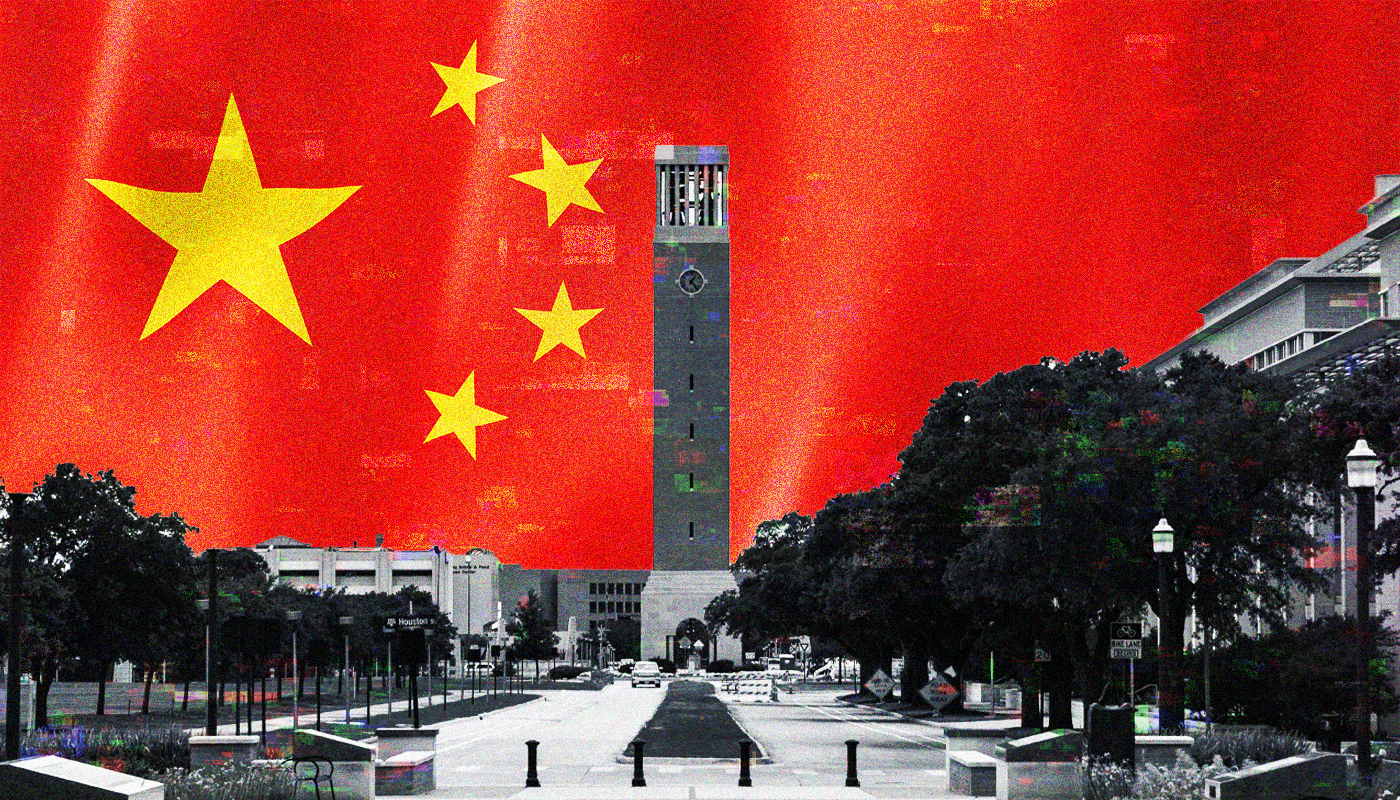
Four Texas universities allowed more than 4,000 students from China, Russia, and Iran to enroll for the Fall 2025 semester. These are countries the U.S. Office of the Director of National Intelligence identified as national security threats in its 2025 Annual Threat Assessment.
Additionally, UT-Austin, Texas A&M, Texas Tech, and University of Houston have U.S. defense contracts.
The University of Texas at Austin accepted 1,377 students from China, 70 from Iran, and 31 from Russia. Texas A&M University accepted 917 from China, 179 from Iran, and 18 from Russia.
The University of Houston accepted 1,050 from China, 119 from Iran, and 19 from Russia, while Texas Tech accepted 146 from China, 119 from Iran, and 12 from Russia.
Texas Scorecard acquired this information through public information requests.
As of December 3, Texas State University reported it accepted 25 students from Iran, but its database does not indicate the time frame. A spokesperson for the university stated its “admission policies fully comply with all applicable laws and legal requirements. The admission of all students aligns with TXST policy and meets all legal standards.”
In July 2024, Texas State joined a project to develop semiconductor microsystems for the U.S. Department of War.
Universities are part of America’s supply chain of critical technological development. Research security specialist Allen Phelps warned that foreign influence groups linked to China, Russia, and Iran target these institutions to steal technology to supplant America as a world power.
In a December 3 report, Jennifer Richmond of the Foundation for Defense of Democracies called students from China attending American universities “China’s influence operation in American higher education.”
An example she gave was the Chinese Student and Scholar Associations (CSSA), which had 150 chapters on campuses across America in 2024. Seth Kaplan and John Metz reported in 2022 that these “function as the eyes and ears of the Chinese government on campuses, creating immense pressure for Chinese students not only to conform to their government’s standards but to inform on one another to demonstrate their own loyalty.”
In 2023, specialists warned that China’s 2017 national intelligence law compels citizens to engage in espionage when abroad. Regarding accepting study abroad students from China, national security analyst Kyle Bass advocated shutting down Chinese Communist Party‑linked educational exchanges and programs due to the threat of espionage in a December 2023 interview.
“The only way you effectuate change is you shut it down, and you make the people upset with their leadership or what they’re doing,” he said.
Richmond warned that “U.S. education remains far from immune to Chinese influence,” and stated that “the Chinese student population on American campuses is expected to double.”
UT-Austin, Texas Tech, Texas A&M, and University of Houston did not respond to a request for comment. Each is a component of a different university system governed by boards of regents appointed by the governor and confirmed by the Texas Senate.
If you are a student, parent, faculty member, or concerned citizen who would like to partner with us to promote transparency in taxpayer-subsidized higher education, please email scorecardtips@protonmail.com.