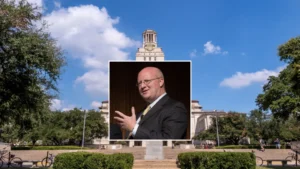
Texas’ taxpayer-subsidized university systems began a process of transformation in 2025, following citizen-driven legislative reforms. However, long-festering problems in academia continue to surface.
Ultimately, this iterative metamorphosis led to the University of Texas at Austin placing second in rankings of the top universities across the United States published by City Journal in October. The University of Florida placed first.
UT-Austin earned high marks for quality of education, commitment to meritocracy, resisting politicization, and was found to have been “largely unburdened” by its previous DEI regime. State lawmakers abolished DEI bureaucracies in 2023.
Texas A&M, along with private universities Baylor and Rice, also placed within the top 100.
City Journal’s rankings commemorated a year of changes across higher education in the Lone Star State.
Senate Bill 37
State lawmakers, at the public’s behest, became the primary drivers of this newfound political will.
During the 2025 regular legislative session, Texas lawmakers overhauled several aspects of university governance under Senate Bill 37.
Most importantly, SB 37 abolished the practice of “shared governance.” Under that system, university presidents delegated formal decision-making authority to faculty representatives elected by their colleagues.
Under the new law, faculty bodies may only serve in an advisory capacity. Campus presidents, who report to boards of regents, maintain all formal decision-making authority.
Boards of regents are accountable to Texans through the governor, who appoints them, and the Texas Senate, which confirms these appointments.
The new law also requires boards of regents to conduct a review of all general education curricula every five years to ensure they “are foundational and fundamental to a sound postsecondary education, are necessary to prepare students for civic and professional life; equip students for participation in the workforce and in the betterment of society; and ensure a breadth of knowledge in compliance with applicable accreditation standards.”
Additionally, the new law gives boards of regents final say over hiring for senior leadership positions.
SB 37 took effect in phases, with the section abolishing faculty senates and councils beginning September 1. Provisions expanding board jurisdiction will apply starting January 1, 2026.
Longhorns Lead
Texas’ flagship institution embraced reform with zeal.
In May, regents announced a $100 million commitment to the School of Civic Leadership, designed to promote classical education.
Regents tapped James E. Davis, who had earlier served in the Texas attorney general’s office under Greg Abbott and Ken Paxton, to lead these efforts. Regents named Davis interim president in February and gave him the job permanently in August.
Davis named William Inboden, a scholar of the life of Ronald Reagan, as provost, which is the chief academic officer of a university.
During his inaugural address, Davis spoke of the need to address “a general loss of public trust in higher education” and the need to balance academic freedom with academic responsibility. To that end, the university released a statement on academic responsibility in early November. Notably, professor Mark Regnerus, who had previously been subjected to a far-left cancellation campaign, took part on its drafting committee.
While Davis has overseen the removal of personnel who promoted woke policies, he has also faced criticism for including Richard Reddick, a vice provost with an extensive history of promoting DEI, on a core curriculum advisory committee.
Red Raiders, Bobcats Make Significant Strides
Texas’ higher education reforms extended far beyond the forty acres.
In Lubbock, Texas Tech regents tapped former State Sen. Brandon Creighton, the primary author of SB 37, as system chancellor.
He took office shortly after his predecessor had faced criticism from left-wing media outlets for affirming basic biological reality. As chancellor, Creighton is now in charge of implementing the reforms he wrote.
He issued a policy memo shortly after taking office in December that prohibited the advocacy of “race or sex based prejudice.”
In other Red Raider news, regent Chairman Cody Campbell became a significant player in national discussions over the future of Name, Image, and Likeness compensation in athletics.
In San Marcos, Texas State University was at the center of several national discussions.
In September, Texas State fired professor Tom Alter after he advocated for the overthrow of the U.S. government. Alter’s termination is the subject of ongoing litigation.
In November, Texas State issued guidelines on “Value Neutral Instruction” to steer discussions of a course audit announced in October. The ultimate objective is to encourage instruction and open discussion rather than indoctrination.
The 16-page document examines how educators can present material without imposing personal values and allow students to critically engage with content based on evidence and reasoned discourse. It emphasizes the importance of anchoring curriculum goals and objectives to broader educational aims without endorsing ideological worldviews.
“Texas State is the first [university] to apply [institutional neutrality] statements to actual curriculum and instruction,” scholar Scott Yenor told Texas Scorecard.
Aggies Lag
College Station saw a tumultuous 2025.
In September, former TAMU President Mark Welsh stepped down following a public uproar sparked by his handling of a children’s literature course that included instruction on introducing LGBT and gender identity materials to children as young as three.
The situation came under public scrutiny after State Rep. Brian Harrison (R–Midlothian) released a recording of a student objecting to the curriculum and subsequent allegations that the student was kicked out of class for expressing concerns about transgender indoctrination. Initially, Welsh defended the professor involved, but he later reversed course, firing the instructor and removing the department head and dean from their posts.
Welsh had a history of long-standing support for Diversity, Equity, and Inclusion (DEI) initiatives, both during his tenure as president and beforehand, when he led the Bush School of Government and Public Service. Under his leadership, DEI programs were expanded, and mandatory training sessions were introduced, amplifying scrutiny and fueling calls for change even before the latest classroom scandal.
Gov. Greg Abbott had threatened to fire him in January for sponsoring a DEI conference, and only with his job on the line did Welsh backtrack and withdraw A&M’s support.
Despite his resignation, Welsh received a $3.5 million settlement from Texas A&M.
Following Welsh’s departure, TAMU regents named former State Senator Tommy Williams interim president. Regents are expected to announce a permanent replacement in 2026.
In November, regents also revised their policy to require campus presidential approval for courses that “advocate” gender or race ideology or topics related to sexual orientation or gender identity. Nevertheless, this policy change faces likely litigation due to its “unacceptably vague” terminology.
In December, a Texas Scorecard investigation uncovered a Texas A&M research project that seeks to “mitigate” the Supreme Court’s 2022 pro-life Dobbs decision, raising questions about why the university is funding research intended to undermine state laws.
Other Texas Universities
Baylor University received a grant in July from the far-left Eula May and John Baugh Foundation to “foster inclusion and belonging in the church.” A university announcement stated that the $643,401 grant was designed to “help us better understand the disenfranchisement and exclusion of LGBTQIA+ individuals and women within congregations to nurture institutional courage and foster change.”
Baylor University returned the grant following backlash.
The University of North Texas is the subject of an ongoing investigation by the attorney general following the ideological bullying of a student who objected to celebrations of Charlie Kirk’s murder.
The University of Houston was recently the subject of an audit that found “insufficient” oversight in its foundation’s financial management. It is also facing scrutiny over its research security practices, as Chinese attempts to secure cutting edge research from American universities is being heavily monitored.