AUSTIN—Regents of the University of Texas System approved a resolution to guide how their component institutions will teach disputed subjects at Thursday’s quarterly meeting.
The resolution, formally titled “University of Texas System Expectations of Academic Integrity and Standards for Teaching Controversial Topics,” drew unanimous support.
The resolution reaffirms academic freedom for faculty members and counterbalances it with several new standards for academic integrity, including:
- Foster classroom cultures of trust in which all students feel free to voice their questions and beliefs, especially when those perspectives might conflict with those of the instructor or other students;
- Fairly present differing views and scholarly evidence on reasonably disputed matters and unsettled issues;
- Equip students to assess competing theories and claims, and to use reason and appropriate evidence to form their own conclusions about course material;
- Eschew topics and controversies that are not germane to the course.
The resolution further states that instructors “must not attempt to coerce, indoctrinate, harass, or belittle students, especially in addressing controversial subjects and areas where people of good faith can hold differing convictions.” It also includes safeguards to protect student speech.
The resolution creates standards to ensure balance and germaneness in course materials and general education requirements.
To that end, “U.T. institutions must take steps to build appropriate breadth and balance in the faculty body and the curriculum so that students have access to a variety of viewpoints and perspectives and are not, as a practical matter, only exposed to a single viewpoint or perspective.”
A series of speakers addressed the board to oppose the new policy.
State Rep. Donna Howard (D–Austin) called the resolution “micromanagement and completely discriminatory.” She also criticized the proposal for its vagueness.
Howard cited the era of legendary Longhorn regent Frank Erwin as a parallel to the current moment. Erwin was a controversial, though generally popular, figure who publicly feuded with campus protestors. Howard stated that she was once one of those protestors.
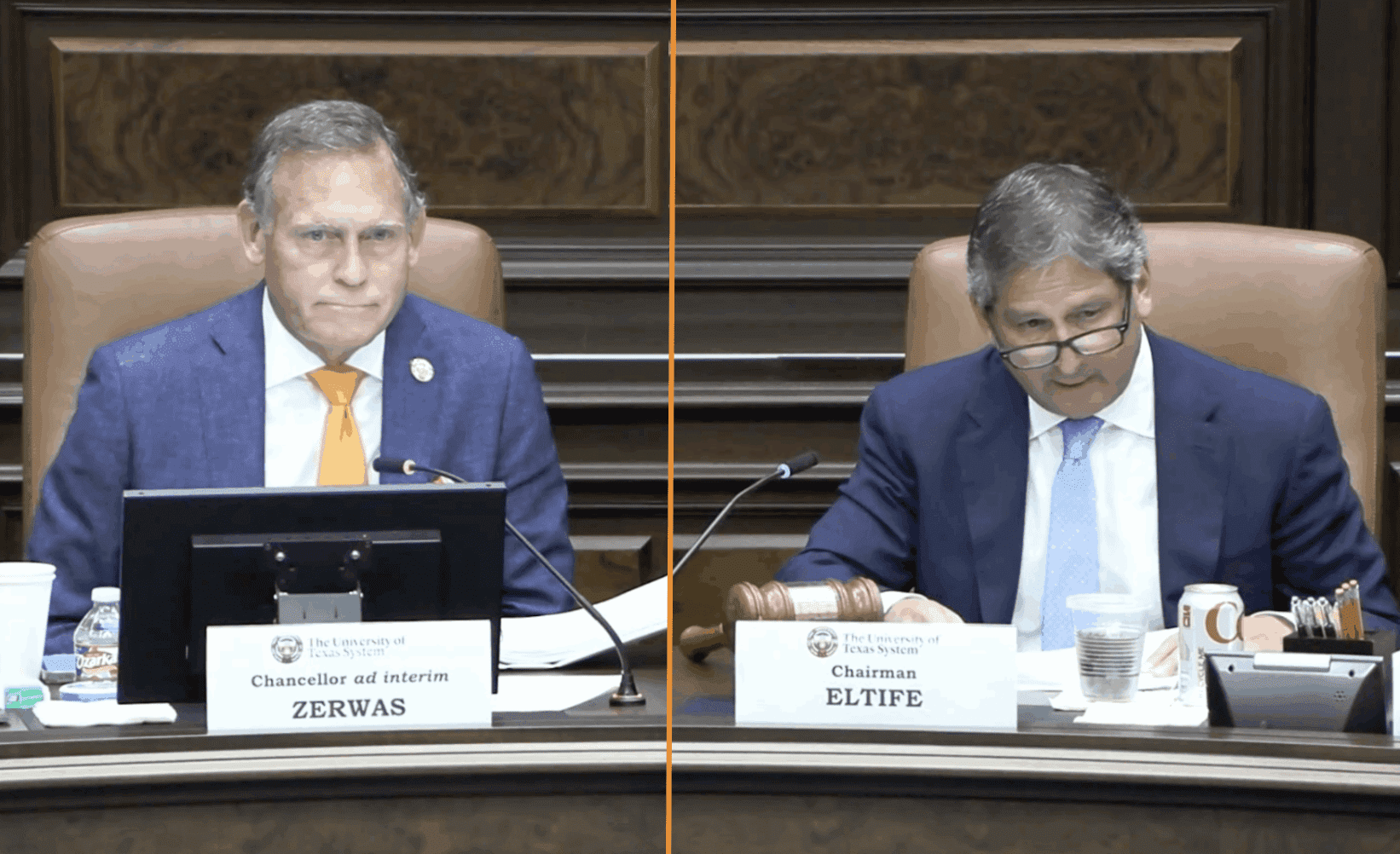
Regent Chairman Kevin Eltife thanked Howard for providing legislative feedback.
Another speaker suggested that the new policy could open the door to teaching Biblical creation in science classes.
Regents also approved the appointment of Dr. Melissa Taylor to a vice provost position at UT-Austin as part of the consent agenda. Taylor previously held a DEI-themed position and advocated for so-called “radical joy,” which author James Lindsay has described as removing sexual restraint to promote ideological revolution.
Taylor’s appointment, required under a new state law, was part of the meeting’s 65-item consent agenda. Consent agendas are intended to enable governmental bodies to quickly approve unobjectionable items but are sometimes abused to hide controversial measures.
Regents also approved less controversial vice provost appointments at UT-Tyler, UT-Dallas, and Stephen F. Austin State University.
Elsewhere on the consent agenda, regents approved over $1 billion in spending and debt without discussion. Approved items included a series of $70 million contracts for MD Anderson Cancer Center.
A consent agenda item to create a new “mental health facility” at UT Southwestern Medical Center was briefly discussed during the Health Affairs Committee meeting on Wednesday.
Finally, the consent agenda included contract approvals for new Longhorn defensive coordinator Will Muschamp and a contract extension for offensive coordinator Kyle Flood. Muschamp’s hire has been widely praised while Flood was recently criticized for the offensive line’s underperformance in 2025.
Regents also approved a series of capital expenditures from the Permanent University Fund (PUF), including new turbines for the Hal C. Weaver power plant at UT-Austin and the construction of a new “Central Utility Plant” at a proposed North Austin medical complex.
Regarding the North Austin facility, Eltife told regents it would be built on university-owned land “west of the J.J. Pickle research campus.” Eltife further stated that plans for the former site of the Frank Erwin center, where the project had previously been planned, would be unveiled at a later date.
Regents discussed cybersecurity during executive sessions on Wednesday and Thursday but took no public action.
Regents approved a ground lease agreement with the University of North Carolina related to the “the construction and operation of the Argus Telescope Array” at UT-Austin’s McDonald Observatory in West Texas.
The University of Texas System consists of nine academic institutions, including the flagship campus in Austin, and four health centers. It is overseen by a Board of Regents appointed by the governor and confirmed by the Texas Senate. Kevin Eltife of Tyler is the current board chairman.