


- Never personal
- Always trustworthy, with the facts in context
- Relentlessly pro-citizen, unabashedly pro-liberty
- Pursuing our heritage of self-governance
- Inspiring, without venting
U.S. Secretary of Agriculture Brooke Rollins says a single confirmed case of New World screwworm is contained, as state and federal officials move quickly to quarantine the area.
During a Thursday press call, Rollins reported that the single screwworm case was confirmed in a three-week-old beef calf on Wednesday in La Pryor, south of Uvalde. The U.S. Department of Agriculture immediately created a unified incident command team with the Texas Animal Health Commission and deployed the USDA Animal and Plant Health and Inspection Service to the area.
A 20-kilometer control zone was established around the detection site, and an expedited, targeted release of 4 million sterile New World screwworm flies a week is planned for the immediate area.
Texas State Veterinarian Dr. Lewis Dinges told the press that his staff have reported that the infested calf is improving and they have not found any other infested animals on the premises. There has also been no recent movement of animals onto or off the premises.
Dinges encouraged Texans to monitor their animals as often as possible and keep a close eye on any open wounds.
A quarantine has been issued on all warm-blooded animals within the control zone.
“Animals will still be able to move,” said Dinges. “We just need to make sure that they are moving safely and not moving the screwworm with it.”
Rollins highlighted that there is no reason that this case will result in “any sort of establishment of the pest” if producers and companion animal owners follow the movement guidelines and restrictions and do not move animals near the zone without proper treatment or inspection.
“These flies do not fly to new areas on their own, they are moving, and if they move, it’s because they’re moving with the animals,” said Rollins. “So that’s a really, really important piece of this as well, for us to contain the pest in the limited area we’re talking about, without disrupting too much commerce and too much of our livestock producers’ ability to make a living.”
Both Rollins and Dinges emphasized that the screwworm is not a food safety issue.
“The food supply is not compromised at all,” said Rollins. “This is not a disease, it is not a virus, it is simply an insect that lands in a wound and lays eggs that like to eat the flesh around the wound.”
There are currently 12 products available to treat screwworm for multiple species.
As of publication there have been no additional cases of screwworm confirmed within the U.S.
The USDA has started a new X account to provide up-to-date information on the screwworm.
Pro-LGBT organization Round Rock Pride could run afoul of a Texas law that prohibits sexually oriented performances in front of minors. The group’s fifth annual “Pride Festival” is set for Saturday, June 6, at Centennial Plaza.
Free and open to the public, the event is specifically marketed as family-friendly, which raises questions about potential violations to Texas law.
Senate Bill 12 passed in June 2023 prohibits “sexually oriented performances” on public property or in the presence of minors. Under the law, a performance is sexually oriented if it involves nudity or certain forms of sexual contact and “appeals to the prurient interest of sex.”
The law is currently enforceable after the U.S. Fifth Circuit Court of Appeals reinstated it, though litigation remains ongoing.
The upcoming festival’s performers include drag queen Cynthia Lee Fontaine.
Also featured are the Weird City Sisters, the Austin chapter of the Sisters of Perpetual Indulgence. The group has drawn pushback over its mockery of Christianity.
In 2023, then-U.S. Senator Marco Rubio protested the Los Angeles Dodgers’ decision to honor the Sisters of Perpetual Indulgence, saying the group “mocks Christians through diabolical parodies of our faith.”
A citizen concerned with the upcoming festival is raising questions about compliance with SB 12, calling on Round Rock Mayor Craig Morgan and Texas officials to enforce the law.
Texas Family Project posted on X that, “Children deserve parks, festivals, and public spaces free from sexualized entertainment. Public officials should be protecting families, not championing controversial events that raise serious concerns about the appropriateness of the content for minors.”
While some have commented that not all drag is sexual, that question may ultimately be up to a court to decide.
Despite these concerns, city officials are actively promoting the event.
Mayor Morgan and City Councilmember Hilda Montgomery are both scheduled to give opening remarks. The city has also advertised the event on its official website.
Unlike Fate Mayor Andrew Greenberg, who honored “nuclear family month,” Morgan signed a proclamation officially designating June as LGBT “Pride Month” and actively promoting the upcoming “Pride Festival.”
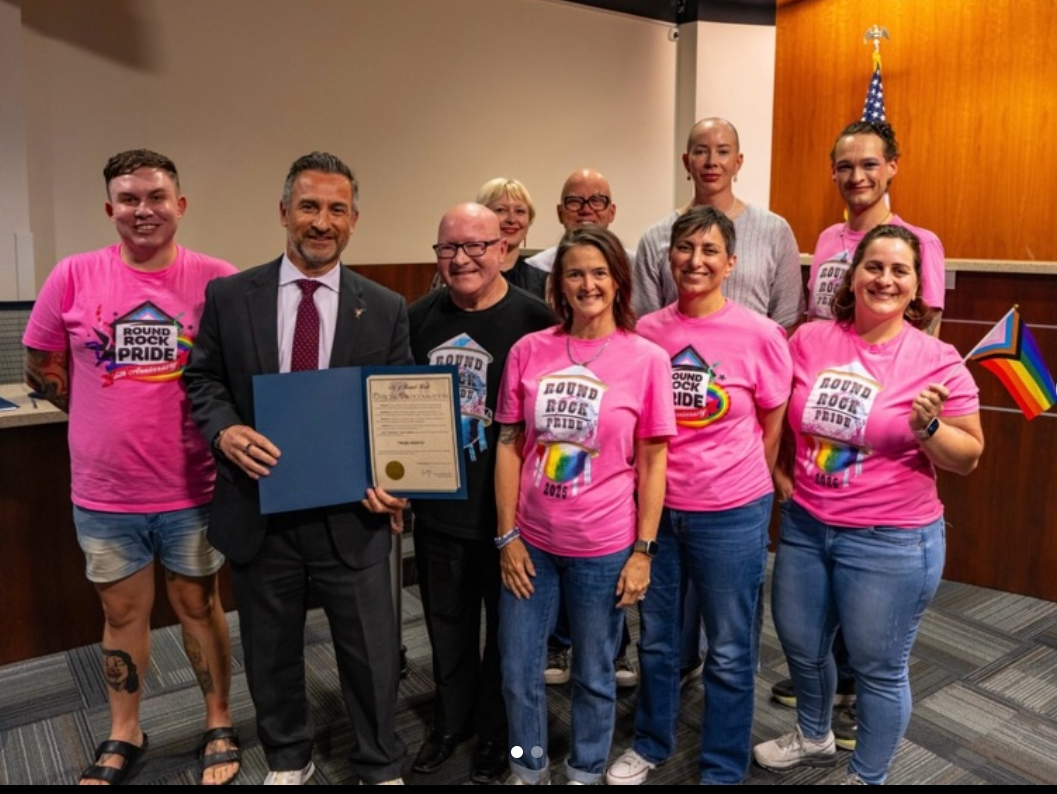
This is not the first time the city has involved itself with the annual festival. In 2024, the Round Rock Police Department posted about officers’ participation, a move that drew criticism that “endorsing this increasingly toxic ‘identity’ brand is not healthy for the community or its families.”
-Three Years Later, Lawmakers Question Cities’ Compliance With State Preemption Law
-Admitted Texas Vote Fraudster Still Free After Losing Appeal
-Samsung to Move US Headquarters to North Texas
A now-former principal in the Wylie Independent School District was arrested for allegedly offering an underage student alcohol and lingerie in exchange for sex.
Zachary Christian Neu, 32, was arrested June 4 and charged with compelling prostitution of a child under the age of 18, a first-degree felony.
A statement from the Wylie Police Department referred to Neu as a “former” assistant principal at Wylie East High School.
According to police, the investigation began following a report that Neu was communicating inappropriately with a recent 2026 Wylie East graduate.
The department’s Criminal Investigations Division discovered that during conversations with the student, Neu “offered to purchase alcohol for the minor and send money for lingerie in exchange for sexual conduct.”
Police stated that Wylie ISD notified Wylie East parents “once it was deemed safe to do so by our agency,” and that at this time there are “no known additional victims connected to the investigation.”
Anyone with concerns regarding interactions with Neu is asked to contact the Wylie Police Department.
“We would like to thank Wylie ISD for their cooperation during this investigation as the safety of our students are the top priority,” the police statement added.
The Wylie Police Department and Wylie ISD take allegations involving student safety and staff misconduct very seriously. These allegations are thoroughly investigated and addressed when they are reported. We encourage parents to speak with their children regarding appropriate communication and conduct with adults and the different avenues to report any interaction that makes them uncomfortable.
Online records show Neu had worked for Wylie ISD since the 2017-18 school year.
Neu has held a Texas teaching certificate since 2017 and was certified as a principal in January 2026.
Wylie East High School has been the scene of recent controversy concerning an “unauthorized” Islamic group hosted by the Muslim Student Association being allowed on the school’s campus to hand out religious materials.
Wylie ISD recently announced the resignation of Wylie East Principal Tiffany Doolan, ostensibly due to backlash over her handling of the Hijab Day security breach and alleged unequal treatment of a conservative club at the same school.
Neu is the latest among hundreds of Texas public and private school employees accused of sex crimes involving students and other children in just the past few years. Thousands have been reported to the Texas Education Agency for sexual misconduct.
In October 2025, Wylie ISD substitute teacher and former pastor Arthur “AJ” Bass was charged with continuous sexual abuse of a child under the age of 14. According to the state’s Do Not Hire Registry, Bass remains under investigation by the TEA.
The TEA’s Educator Misconduct Reporting Dashboard shows that the agency is currently investigating more than 2,000 sexual misconduct complaints and opening an average of 250 new cases each month.
Attorney General Ken Paxton has launched an investigation into Celsius Holdings Inc. over allegations that the company marketed potentially dangerous energy drinks to children and teenagers.
Alani Nu is a popular low-calorie energy drink with over 200 milligrams of caffeine in a 12 oz can.
Despite the high levels of caffeine in each can, Celsius retains colorful marketing directed towards young adults. This has raised concerns about whether the company is marketing potentially deadly drinks to an at-risk population.
In October 2025, 17-year-old Weslaco teenager Larissa Rodriguez died due to an enlarged heart. The cause was directly linked to the Alani energy drinks she consumed that day.
Benny Agosto Jr., the family’s attorney, stated in an interview with NBC that the cans “had inadequate warnings about the serious cardiac risks” that the beverage brings.
The National Institute of Health warns against the underaged consumption of energy drinks due to a myriad of potential health issues, including elevated heart rate, heart palpitations, high blood pressure, anxiety, and dehydration.
“The tragic death of a 17-year-old Texas girl allegedly caused by consuming a highly caffeinated energy drink is a sobering reminder of what is at stake when companies prioritize profit over the safety and wellbeing of our children. I am looking into Celsius and Alani Nu to prevent more cases like this one and to ensure Texans are made aware of any risks that come with consuming certain energy drink products,” stated Paxton when announcing the investigation.
Celsius’s Alani Nu is being investigated for potential violations of the Texas Deceptive Trade Practices Act, which protects consumers from misleading marketing practices and unconscionable actions.
Texas Scorecard has reached out to Celsius Holdings, but it did not respond to the request for comment before publication.
As U.S. Immigration and Customs Enforcement operations ramp up across the country, federal agents in the field are encountering threats to themselves and their families. Federal agents are being doxxed, threatened, and abused in the field.
Pfluger (R–San Angelo), Chairman of the House Committee on Homeland Security’s Subcommittee on Counterterrorism and Intelligence, has gained bipartisan support to increase federal penalties for individuals who dox, intimidate, or threaten federal agents.
During a Wednesday hearing on the issue, California Democrat Lou Correa said he would sign onto the legislation if it also included elected officials.
The increase in penalties follows DHS’s statement last fall condemning the threats to federal law enforcement.
In addition to threats facing law enforcement, Pfluger asked Secretary of Homeland Security Markwayne Mullin whether or not there were people who were let into the country that matched the description of individuals on the terror watchlist.
“Every single week, we’re arresting terrorists, either coming across our border or that are already in this country,” replied Mullin.
Tech giant Samsung has announced that it will be moving its U.S. headquarters to Plano by the end of the year.
The company established its headquarters in New Jersey more than 40 years ago, first in Ridgefield Park and then in Englewood where it has been headquartered for less than one year.
Samsung told NBC DFW that the move is part of a “business transformation” to better position the company for long-term growth and “is intended to strengthen alignment across teams and offices, and sharpen our focus on the areas that will drive the greatest impact for our customers, partners, and business.”
Approximately 1,000 employees will be relocated to Texas.
The presence of the Korean company is not new in Texas, as the company established its first fabrication plant in the Austin area in 1997. An additional plant was constructed in 2007, and a third plant is under construction in Taylor.
According to Dallas Innovates, Samsung will move to its existing flagship campus in Plano, which was built in 2019. In 2023, the company opened a Samsung Networks Innovation Center at this location as well.
Samsung is the second company in two weeks to announce it will be leaving New Jersey. It follows ExxonMobil, which is set to move its legal domicile to Texas.
AT&T is also constructing a new global headquarters in Plano, with a projected move-in date sometime in 2028.
Aspiring North Texas politician Zul Mohamed has lost an appeal in his six-year-old voter fraud case, in which he admittedly schemed to illegally request and receive other people’s ballots to cast fraudulent votes for himself.
But despite a May 26 appellate ruling that affirmed the lower court’s judgment against him, Mohamed is not headed to prison just yet, nor is he barred from election-related activity.
Mohamed pleaded guilty in December 2024 to more than 100 voter fraud felonies in his failed 2020 campaign for Carrollton mayor and was sentenced to four years in prison.
His appeal allowed him to remain free on bond.
The appeal also allowed Mohamed—declared delusional by his attorney—to remain politically active.
In May, Mohamed made a second failed run for Carrollton mayor, then announced plans to run for the U.S. Senate in November.
Mohamed also drew political attention by promoting a “Rally Against Rednecks” in Frisco on June 2, which turned out to be little more than a brief shouting match with counter-protesters.
Now that the Seventh Court of Appeals has affirmed the district court’s judgment, Mohamed has 30 days to submit his case to the Court of Criminal Appeals for review, which would delay a final resolution even longer.
If he does file an appeal, Denton County prosecutors confirm that it’s up to 462nd District Judge Lee Ann Breading to decide if Mohamed continues to remain free on bond and, if so, whether his election-related activity will be restricted as a condition of that bond.
The Cases Against Mohamed
In October 2020, Mohamed was arrested after getting caught with a box of fraudulently obtained mail ballots. The scheme cooked up by Mohamed involved submitting forged ballot-by-mail applications and directing the ballots to the addresses of commercial mailboxes he leased using fake ID.
After four years of legal wrangling, Mohamed pleaded guilty in December 2024 to 81 counts of fraudulently using a mail-ballot application (3 counts were thrown out) and 25 violations related to possessing other voters’ ballots.
Mohamed’s attorney argued during sentencing that his client suffers from delusional disorder and should not be imprisoned.
A jury agreed Mohamed is mentally ill but still sentenced him to four years in state prison and 10 years of probation.
Mohamed then appealed parts of his conviction and sentencing, arguing that the sting operation used to trace a mail-ballot fraud scheme back to him was constitutionally suspect, as was the court’s condition of probation that barred Mohamed from engaging in any election-related activities.
Following an April 1 hearing, the Seventh Court of Appeals issued an opinion on May 26 that affirmed the judgment of the 462nd District Court except for certain probation conditions restricting Mohamed’s election-related activities.
The appellate court modified the conditions to more narrowly state that Mohamed “shall not engage in registering voters, accessing or requesting voter data, assisting any voter to complete a ballot or ballot application, poll watching or poll greeting, or working or volunteering for any political campaign.”
However, Mohamed is not yet on probation, so those conditions are not yet applicable.
Denton County felony prosecutor Jesse Davis told Texas Scorecard that his office asked Judge Breading to add the election-related prohibitions as conditions of Mohamed’s bond, but as of June 4 she has not yet ruled on the request.
Davis said if Mohamed moves forward with another appeal, his office will ask the judge to revoke Mohamed’s bond.
If bond revocation is denied and Mohamed remains free, Davis will again ask Judge Breading to apply the election-related restrictions to Mohamed’s bond conditions, in the form approved by the appellate court.
Davis noted that the state’s concern is the same whether Mohamed is free on bond or on probation: safeguarding the public from an admitted vote fraudster.
Mohamed is also facing six counts of impersonating a public servant, a third-degree felony.
The charges stem from fake jury duty notices sent to dozens of Denton County residents for the first day of Mohamed’s voter fraud trial, which authorities traced back to Mohamed.
His next court date for those charges is set for August 14 before Judge Breading.
Mohamed’s Ongoing Political Activity
While he continues to appeal, Mohamed is not considered “finally convicted” of a felony and therefore is not barred from running for political office.
Earlier this year, Mohamed again ran for mayor of Carrollton. As expected, he lost the May 2 election to incumbent Mayor Steve Babick, although he did manage to garner 450 votes—6.5 percent of the total votes cast.
Mohamed has since announced that he intends to run for U.S. Senate in November against Ken Paxton and James Talarico, as the candidate of the American Millennial Party he founded—assuming he is still out of prison and not prohibited by the terms of his bond from political campaigning.
He also announced last week that he would be hosting a “Rally Against Rednecks” on June 2 at Frisco City Hall and invited the “local Asian community” to attend the event.
Local conservative activists organized a counter-protest “Redneck Rally.”
While covering the rallies, North Texas-based political media outlet Current Revolt contacted Mohamed by phone about his plans. Mohamed said he wasn’t holding a rally, just speaking at that evening’s Frisco City Council meeting—which did not include public comments.
Mohamed told Current Revolt that people “misunderstood” his posts and that he wasn’t holding any sort of event.

Texas Scorecard will continue providing updates on Mohamed’s criminal cases and political activities.
Texas lawmakers are examining whether local governments are complying with a state law designed to prevent cities and counties from regulating in areas already governed by state law—and whether stronger enforcement tools are needed to ensure compliance.
The Texas House Select Committee on Governmental Oversight held its first hearing Thursday to review implementation of the Texas Regulatory Consistency Act, a 2023 law that limits local regulations in broad areas of state law. Supporters say the measure helps businesses by ensuring consistent rules across Texas, while opponents argue it restricts local control.
Committee Chairman Cody Vasut (R–Angleton) began the hearing by noting that lawmakers have been tasked with determining whether local governments have repealed ordinances that conflict with the law and whether additional enforcement mechanisms may be warranted.
“We’re going to investigate and identify local ordinances that conflict with the act and determine whether local governments are unlawfully enforcing such ordinances,” Vasut said.
The law preempts local regulations in areas covered by several sections of state law, including the Agriculture Code, Business & Commerce Code, Finance Code, Insurance Code, Labor Code, Natural Resources Code, Occupations Code, and Property Code.
James Quintero of the Texas Public Policy Foundation argued that many local governments have made little effort to review their ordinances since the law took effect.
“One of the things that I’ve noticed in my 20 years or so at the Texas Public Policy Foundation is sometimes the legislature can pass a law, but it doesn’t necessarily translate into local action,” Quintero told lawmakers.
Quintero said his organization submitted public information requests to a number of cities and counties seeking records showing what actions they had taken to comply with the law.
“In every case those entities came back and effectively implied that they had done nothing,” he said.
According to Quintero, Dallas was the lone exception. He testified that the city identified approximately 100 ordinances that could potentially conflict with the law but repealed only a handful after receiving notice of potential litigation from the foundation.
TPPF is currently appealing a district court ruling in litigation against Dallas involving dozens of city ordinances it argues are preempted by state law.
Quintero also pointed to examples of ordinances that remain on local code books despite having been invalidated by either courts or state legislation.
He cited Austin’s paid sick leave mandate and Brownsville’s single-use plastic bag ban, both of which he said can still be found in municipal code books despite no longer being enforceable. He argued that leaving such provisions in place creates confusion for residents and businesses trying to determine what rules actually apply.
“If you’re just John Q. Public looking to see, ‘Hey, what laws, what ordinances, what regulations am I subject to,’ you have to effectively have a legal degree in some measure of historical knowledge to know, well, this one’s on the books, but it’s not enforced,” Quintero said.
Bill Longley, general counsel for the Texas Municipal League, pushed back on the suggestion that cities are intentionally ignoring the legislature’s directive.
“I don’t think cities are ignoring the law,” Longley said. “Cities call our legal department regularly to ask about how this law might apply to various ordinances that they’re considering adopting.”
“There are lots of questions about the extent of the field preemption, and I don’t think anyone has an answer to that,” he said.
The hearing also raised questions about whether the current enforcement mechanism established by the law is sufficient.
State Rep. Mitch Little (R–Lewisville) noted that the Texas Regulatory Consistency Act was enacted nearly three years ago, yet major legal questions surrounding the law remain unresolved.
“It’s now the year of our Lord 2026,” Little said. “None of the challenges have reached the Texas Supreme Court.”
Little argued that because lawsuits are currently brought by private individuals, associations, or businesses, cities can spend years litigating threshold issues before courts ever reach the question of whether an ordinance actually violates state law.
“The first challenge from the municipality is you lack standing,” said Little. “Now the plaintiffs are on a three-year ride up to the Court of Appeals, at best to the Texas Supreme Court, and all the way back down before a decision is made on the basic question of do you have standing.”
As a potential solution, Little suggested giving the attorney general direct authority to enforce the law and seek expedited judicial review.
“It seems to me a much more efficient process would be that the Attorney General would have standing to bring the lawsuit,” he said.
Little also suggested requiring cities to conduct periodic reviews of their ordinances and publicly identify provisions that conflict with state law.
“Every city should be required to audit its ordinances to determine their compliance with TRCA,” said Little. “And then, if they are out of compliance and are being repealed, they should have to publish that to the public.”
Quintero endorsed the proposal, calling an expedited review process “exactly what’s needed here.”
The discussion appeared to align with concerns raised by Vasut, who suggested lawmakers may need to consider stronger enforcement mechanisms moving forward.
Among the ideas discussed during the hearing were empowering the attorney general to issue notices of noncompliance, requiring expedited judicial review of disputed ordinances, and imposing penalties on local governments that continue enforcing ordinances found to violate state law.
The committee is expected to continue studying the issue ahead of the 2027 legislative session, when lawmakers could consider changes to the Texas Regulatory Consistency Act and its enforcement provisions.
Austin Independent School District has released its recommended budget for the 2026-2027 school year, including cuts to reduce the $181 million deficit. The cuts will affect over 558 positions.
Superintendent Matias Segura has guaranteed that teachers with state certifications will retain their jobs. However, non-certified teachers will move to different qualifying roles that the district is still working to find. Additionally, 112 qualified teachers will move to different districts, and Austin ISD will eliminate 228 department vacancies.
Austin ISD will also close 11 schools, saving approximately $21 million.
The district is also planning to increase the teacher-student ratio and reduce the amount of teacher planning periods. Educators have already started petitions claiming that the reduced amount of time will not allow them to serve their students effectively, especially when increasing the teacher-student ratio.
Campus librarians serving less than 400 students will be reduced to part-time capacity over the next year, saving $897,000. The district is also reevaluating the system used to determine the number of counselors per school. Elementary schools will now have one counselor; middle schools with greater than 400 students will have two; and high schools will have three. This change is expected to save $2.1 million. The number of assistant principals will also be reduced, saving $1.2 million.
A new transportation model, expected to save $2.4 million, will affect middle and high school students across the entire district. Instead of having individual stops, Austin ISD transportation will utilize a hub system that will ferry students to and from local elementary schools. Late night bus activities will also end, saving an additional $1 million.
District-wide transportation for Montessori, Gus Garcia YMLA, Campbell Elementary, Sadler Means YWKA, and Eastside Early College will end. Students who live more than two miles away will still be able to access district transportation. These transportation cuts will save an estimated $933,000.
Changes to magnet school transportation are yet to be determined, though the district is considering implementing a partial fee where parents pay for their child’s transportation.
Additional cuts have been announced to the Austin ISD Police Department, operations department, and employee benefits. The operations department budget will be reduced by $9.8 million, effectively halting new campus construction and some repairs.
The district’s fiscal retrenchment comes as enrollment recently hit a 30-year low, despite Austin’s perennial status as one of the fastest-growing cities in the country. The district has faced repeated criticism for poor academic outcomes and promoting sexualized content to students.
The district has already laid off 20 percent of its headquarters staff.
The budget will be presented to the board of trustees today, and the board will vote on June 18.
Google has announced a $10 million investment into a Water Preservation fund for Texas. As data centers continue to pop up all over the state, concerns regarding the use of the precious resource for cooling purposes leave local residents troubled.
“Data centers are the nerve of the digital world,” according to Google. “As we grow our data center footprint to support these services, we recognize that how we build is just as important as what we build.”
Water cooling methods involved in data centers reportedly reduce energy consumption by 10 percent. This allows the AI technology housed inside to be more cost effective and largely available in the hands of many consumers. Despite the immense amount of water being used, Google claims that “U.S. data centers use less than 1% of the water that Americans use on their lawns annually.”
Google has made five public commitments to Texans to “manage vital water resources where we build and operate data centers.” These commitments are to:
- Replenish more water than data centers consume.
- Help to modernize water and wastewater infrastructure in communities.
- Protect at-risk watersheds with air-cooled solutions.
- Report annual water usage.
- Pursue alternative and reclaimed water solutions to protect water resources.
In addition to the $10 million investment into the Water Impact fund, Gov. Greg Abbott announced last November that Google is slated to invest an additional $40 billion in Texas as a part of its “Investing in America” initiative.
“Google’s $40 billion investment makes Texas Google’s largest investment in any state in the country and supports energy efficiency and workforce development in our state,” said Abbott.
However, no one knows just how much water data centers are using across the state. The Texas Water Development Board uses self-reported survey data to attempt to accurately portray the water data centers are using. In 2024, TWDB sent out 70 surveys to attempt to account for groundwater and surface water usage in data centers. Only 18 recipients responded.
Traditionally, data centers are required to respond, but failure to do so results in a fine of $500 or less, amounting to less than a slap on the wrist for large corporations.
The Texas House Committee on Natural Resources is holding a hearing on June 23 to discuss data center water use and conservation.
Today, I breakdown why I’m confidently voting for the George Hopper ticket next week at the Texas GOP Convention.