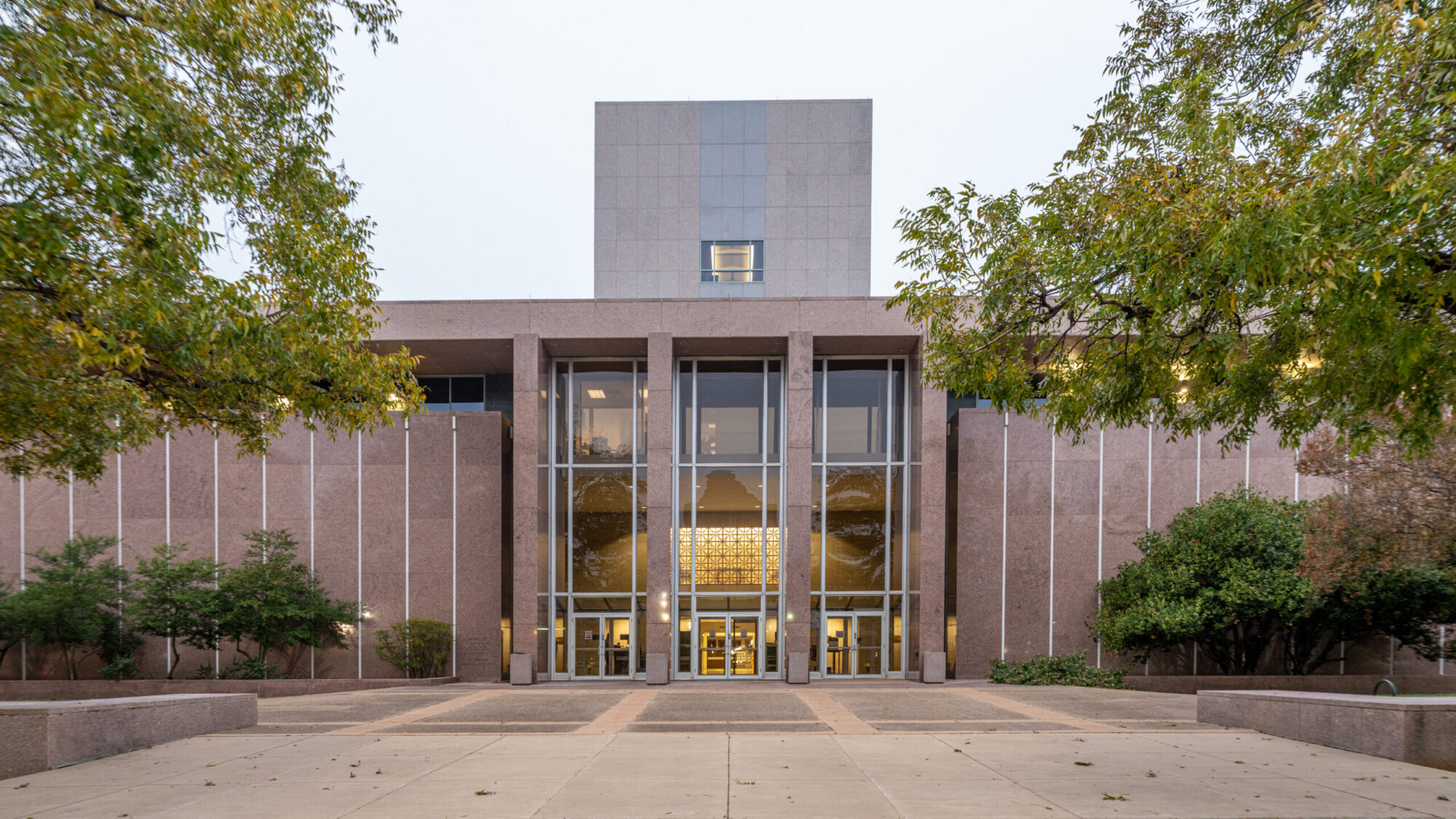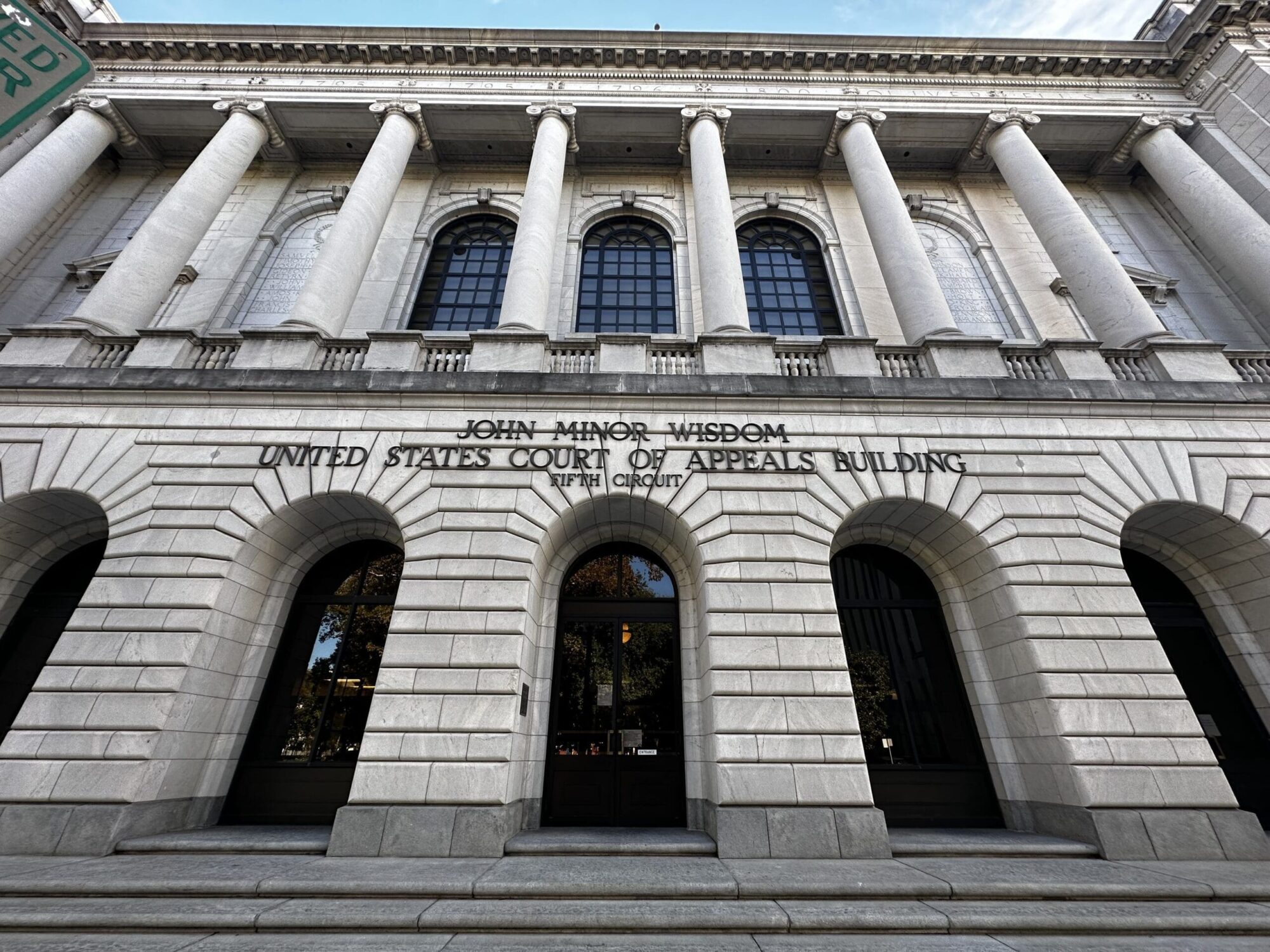
Attorneys for Texas and Louisiana defended the constitutionality of the states’ Ten Commandments laws before the Fifth Circuit Court of Appeals in New Orleans on Tuesday.
Both states’ legislatures had passed laws requiring the display of the Ten Commandments in public school classrooms. Lawsuits challenging the constitutionality of the laws have led to preliminary injunctions blocking the laws’ enforcement. In Texas, the law is only blocked in the school districts specifically named in the lawsuit.
The Fifth Circuit set the Louisiana and Texas appeals for the same argument session and heard consolidated oral arguments on whether to leave the injunctions in place. Oral arguments were heard in an en banc sitting—meaning all 17 judges were present.
Hearing the cases together allows the Fifth Circuit to resolve the same constitutional questions once, producing a unified framework that will control both states’ laws going forward. The en banc sitting prevents separate panels from coming to contradictory decisions.
Questions before the court include whether Establishment Clause precedent set by Stone v. Graham survives in light of the Supreme Court’s recent “history and tradition” approach, and how that test applies to religious displays in modern public schools.
Louisiana Case
Louisiana’s House Bill 71 requires permanent display of the Ten Commandments in every public school classroom, with optional “context” documents. The law was found facially unconstitutional by the Middle District of Louisiana, which blocked the state from enforcing the law.
The case, Roake v. Brumley, was before a Fifth Circuit panel in June 2025 that affirmed the preliminary injunction, calling HB 71 “plainly unconstitutional” under Stone v. Graham—a 1980 Supreme Court case that struck down a Kentucky law requiring the Ten Commandments to be posted on the wall of every public school classroom.
However, Stone v. Graham is often considered an outdated precedent, as it relied on the “Lemon test” for determining whether a law violated the Establishment Clause of the First Amendment. Under this test, legislation must have a clear secular purpose and not create an excessive governmental entanglement with religion.
In 2022, Kennedy v. Bremerton School District described the Lemon test as having been “long ago abandoned,” choosing instead to analyze Establishment Clause disputes by referencing the country’s historical practices and understandings. This new framework has convinced many state legislatures to pass pro-religious liberty legislation.
However, the Fifth Circuit panel held that Stone v. Graham remains binding and that a stand-alone Ten Commandments posting, not integrated into a curriculum and with an avowed religious purpose, violates the Establishment Clause. The panel also rejected the state’s arguments that the statute had a secular, historical-education purpose.
The panel’s opinion was later vacated when the full court granted rehearing en banc.
Texas Case
Texas’ Senate Bill 10 similarly requires Ten Commandments postings in public school classrooms. As previously reported, a federal district court blocked the law from being enforced against the school districts included in the lawsuit.
The case, Rabbi Nathan v. Alamo Heights ISD, raises the same core issues: whether the display of the Ten Commandments in public school classrooms is within the historical practices and understandings of the United States, and whether the Lemon test is still controlling precedent.
Oral Arguments
On Tuesday, the Fifth Circuit heard oral arguments for both cases.
Arguments focused largely on which precedents were to be considered. Since Kennedy v. Bremerton concerned a football coach praying in the middle of the field after each game, the court questioned whether it could be applied to a law requiring religious doctrine to be permanently posted in classrooms.
Attorneys for the states argued that the classroom postings merely state that “these are the Ten Commandments,” but do not require a belief in them by the students. The court questioned how a child who follows a non-Abrahamic religion could not feel disparaged by such displays.
The states’ attorneys contend that this is no different from the Pledge of Allegiance—required in all public schools in both states—which references a single God. Furthermore, they argued that teachers use the Ten Commandments to show “ordinary principles.”
They further argued that something associated with Christianity does not necessarily constitute discrimination against other religions—citing crosses that have been erected on public property.
Attorneys for the plaintiffs who challenged the laws contend that even religious institutions generally do not support putting any version of the scriptures in secular settings, even when it is the version that they agree with.
The states’ attorneys argued that although there may be disagreements over which version of the Ten Commandments is proper, these are merely political debates. The question at hand must be whether the display of any version necessarily creates an established church. Historically, that is what constitutes a violation of the Establishment Clause, and is precisely what the plaintiffs are contending.
They characterized the plaintiffs’ argument as claiming that posting the Ten Commandments is “somehow the equivalent” of Texas declaring that Christianity is the official religion of Texas—but argued that is not what is happening.
The court responded that Stone v. Graham says that is precisely what posting the Ten Commandments in public classrooms does.
The states’ attorneys are therefore asking the court to reject that reasoning. They also attempted to distinguish their states’ Ten Commandments laws from those Kentucky had passed in the Stone v. Graham case.
What Happens Next
The Fifth Circuit has yet to rule, meaning the existing district court injunctions remain in place. Regardless of the decision, the case is expected to be appealed to the U.S. Supreme Court.
Having one en banc court decide parallel cases offers the Supreme Court an easy opportunity to revisit or overrule Stone v. Graham, as the factual and legal issues are fully presented by the two states.
If you or anyone you know has information regarding court cases, please contact our tip line: [email protected].
No ads. No paywalls. No government grants. No corporate masters.
Just real news for real Texans.
Support Texas Scorecard to keep it that way!