An eminent domain attorney is raising concerns about vague language in a form he says Oncor has provided to his clients seeking permission to survey their land for a 765-kilovolt transmission line.
This is regarding electricity delivery company Oncor’s Dinosaur to Drill Hole 765-kV line. Made up of two segments, Dinosaur to Longshore and Longshore to Drill Hole, it would span more than 380 miles from near Glen Rose to near the Culberson-Reeves county line.
This project is part of the Strategic Transmission Expansion Plan (STEP) Permian, a key part of the Permian Basin Reliability Plan. STEP Permian proposes three 765-kV transmission lines spanning more than 1,200 miles to move electricity from East Texas to the natural gas-rich Permian Basin. Dinosaur to Drill Hole is the northern line.
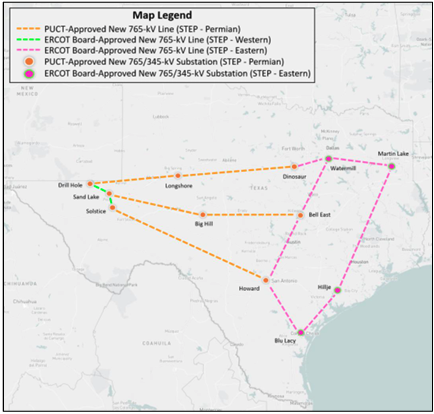
The Public Utility Commission of Texas approved both line segments on August 28. Eminent domain attorney Nick Laurent of the law firm Barron, Adler, Clough & Oddo provided Texas Scorecard with a copy of an Access Consent Form he said Oncor gave his clients to sign.
The document states that it “does not grant easement or construction rights,” but Laurent had concerns.
“It is very cursory and very one-sided in my view. It’s really substantively about one paragraph or a sentence or two that says essentially Oncor has permission to come on the property and kind of do whatever it likes,” he said in a November 11 interview with American Energy Works. “There’s no duration, there’s no notice provisions, anything like that. There are some problems that come with unfettered and unknowing access for indefinite amounts of time that are sort of obvious.”
Providing general, not legal advice during the interview, Laurent urged landowners who have received one of these forms and haven’t signed them yet to consult with a lawyer.
Laurent said he told his clients it is okay to allow Oncor to come on property to conduct a survey, but they should seek a negotiated agreement. If no agreement is reached, Oncor is likely to seek a court order injunction to give them access.
He is currently negotiating with Oncor over what is allowed or required for access.
First is specifying what activities Oncor is allowed to engage in on the property. “For example, non-invasive surveys like on the ground surveying, but not geotechnical inspections where Oncor may be boring core samples and things like that. That can be disruptive to the property,” Laurent said.
Other requirements include notifying the landowner when someone is going to come on the property, minimizing disruption, restoring any damages to the property as a result of the survey, a right to a copy of the reports and materials that are generated from the inspection, and keeping gates closed so livestock do not escape.
Laurent said the notice requirement could be helpful in the situation of White Horse Christian Academy in Stephenville. Vanessa Halford, the academy’s executive director, has expressed concern about having “appropriate background checks” for transmission line employees who would be working in close proximity to young children.
“I think that the notice provision can help address a lot of that if the property owners know when the survey crews are going to be there, they can be prepared for that and take protective measures with respect to children in the area, make sure there’s additional people there to the extent there’s security officers or guards on site,” Laurent said.
Halford told Texas Scorecard that she has not heard much from Oncor since an October 1 meeting with their representatives.
“We did discuss my concerns regarding the proximity of the towers to the school as well as the proposed line placement between my home and the school. The Oncor engineer at the time was not very positive about the possibility of adjusting the lines where they are further away from the school,” she wrote. “The Oncor representative stated that he would present my case to the Oncor board and he would be in touch with my lawyer.”
Laurent is also seeking for Oncor to stake “at least the center line of the easement.” That way, the landowner can better evaluate where the proposed easement will be on their property. That information would be helpful if the owner requests a route modification. Laurent said Oncor’s deadline for submitting modification requests is the end of this week.
If a landowner has already signed a form and the surveying is done, Laurent said the issue may be “moot.” If it isn’t, according to him, nothing precludes owners from rescinding previously given permission.
“If an owner has signed Oncor’s form and now has second thoughts about that, I would suggest that they consider informing Oncor that prior agreement is rescinded,” he said. “I would tell the Oncor folks … we are okay with the general idea of agreeing to allow you to come on to survey, but we may want to add some additional terms and conditions on that right of entry.”
Unlike what landowners experienced during the route design process earlier this year, Laurent said it should be easier to find an attorney during this condemnation stage.
“The problem that a lot of people ran into on the routing process is once a lawyer is engaged by a landowner or a group of landowners on a particular route, they have a big conflict problem with taking on additional landowners that are on different routes because of the inherent conflict and where the line may ultimately be placed,” he said.
The condemnation stage is different. “Each individual owner will have their own case and you can have the same lawyer represent a number of owners on a particular project and you don’t have a conflict problem,” Laurent said.
He warned, “It is really important for [land]owners to gather information, consult with a lawyer, preferably one with eminent domain experience.”
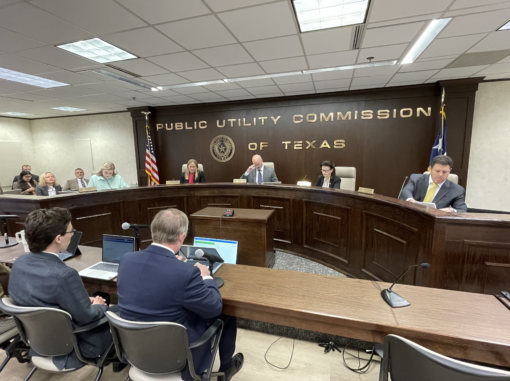
PUCT approved Dinosaur to Drill Hole amid widespread complaints from landowners. During that meeting, Chairman Thomas Gleeson reprimanded Oncor’s attorney. “What we can’t have happen is all these landowners coming here and telling us that they don’t feel on board, negotiated, or had discussions in good faith. The expectation is we will not hear this going forward, that you all need to meaningfully engage with these landowners in this process.”
PUCT did not respond to a request for comment before publication.
Nine days after Republicans were swept from statewide office, PUCT commissioners decided not to take up rehearing motions on the Dinosaur to Drill Hole line.
There are two more STEP Permian 765-kV lines. On November 5, PUCT extended time to consider rehearing motions on AEP Texas and CPS Energy’s Howard to Solstice line.
The third line, composed of two segments from Oncor and the Lower Colorado River Authority Transmission Services Corporation, is in a holding pattern after PUCT remanded the Bell County East to Big Hill segment to the State Office of Administrative Hearings.
In a statement to Texas Scorecard, Oncor spokesperson Andrew Clark wrote, “Landowners are welcome to consult with their own attorneys throughout the process and may contact their designated right-of-way agent with any specific questions on the access request or any other part of the project.”
If you have received an Access Consent Form from any of the transmission companies above for a 765-kV line, please email tips@texasscorecard.com