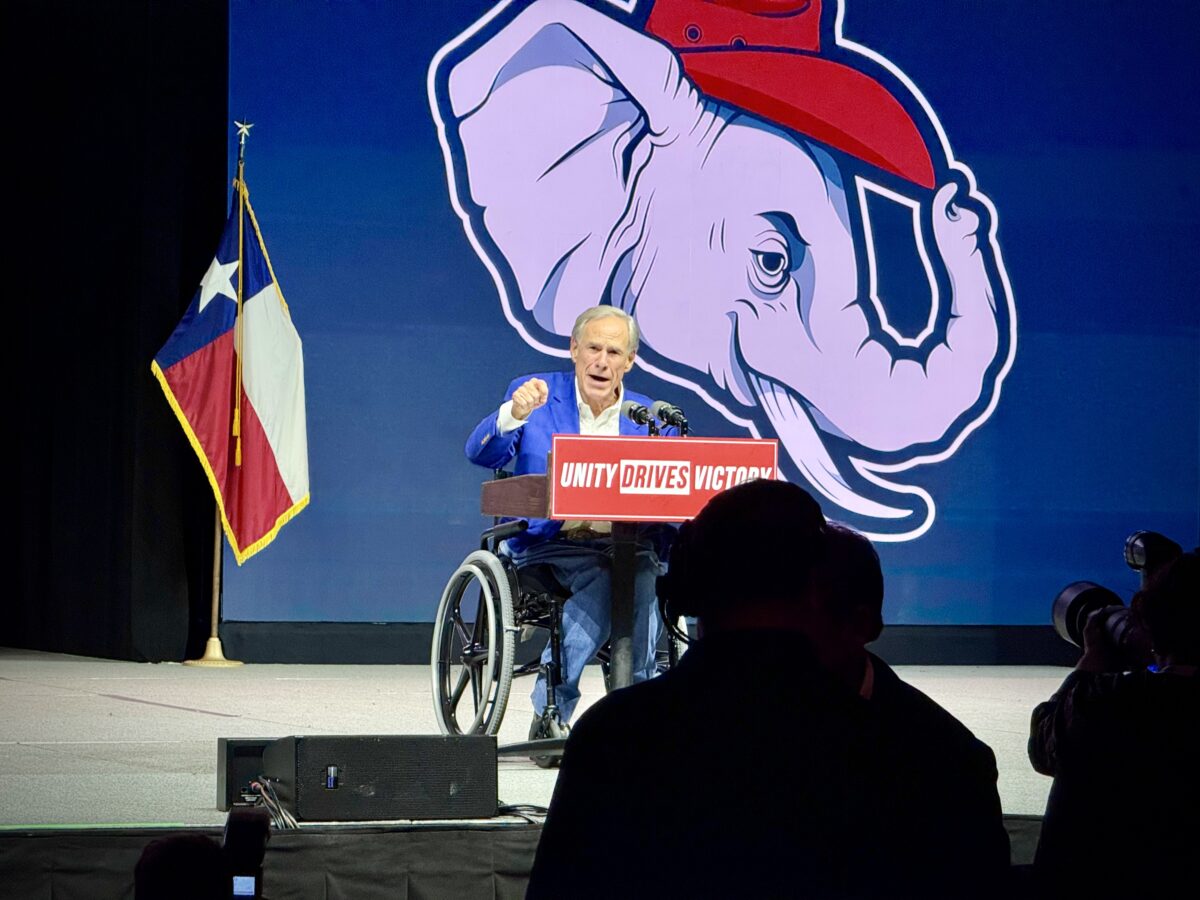
HOUSTON—Gov. Greg Abbott threw his support behind closed Republican primaries Friday, telling delegates at the Republican Party of Texas convention that “only Republicans will vote in Republican primaries” going forward.
The declaration comes just days after Texas Secretary of State Jane Nelson announced she will step down next month and nearly a year after her office became embroiled in a legal battle with the Republican Party of Texas over the issue.
“Let me just emphasize we are going to make clear that in the future only Republicans vote in Republican elections,” Abbott told delegates during his convention speech.
Texas currently operates under an open primary system, allowing voters to choose which party’s primary they wish to participate in during a given election cycle.
Last year, the Republican Party of Texas sued Nelson’s office after she declined to implement a closed-primary system proposed by the party. The lawsuit argued the change was necessary to prevent Democrat interference in Republican primary elections. In an interview with Texas Scorecard following the speech, Abbott indicated that he would prefer a legislative approach, saying “Legislators can and should be more responsive to Republicans than a judge may be.”
The dispute created a split among Texas Republicans. Attorney General Ken Paxton sided with the Texas GOP, while Nelson’s office sought dismissal of the lawsuit. The litigation remains ongoing.
Abbott largely stayed out of the public dispute at the time.
His remarks Friday, however, represent his first clear endorsement of the policy.
The issue has long been championed by grassroots activists within the Republican Party, who argue that only voters affiliated with the party should be allowed to participate in selecting Republican nominees.
The governor’s endorsement also comes as speculation grows over who will replace Nelson as secretary of state. Because the office oversees Texas elections, any future action involving party primaries would likely involve the agency. Abbott has not announced a successor, though multiple sources have suggested outgoing State Rep. Nate Schatzline is under consideration.
Abbott’s endorsement of closed primaries was one of several policy priorities he highlighted for Republican activists ahead of the next legislative session.
The governor urged delegates to make his property tax reform proposal a top priority, arguing that previous tax relief efforts have not gone far enough to address rising local government spending and property appraisals.
“My property tax reform must be one of them,” Abbott said, referring to the convention’s legislative priorities. He called for stricter limits on local government spending, a two-thirds voter approval requirement for property tax increases, and a reduction of the appraisal cap from 10 percent to 3 percent.
Abbott also renewed his call for the creation of a statewide prosecutor position, saying Texas needs a mechanism to pursue criminal cases when local district attorneys fail to do so. He additionally endorsed denying bail to illegal aliens charged with felonies and allowing the Legislature to impeach district attorneys who refuse to enforce the law.
On immigration and workforce policy, Abbott called for an end to “H-1B abuse” in Texas and said an executive order barring state agencies from using H-1B visa holders should be codified into law and expanded to local governments. “Texas jobs should only go to Texans,” he said.
Abbott also called for a complete ban on Sharia law in Texas, saying lawmakers should provide the attorney general with additional tools to enforce such a prohibition. “Next session, we must leave no doubt and totally ban Sharia law,” Abbott said.
Delegates are expected to finalize the Republican Party of Texas’ legislative priorities before the convention concludes Saturday.