By a vote of 3-2, a majority of Hood County Commissioners again rejected a moratorium on data centers. Instead, they unanimously passed a resolution asking Gov. Greg Abbott to call a special session to address the issue.
The commissioners also voted unanimously to formally request District Attorney Ryan Sinclair to respond to a forensic audit that found significant issues at the Hood County Appraisal District.
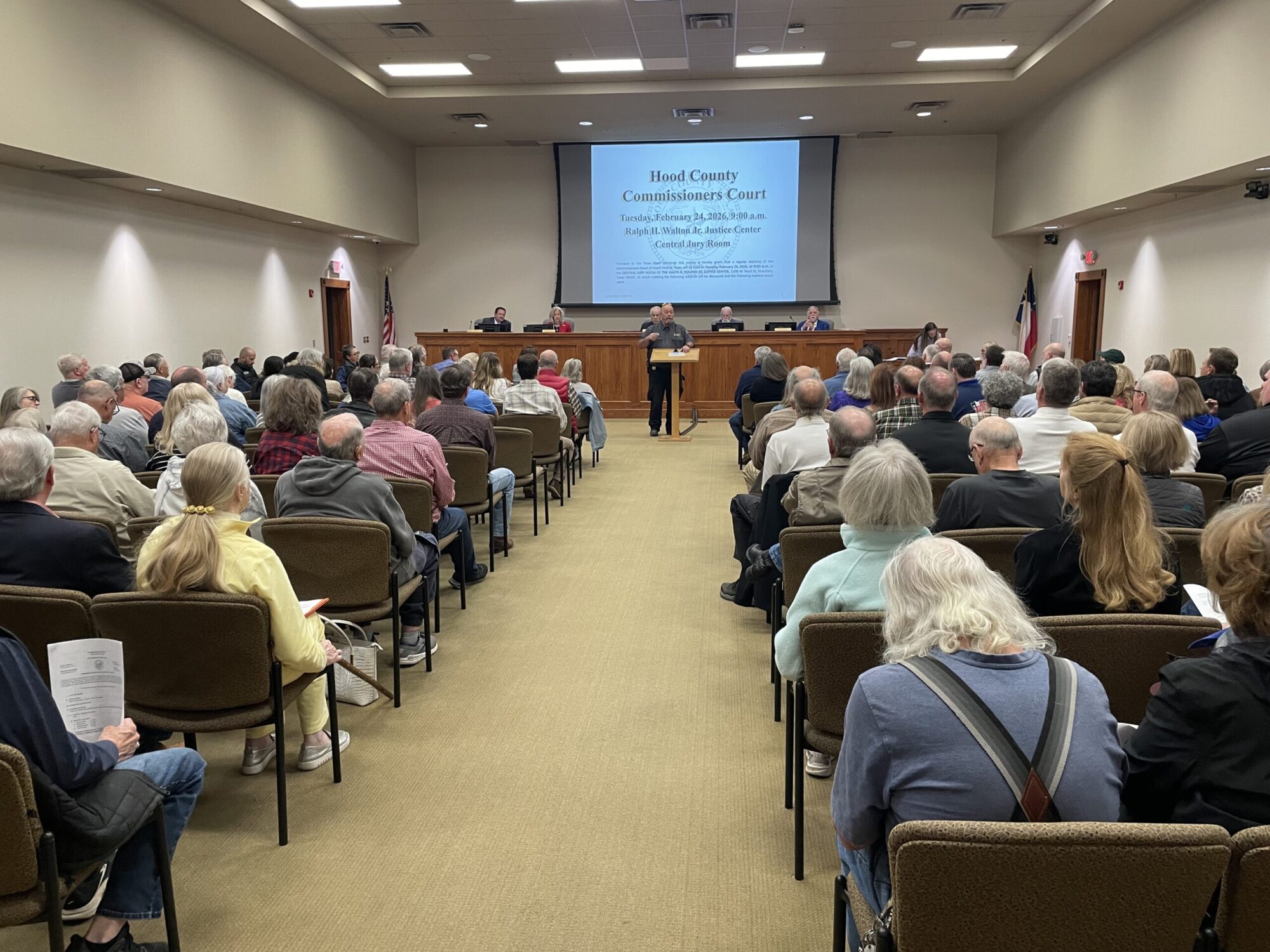
The commissioners decided these items before a courtroom packed with citizens.
Moratorium
Hood County has received five applications for data centers the past several months. In January, commissioners gave conditional approval for one by Florida-based Sailfish.
Citizens reacted negatively, and pressured the commissioners for a moratorium so there would be time to fully investigate the effects of the data centers on their water, air, and the economy, and to better get to know the companies behind them. The all-Republican commissioners court rejected a six-month moratorium by a 3-2 vote on February 10. Commissioners Kevin Andrews, Jack Wilson, and County Judge Ron Massingill voted no.
Commissioners Dave Eagle and Nannette Samuelson, who voted yes, put it on the February 24 agenda. Citizens showed up again to express their concerns.
“They consume extraordinary amounts of water,” said Rachel Jacobsen. “Once these wells run dry, they are done.”
“Will the consequences of water waste and toxic batteries be another burden placed on other generations?” asked Jordan Schmidt.
Commissioner Andrews gave a lengthy speech arguing that counties do not have the power to place moratoriums on developments. While citizens said that Chapter 231, Subchapter K of the Texas Local Government Code specifically empowers Hood County to take such actions, Andrews and Massingill disagreed.
They pointed to opinions from County Attorney Matt Mills, the Texas Association of Counties, and a law firm they consulted, all of which claimed the county cannot issue a moratorium.
During the February 10 meeting, State Sen. Paul Bettencourt (R–Houston) and State Rep. Jared Patterson (R–Frisco) sent a letter to Attorney General Ken Paxton stating they did not believe counties have such power and warning against such actions. State Rep. Shelby Slawson (R–Stephenville), who represents Hood County, published her own letter disagreeing with that position.
On February 23, Hood County Attorney Matt Mills sent Paxton a letter requesting his opinion on whether Subchapter K allows Hood County to impose a moratorium, and if so, for what length of time.
Commissioner Eagle, who disagreed with Bettencourt’s and Patterson’s letter, responded to Andrews.
“The law is not decided right now on this issue,” he said. “I believe there’s a grey area here with this statute because we’re the only county here in this state with subsection K.”
State Rep. David Cook (R–Mansfield), who came to the meeting, told commissioners they do have the power to act. He recommended that the commissioners withdraw conditional approvals for the projects, draft development standards, and appoint a committee that would carry out implementation of the development standards, all as part of a four-month moratorium.
“You do have a presumption of validity. This court has done a four-month moratorium in the past,” he said. “Take the opportunity to use the authority given.”
Cook is running in the March Republican primary to represent Texas Senate District 22, which includes Hood County.
Massingill expressed concern about the costs of fighting a lawsuit if they did issue a moratorium, to which Eagle replied, “This needs to get down to the courthouse.”
Massingill also believed that if the county makes it difficult enough, at least one of the developments will die on the vine due to lack of investor funding. “I do not believe that Sailfish is going to be around in a year and a half,” he said. “The technology is changing so quickly, this may look like windmills and solar farms. The technology may be outdated in a year.”
Instead of a moratorium, Andrews and Massingill proposed controlling the data center development through regulation under Subchapter K and asking the state legislature to act.
“We have to follow the law,” Andrews said. “I will go with you to Austin to march on the steps to get them to do something.”
“Where were you?” citizens asked back, referencing a recent rally in Austin they went to.
After the 3-2 vote was called, citizens audibly expressed their disappointment, with at least one shouting “resign!”
“I’m really disappointed,” said Greg Harrell, chairman of the Hood County Republican Party.
The commissioners did unanimously pass a resolution asking Gov. Greg Abbott for a special session. It is based on a resolution passed by the State Republican Executive Committee on February 7. Eagle asked Cook about the odds of Gov. Abbott calling a special session. “Until he makes a call, it’s not happening,” Cook replied.
The commissioners are set to consider development regulations on March 10.
Texans’ concerns about data centers are rising. Harrell drafted a resolution, that the State Republican Executive Committee passed this month, which expressed strong opposition to the establishment of additional data centers that consume large amounts of water through evaporation in cooling towers until comprehensive, enforceable safeguards are enacted to protect electrical grid reliability, ensure responsible water use, and safeguard community resources and public health.
Appraisal District
On February 10, Granbury Mayor Jim Jarratt publicly asked the commissioners for their help in pressuring District Attorney Ryan Sinclair to make a decision about the Hood County Appraisal District. A forensic audit, published in December, found the appraisal district withheld and spent more than $3 million of surplus taxpayer monies without notifying the local governments that supervise it.
While the district has returned $1.9 million, Jarratt said $1.3 million remains outstanding.
Jarratt wants Sinclair to choose one of three options: take the case to a grand jury, move it to a district judge, or refuse to accept the case, which would allow Jarratt to then seek reimbursement from insurance.
Commissioner Eagle put on the February 24 agenda for commissioners to consider action and to ask Sinclair questions. Sinclair did not attend the meeting.
“I’m disappointed that he’s not in here,” Eagle said. “We need to investigate, and this has been going on long enough.”
One of the items the forensic audit found was that HCAD appropriated $2 million of taxpayers’ money for a new building that was never approved by the local governments that supervise the district. Jarratt informed Texas Scorecard that in May 2021, the appraisal district board set up a shell corporation as a means of financing the building by raising $6 million of debt “without ever having any elected official vote on it.”
He said that the district dissolved it later.
“It’s not as high as the data centers, ladies and gentlemen, but this is a serious issue,” said Mark Lowery, who is running in the Republican primary for county judge. “I’m a retired federal agent, I know a crime when I see it, and there’s a crime here.”
“We do not have legal power over the district attorney. We can make a motion to ask him to do something,” Eagle said.
The commissioners unanimously voted to send Sinclair the formal request.
If you are a citizen concerned with local corruption and would like to partner with us to promote transparency, please email scorecardtips@protonmail.com.