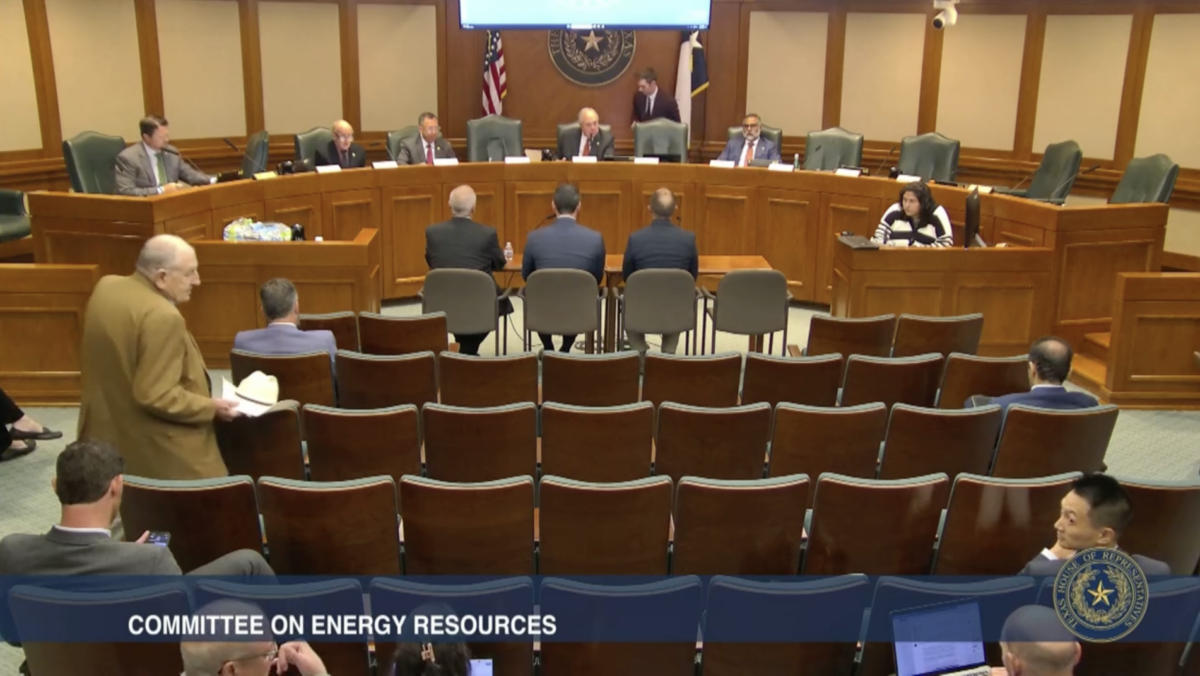
AUSTIN–Critics voiced their concerns to legislators Monday about carbon capture and storage projects in Texas and how taxpayers are footing the bill for it.
Lawmakers and proponents discussed the question of transferring project liability to the state.
This occurred the day before the Texas Railroad Commission’s Tuesday hearing regarding ExxonMobil’s Carbon Capture and Storage Permit Application.
“This is a potentially trillion dollar global market,” Scott Castleman of the Gulf Coast CCS Alliance told members of the Texas House Energy Resources Committee. He argued that Carbon Capture and Storage (CCS) is a safe, proven, and effective technology.
Lindsay Cooper Phillips of Clean Air Task Force Action told committee members that there have been 116 carbon capture projects announced in Texas since 2018.
According to Phillips, based on announced projects and Class VI injection-well applications, Texas is second behind Louisiana, but ahead of third-place California. Class VI wells, according to the U.S. Environmental Protection Agency (EPA), are for permanent storage of carbon dioxide in subsurface rock formations. Typically, these are thousands of feet below the surface and isolated from drinking-water aquifers.
Sean Abbott of the Texas Railroad Commission told lawmakers the agency took over primacy of Class VI CCS Permits from the EPA on December 15, 2025. He said the commission has received 20 Class VI applications, though the number of applications has slowed. “I think that there was a bit of a rush to get in line with EPA,” he said. “Once we got primacy, that has since kind of slowed.”
Erandi Trevino of the Raices Collab Project and George Hillhouse, a mineral rights owner in Upton County, argued taxpayer monies are driving this industry, not the market.
“It is a trillion-dollar industry, except that those trillions are not coming from profits from the industry itself, but rather from the taxpayer,” Trevino told lawmakers. “Annual costs to taxpayers are estimated to reach $60 billion per year by 2030, considering the amount of projects currently proposed, and in fact, full funding for just the projects currently proposed could be as far as $2.1 trillion for taxpayers.”
“This is something that came up and got revitalized in the Biden-era Inflation Reduction Act, and so that’s why you saw all this activity in the last couple of years,” Hillhouse said. “The only thing should be happening here is oil and gas production.”
Phillips said companies can claim a tax credit of $85-per-ton of carbon stored, a credit started by the Bush administration and augmented during Trump’s first term. Participants only receive the tax credit for 12 years and the facility must be under construction by 2032 in order to qualify.
Trevino said that the 12-year limit leads to two possible outcomes.
“Either those credits are expanded further out, which means more taxpayer money going into these projects, or they end and leave the state vulnerable to abandoned projects by companies who may not see a fulfillment of their profit goals,” she said.
Trevino warned against transferring project liability to the state.
Phillips had said Clean Air Task Force Action would support transferring liability to the state after injection “if there were adequate funds” in the anthropogenic CO2 trust fund.
“We see the value of transferring liability from the operator in the long term to the state is that liability must account for the possibility that an operator dissolves, becomes insolvent, or ceases to exist, and that ensures that someone is always present to handle any issues that might arise, meaning the state being always present versus an operator.” Phillips said.
“When we talk about transferring liability to the state after an amount of time, does that mean we’re like creating an automatic process to orphan these wells, basically?” asked State Rep. Jon Rosenthal (D–Houston).
“There is a process part of the application that will require the closure of the well,” Ryan Kammer of the Great Plains Institute replied. He said it would be funded through fees the state collects through the injection process, though currently those fees are just collected for administration. “I think the idea would be that increased fees would make sure that there’s a separate fund that can be stored or available in those instances,” he said.
“I’m worried about transferring the liability. Leave it to the private sector to cover their own liabilities,” said State Rep. Gary Gates (R–Richmond).
State Rep. Drew Darby (R–San Angelo), the committee chairman, said that “right now the state is never going to take liability for that.”
“If we passed a bill for that, we’d have the industry put money into a fund for liability purposes,” he added. “But we have decommissioning for batteries, wind, and solar. We have tried to set aside revenue and those costs would be paid by the industry.”
Michelle Turner of the Cheek Texas Community Association of Jefferson County asked committee members for an “immediate moratorium” on Class VI permits.
“Since June 25, 2024, Cheek residents have raised serious concerns about the proposed ExxonMobil Rose CCS project and its potential impact on our safety, water, property rights, and quality of life,” she said. “Sequestering contaminated CO2 underground carries serious risk, including leaks, potential health effects, water contamination, and seismic activity. We urge you to pause Class Six CCS permitting until strict, enforceable protections are in place.”
The Railroad Commission will meet to discuss ExxonMobil’s project permit at its September 15 meeting.