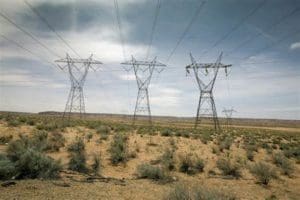
Texas’ Public Utility Commissioners approved the Howard-to-Solstice 765-kilovolt transmission line, with modifications.
The Friday decision came during an open meeting led by Public Utility Commission of Texas (PUCT) Chairman Thomas Gleeson.
The Howard-to-Solstice line, a project of utility companies AEP Texas and CPS Energy, is set to run through Atascosa, Bandera, Bexar, Crockett, Edwards, Kerr, Kinney, Medina, Pecos, Real, Sutton, Terrell, Uvalde, and Val Verde Counties. The approved modifications would move the line north of Uvalde County rather than south, bringing both benefits and drawbacks.
Per a memo from PUCT Commissioner Courtney Hjaltman explaining the proposed modifications, the Uvalde bypass would move the line “to parallel more than 23.6 additional miles of existing transmission line right-of-way,” which should allow “more buildout along views that already incorporate a transmission line, rather than detract from unmarred views of native Hill Country and the South Plains from ranches, homesteads, and country roads.”
The bypass would also address environmental concerns by reducing impact to various Texas ecological sites, such as “upland woodland, bottomland woodland, and wetland areas.”
The approved modification is not without drawbacks, implicating “15 additional habitable structures and about 1.5 miles more of cropland.”
“No line that we consider would be without impacts, but given these tradeoffs and other concerns raised by landowners, I would support language be added to this order to provide greater flexibility for the utilities to work with consenting landowners to minimize property impacts,” stated Hjaltman.
Notably, the modifications to the line route retain Link 238, which connects the line to the property of Chinese businessman Sun Guangxin, an individual allegedly tied to Chinese national interests and the Chinese Communist Party. His businesses deny any such ties.
Gleeson wrote in his memo that the following finding of fact should be added to PUCT’s order. “Siting the transmission facilities on any route approved in this Order does not violate the Lone Star Infrastructure Protection Act,” he wrote.
Signed into law in 2021, the Lone Star Infrastructure Protection Act prohibits agreements that give a covered foreign-owned company direct or remote access to, or control of, critical infrastructure.
Critics also have expressed concern that Mexican cartels could exploit this line, and a local municipal utility district representative is wary of its potential impact on Kinney County’s only source of water.
Kinney County Judge John Paul Schuster told Texas Scorecard that the modified Route 4 will still go through his county. The PUCT referred to the memo when asked about the line’s movement.
Additionally, the commission chose to keep Link 165 in the line route, which spans the Pecos River and has raised concerns over “a technically prohibitive vertical rise or river crossing.” The decision followed testimony from Stephanie Houle, vice president of regulatory affairs at AEP Texas, who stated that the company had the engineering expertise to carry out the span and would work with landowners to mitigate impacts.
“AEP has an experienced transmission team that has constructed transmission lines under these similar circumstances, we have the engineering capacity and capability to accomplish this span,” said Houle. “We do care a lot about our landowners and appreciate the addition of that provision to work with landowners.”
The Howard to Solstice line is part of the 765-kV Strategic Transmission Expansion Plan (STEP) Permian, a key part of the Permian Basin Reliability Plan (PBRP).
STEP-Permian proposes three transmission lines spanning more than 1,200 miles to move power from East Texas to the natural gas-rich Permian Basin. The Howard to Solstice line is the southernmost line. A pro-landowner group likened this project “to hauling water to the sea.”
Another of the STEP-Permian lines is the Big Hill Substation-to-Sand Lake Switch Line and Bell County East Switch-to-Big Hill segments, which form the center pathway. Also on Friday’s agenda, the commissioners remanded the Bell County East to Big Hill segment. Gleeson had recommended this move, claiming the administrative law judges who presided over it failed to provide adequate information the commission had requested.
As a consequence, the PUCT will not make a final decision on these two segments or hear oral arguments until after the State Office of Administrative Hearings addresses the remand.
The 765-kv transmission line projects have received substantial pushback from both private citizens and public officials.
Multiple individuals attended the Friday meeting to express their disdain for the lines and the negative impact they believe the lines will have on the state.
“Years from now, if [the commission] approves these projects, I hope your grandchildren ask what Texas looked like before industrial infrastructure condemned and carved up its ranches and scarred the open country. What did the sunsets look like before those giant lines? How many stars could you see before towers and data centers lit up the night? What did silence sound like before all this noise?” said one individual.
The Texas Public Policy Foundation estimates the lifetime cost of all STEP projects ERCOT approved through December 2025 at nearly $100 billion, to be borne by ratepayers. Critics have argued that the PUCT, the Electric Reliability Council of Texas (ERCOT), and Oncor transformed a regional reliability directive into a de facto statewide 765‑kV grid plan without state lawmakers’ authorization.
Earlier this week, Lt. Gov. Dan Patrick said he was “very disappointed” with PUCT for ignoring lawmakers in the transmission line approval process. “I don’t like it when any major agency takes action only four months before session,” said Patrick.
AEP Texas and CPS Energy have not responded to a request for comment. If you are a citizen with information regarding bureaucratic overreach, please email scorecardtips@protonmail.com.