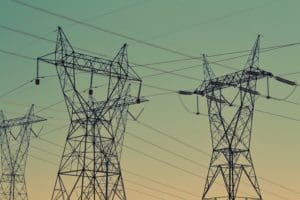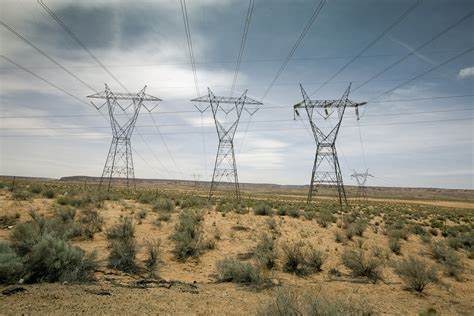
A border county official and a security specialist caution that a proposed 765-kilovolt transmission line could provide opportunities for the Mexican cartel to exploit.
These concerns loom over the Public Utility Commissioners of Texas as it is set to take up the proposed line Friday.
The proposed Howard to Solstice transmission line, a project of electricity delivery companies AEP Texas and CPS Energy, would stretch approximately 370 miles in South and West Texas from the San Antonio to Fort Stockton areas.
It is part of the 765-kV Strategic Transmission Expansion Plan (STEP) Permian, a key part of the Permian Basin Reliability Plan (PBRP). STEP-Permian proposes three transmission lines, broken down into five segments, spanning more than 1,200 miles to move power from East Texas to the natural gas-rich Permian Basin. A pro-landowner group likened this project to “hauling water to the sea.”
The Howard to Solstice line, the southernmost segment, would pass through Kinney County. Bordering Mexico, the county was Texas’ front line during the border crisis under President Joe Biden.
The Public Utility Commission of Texas (PUCT) has the final decision on the project.
Kinney County Judge John Paul Schuster, chairman of the Texas Border Sub-Regional Planning Commission, told commissioners last Friday that the transmission line would increase security burdens.
“For decades, we’ve had to live with illegal immigration, border crime,” he said. “Building this transmission line this size through our part of the country is a super highway, not only into our county but into Texas and in the United States.”
Schuster and Sabinal Mayor Erik Gomez voiced this concern to representatives of AEP Texas and CPS Energy in July.
Ammon Blair, a security specialist at the Texas Public Policy Foundation, also warned that the transmission line would provide a different kind of doorway for Mexican cartels.
“The central danger is not that a smuggler might follow a power line north,” he wrote to Texas Scorecard. “It is that Texas could place strategic energy infrastructure inside an operating environment where cartels already control territory and access from Mexico into the United States and can provide that access to actors whose objectives extend well beyond smuggling.”
Blair described what cartel control looks like: “Major Mexican cartels exercise territorial control, govern communities and economic activity, control transportation and smuggling corridors, field organized paramilitary forces, use military grade equipment, technology, and fight rival groups and the Mexican state for control of territory,” he wrote.
With that type of control, Blair said, these cartels are the gatekeepers of who moves through their regions. This gives foreign adversaries access to the United States that they could not easily gain on their own.
“China, Iran, and other hostile state and non-state actors do not need to seize territory along the U.S.-Mexico border when they can use organizations that already control the approaches to it,” Blair explained.
As previously reported, critics have alleged that the recommended route for the Howard to Solstice line crosses land whose owners are linked with China.
According to Blair, the project would not merely add a transmission line, but a security requirement U.S. Customs and Border Patrol (CBP) cannot absorb, particularly since cartels change operations based on observed patrol activity.
“Border Patrol exists primarily to detect, interdict, and apprehend unlawful cross border movement,” he wrote. “It is not organized to provide persistent protection for hundreds of miles of high-voltage transmission infrastructure, substations, access roads, nearby communities, and other strategic assets.”
In a statement, a CBP spokesperson wrote, “Cartels will attempt to use any tactic they can, especially as we gain more operational control of the border. U.S. Border Patrol adjusts its operational posture as needed to deter and disrupt cartel activity, relying on an agile workforce and a combination of infrastructure, technology, and partnerships to ensure the border is secure.”
Border security is one of the reasons Schuster wants PUCT to deny the Howard to Solstice application. Blair believes the state needs to evaluate the proposed route as a “homeland defense problem tied directly to the armed conflict across the border.”
“The state should examine cartel territorial control opposite the proposed corridor, known avenues of approach, drone and ground surveillance, cross-border and U.S.-side facilitation networks, private-property access, transportation nodes, law-enforcement response times, substations, and other critical points,” he recommended. “It should also determine how easily foreign adversaries or their proxies could obtain access through cartel-controlled networks.”
Texas Scorecard filed a public information request with the Texas Department of Public Safety for records dating to June 2023 concerning the transmission line’s impact on Operation Lone Star and border security efforts. Brian Riemenschneider, the department’s assistant general counsel, responded that DPS had “conducted a good faith search and has determined there are no responsive record(s) to your request.”
Neither PUCT, DPS, nor the Texas Military Department responded to a request for comment before publication.
For Schuster, PUCT’s upcoming decision is not one to be made quickly. “The next great Texans will suffer if we don’t do this right,” he told commissioners.
The Texas Public Policy Foundation estimates the lifetime cost of all STEP projects ERCOT approved through December 2025 at nearly $100 billion, to be borne by ratepayers. Critics have argued that PUCT, ERCOT, and electricity delivery company Oncor transformed a regional reliability directive into a de facto statewide 765‑kV grid plan without an explicit vote by state lawmakers.
In June, 43 lawmakers asked for PUCT to pause the project. After a July Texas Senate committee hearing, where landowners complained about how a rushed process was impacting their private property rights, Patrick and State Sen. Charles Schwertner (R–Georgetown) urged commissioners to reject applications for all pending 765-kV applications.
On August 29, PUCT commissioners gave final approval to the first of the three proposed lines.
Yesterday at a Texas GOP breakfast, Patrick said he was “very disappointed” with PUCT. “I don’t like it when any major agency takes action only four months before session,” he said.
Neither AEP Texas nor CPS Energy responded to a request for comment before publication.
If you are a citizen with information regarding bureaucratic overreach, please email scorecardtips@protonmail.com.