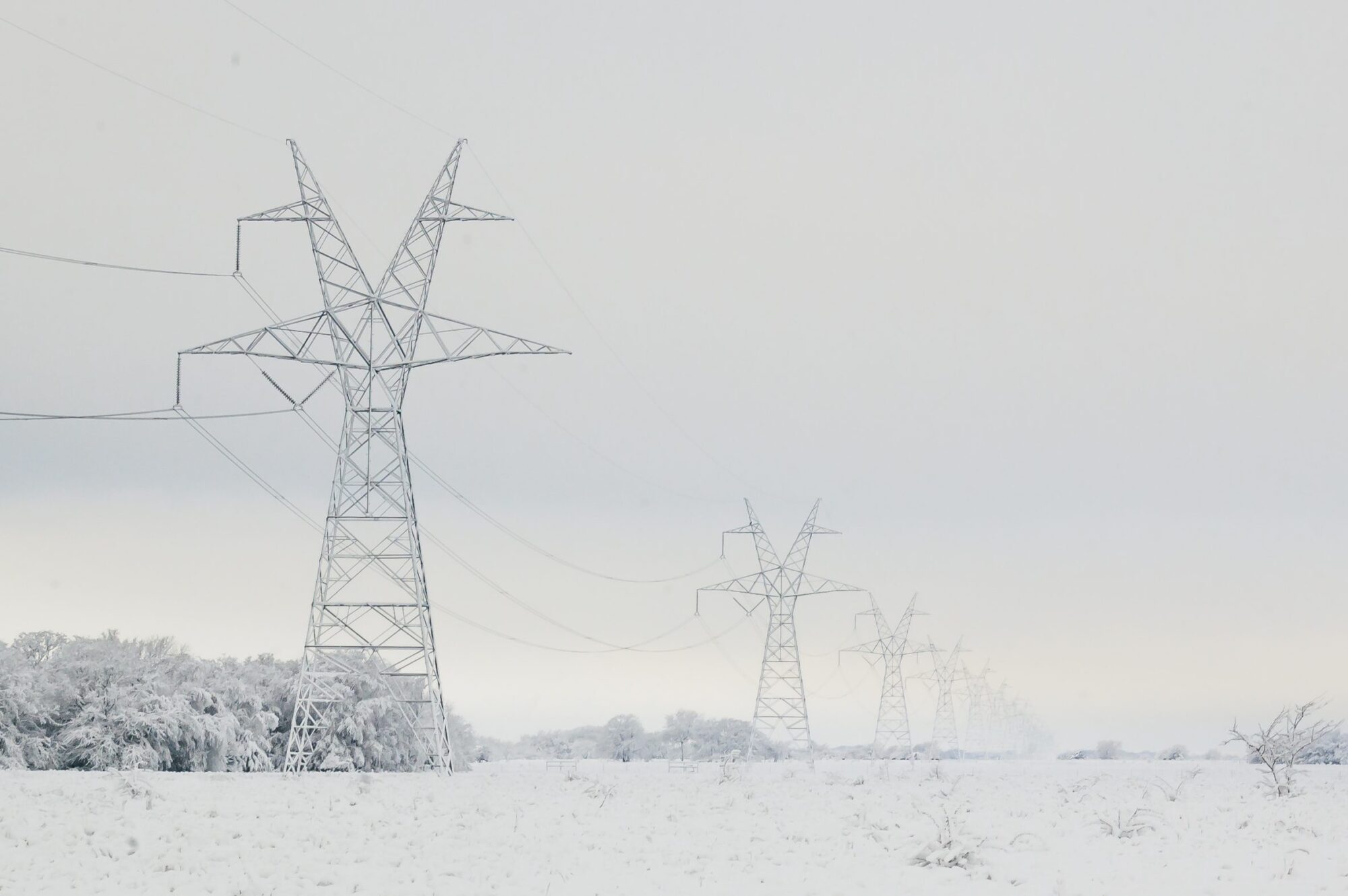
Despite Texas’ new laws and spending after the 2021 winter storm, the risk of winter outages is rising, according to a Texas Public Policy Foundation report.
A data center boom in Texas has added to a surge in electricity demand, while the number of dispatchable power generation sources—such as natural gas and nuclear—remain roughly the same. Intermittent power generation from wind and solar rely on specific weather conditions to function that do not always align during winter peak demand conditions.
Battery storage mitigates the intermittent supply but is costly compared to dispatchable natural gas, and its stores are depleted quickly.
State programs created following the 2021 winter storm provide corporate handouts in the form of low-interest loans and tax breaks in order to incentivize dispatchable generation. Yet, according to the report, only 2.3 gigawatts (GW) of natural gas capacity has been added compared to over 25 GW of solar and 16 GW of battery storage.
Data Center Demand
Data centers comprise the largest demand type as revealed at the ERCOT Board of Directors meeting last week.
Kristi Hobbs, a vice president at ERCOT, stated they have received 225 new large load requests to connect to the grid in 2025 as of November 18. Nearly three-quarters of the demand from those requests are from data centers, amassing a total demand of 164,191 megawatts (MW) or 164 gigawatts (GW).
A report released by ERCOT in November claims 1 MW of electricity can power 250 Texas homes during periods of peak demand. Based on this statistic, 164,191 MW can power over 4.1 million homes during a peak demand period.
Rising electricity demands from new data centers and other large industrial end users in Texas are contributing to ongiong risk of supply shortfalls and lengthening peak demand periods due to their round-the-clock operating pattern, according to the Winter Reliability Assessment by North American Electric Reliability Corporation (NERC).
ERCOT’s Supply
Reserve margins are used to measure the extra unused energy capability of an electric power system at peak load as a percentage of total capability.
These reserve margins serve as a metric to understand the power grid’s reliability during peak demand hours.
“Utilities across the country strive to achieve a 15 percent reserve margin in order to account for power plant failures and other outages that occur during extreme weather events,” the TPPF report stated. “Outages took down over 30 percent of the ERCOT grid during Winter Storm Uri, but even under normal circumstances, outages can easily be up to 10 percent of the system. Hence, the desire for a 15 percent margin.”
Yet the winter reserve margin dropped from 17.5 percent in 2021 to a projected 10.1 percent in 2026, according to the TPPF report.
TPPF attributes the decrease in the winter reserve margins to the increased demand and roughly stagnant amount of dispatchable power generation sources.
Dispatchable generation—on-demand power generation sources like natural gas, coal, and nuclear—is roughly the same as it was during 2021, as shown in the TPPF report.
ERCOT’s Monthly Outlook for Resource Adequacy (MORA) for January 2026 shows a 20 percent increase in winter peak electricity demand since 2021.
According to ERCOT reports for January 2021 and January 2026, over 31 GW of solar and 18 GW of wind has been added to the grid in the past five years.
The NERC assessment explains that during winter, “peak demands typically occur before sunrise and after sunset coinciding with the unavailability of solar generation making the system dependent on wind generation and dispatchable resources.”
However, the TPPF report highlights that “unless the wind happens to blow at the right time, a half day or more of outages is likely.”
Battery storage systems help mitigate this unreliability, but they can only be charged from the extra energy on the grid. If there is no extra energy on the grid, batteries deplete within hours when discharged at peak rates. During a prolonged winter storm with sustained high demand, they provide only a fraction of the reliability that dispatchable gas and coal plants offer.
The TPPF report also explained that the “amount of energy stored in all the batteries in ERCOT is only equal to running a 1 GW gas plant for about a day and a half.”
All of ERCOT’s batteries combined cost as much to build as 7 to 8 GW of gas capacity, according to a research report from June of this year.
The NERC assessment explained “maintaining sufficient battery state of charge will become increasingly challenging for extended periods of high loads, such as a severe multi-day storm like Winter Storm Uri,” warning that Texas’ data centers are exacerbating the issue.
Senate Bill 3 was passed in 2021 following Winter Storm Uri and directed the Railroad Commission to implement the Weather Emergency Preparedness Standards rule, which requires the natural gas supply in Texas to be prepared to operate during weather emergencies.
In the Railroad Commission’s press release regarding the adoption of the rule, Chairman Wayne Christian stated “our current facilities are prepared for the next weather emergency, but we must make sure there are enough of them to meet the energy demands of our growing state.”
Texas Energy Fund
Senate Bill 2627 was passed in 2023 to create a funding mechanism for dispatchable electric generating facilities, laying the foundation for the Texas Energy Fund programs.
Administered by the Public Utility Commission of Texas, the Texas Energy Fund provides grants and loans to finance the construction, maintenance, modernization, and operation of electric facilities in Texas.
As of November 26, nearly $900 million in loans has been dispersed to six projects under the In-ERCOT Generation Loan Program since the first award date on July 1. The loans given to these corporations under this program have a fixed rate of 3 percent interest under the condition that the facility will add at least 100 MW or 0.1 GW of new dispatchable generation capacity to the ERCOT grid.
This isn’t the only assistance these projects can get.
One project was awarded an additional tax break by Texas’ Jobs, Energy, Technology, and Innovation (JETI) corporate handout program, which provides a school district property tax break for companies that provide a qualifying number of required jobs.
The JETI program provides an additional property tax break to projects located within federally designated Qualified Opportunity Zones. Another project by the same company received a Texas Energy Fund low-interest loan and the JETI tax break and is eligible for the additional federal Qualified Opportunity Zone tax break.