This article has been updated since publication.
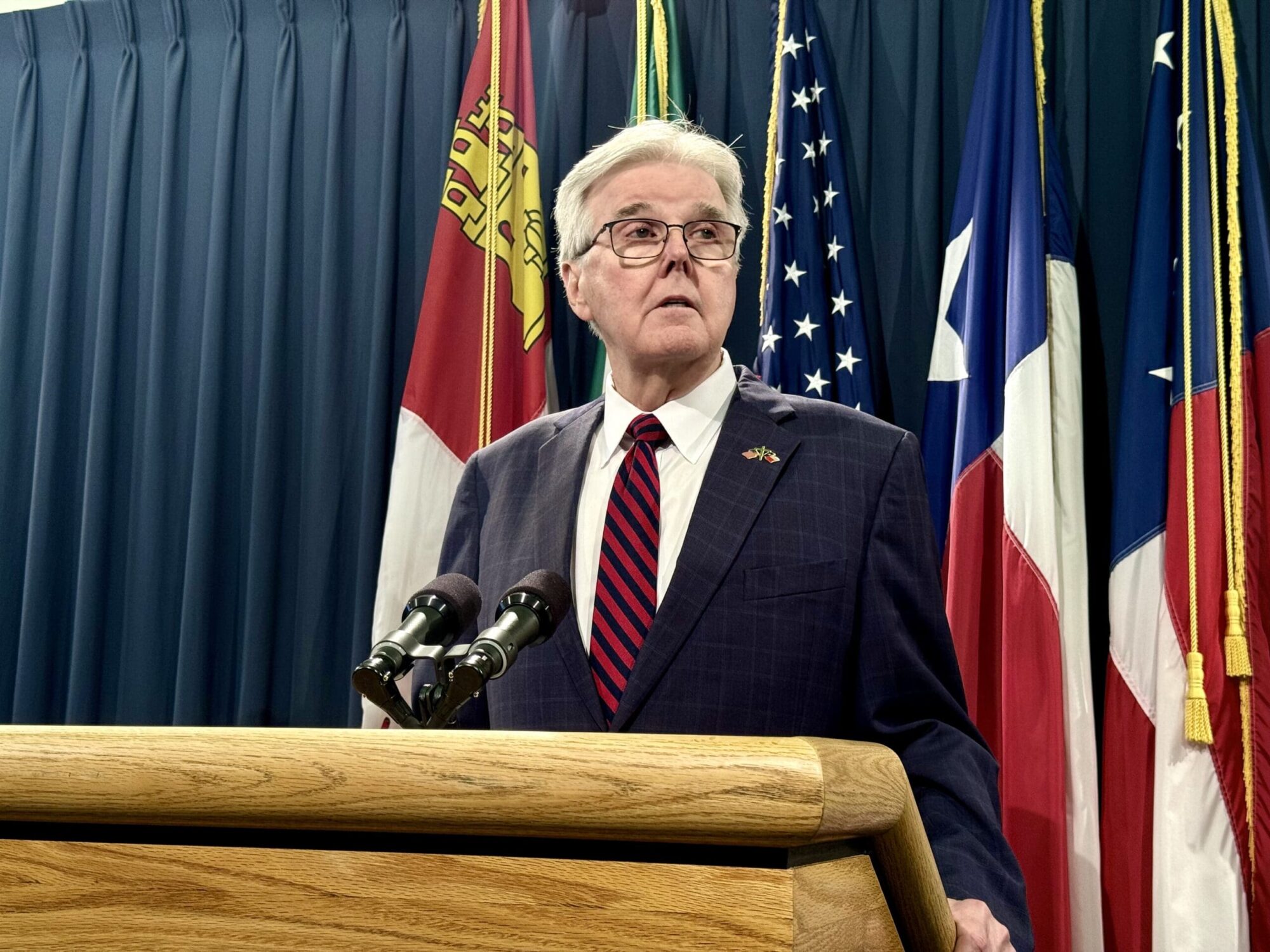
Lt. Gov. Dan Patrick says he has “lost total confidence and trust” in ERCOT Chairman of the Board Bill Flores in a social media post. This came after the board backed down from a contract extension for ERCOT President and CEO Pablo Vegas, which Patrick had criticized.
Since then, it was widely reported that Flores said he had “three conversations” with Patrick about the board’s direction on approaching contract decisions. Flores later corrected himself, saying he had not spoken with Patrick three times but had instead informed the Office of the Governor about Vegas’ extension.
Patrick wrote on Wednesday evening that Flores “has changed his story multiple times to my office,” the Public Utility Commission of Texas, and a news publication.
“He clearly has a problem keeping facts straight,” Patrick posted to X on Wednesday evening. “I’ve lost total confidence and trust in ERCOT Board Chair Flores to look out for Texas ratepayers and to be the Chair of the ERCOT board.”
ERCOT did not respond to a request for comment on Patrick’s statement.
The conflict started on Tuesday.
According to an ERCOT presentation, the board was considering an extension that, if passed, would allow Vegas to earn a maximum of $6.4 million that would be paid out over time. This includes a final “make-whole payment” of $1.3 million, finishing the $6.6 million ERCOT agreed to pay Vegas to cover what he would have earned from his previous employer, NiSource.
Of that amount, Vegas’ maximum base pay plus incentives earned next year would be $4.4 million if he met key performance indicators (KPIs) the board set. Not all of that would be paid at once.
The presentation file showed a short-term incentive target of 100 percent of his base salary, which under the extension would be $1.1 million, would be paid out on or before March 15, 2028. A long-term incentive target increases from $420,000 for the 2024-26 period to 180 percent of his salary, approximately $2 million, which would be paid out on or before March 15, 2030.
These would continue to be paid out until 2033, when Vegas would have received payments of long-term incentives earned in 2030, 2031, and 2032 had he met KPIs.
It was widely reported that Vegas’ maximum potential pay this year is $4 million if he met all KPIs.
According to a document ERCOT shared with Texas Scorecard, ERCOT would have paid Vegas at most $4.13 million in 2027, with the new long-term incentive and retirement benefits coming later. His base pay in 2027 would have increased 7 percent from $1.08 million to $1.16 million, while his total compensation package increase from 2026 to 2027 would have been 2.7 percent.
According to Vegas’ October 2022 agreement, his starting base pay in 2022 was $990,000.
The contract extension would have increased the long-term incentive target of $420,000 if KPIs were met. Payouts of these were not scheduled to begin until the fourth quarter of 2026, which would cover the incentive earned in 2023, and end in the fourth quarter of 2030.
ERCOT did not respond before publication when asked for the KPIs in his current agreement and the extension.
On Tuesday evening, Patrick posted on social media that as soon as he learned of the extension, he told Flores and Thomas Gleeson, chairman of the Public Utility Commission of Texas, that they should “immediately reverse” the action if they wanted to be on the side of ratepayers and let state lawmakers weigh in next year.
“During a time of increasing utility costs, this is not the time to give the CEO of ERCOT a multi-million-dollar pay raise on the backs of ratepayers,” Patrick wrote. “I am against this increase, and I think the legislature will agree that the amount is shocking.”
In a statement to Texas Scorecard, an ERCOT spokesperson wrote, “The ERCOT Board and PUCT on September 15 voted to authorize the extension of the CEO contract. The Board did not finalize the contract. The current contract doesn’t expire until the end of 2027.”
Rising Utility Rates
PriceOfElectricity.com reports that the average Texas residential electricity rate has increased more than 32 percent from 2021 to January-June 2026, from 12.15 cents to 16.14 cents per kilowatt-hour. Vegas became ERCOT CEO and president in October 2022.
In its December 2025 report, the Texas Energy Poverty Research Institute projected that “residential electricity prices across the ERCOT Competitive Retail Market are expected to rise by 29% from 2025 to 2030,” driven largely by transmission and distribution investment.
The report’s authors cautioned that their projections “are likely conservative because the analysis does not account for potential additional cost drivers such as extreme weather events, tariff adjustments, or the phase-out of renewable generation subsidies.”
When asked about Vegas’ plan to lower utility rates, the spokesperson replied that “ERCOT does not set or regulate retail electricity pricing. Texas has a deregulated retail market — rates are set by competitive retail electricity providers (REPs), with oversight from the Public Utility Commission of Texas (PUCT), not ERCOT.”
The response continued that “ERCOT’s role is limited to operating the grid and administering the wholesale market to ensure reliability. Questions about strategies to lower residential rates would be best directed to PUCT or to retail providers directly.”
This is the latest in a series of conflicts between Patrick and PUCT. On September 9, Patrick said he was “very disappointed” after PUCT commissioners had voted to approve the first of three proposed 765-kilovolt transmission lines, spanning more than 1,200 miles from East Texas to the natural-gas-rich Permian Basin.
PUCT commissioners approved the second line on September 11, while remanding the third to the State Office of Administrative Hearings.
An applicant for the second approved line is AEP Texas, where Vegas served as president and chief operating officer.
Part of the Strategic Transmission Expansion Plan (STEP), the Texas Public Policy Foundation reports that these 765-kV transmission projects will increase ratepayers’ burdens. The Foundation estimates the lifetime cost of all STEP projects ERCOT approved through December 2025 at approaching $100 billion.
In July, Patrick and State Sen. Charles Schwertner (R–Georgetown) had urged PUCT to deny all pending applications until lawmakers could review the approval process.
Gov. Greg Abbott’s office did not respond to a request for comment before publication.