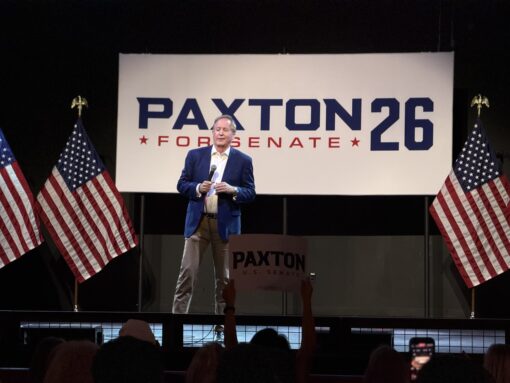
Attorney General Ken Paxton has joined the Republican Party of Texas in its legal effort to close the state’s GOP primary elections, filing a joint motion with the party to strike down what it calls an unconstitutional provision of the Texas Election Code.
The motion, filed Thursday, supports the party’s ongoing lawsuit against the State of Texas and Secretary of State Jane Nelson. That lawsuit argues that Texas’ open primary system—which allows Democrats and independents to vote in Republican primaries—violates the GOP’s First Amendment right to free association.
“This unconstitutional law stopping the RPT from closing its primaries is completely indefensible and a slap in the face to the Republican Party and voters,” said Paxton. “I am in total agreement with the RPT that this law is deeply flawed and a violation of the First Amendment.”
Paxton’s motion urges the court to declare the relevant sections of the election code unconstitutional and allow the Texas GOP to limit participation to those who have affiliated with the party.
In states with closed primaries—such as Florida, New York, and Kentucky—voters must declare their party affiliation in advance, often as part of their voter registration, to participate in that party’s primary election. That means only registered Republicans can vote in Republican primaries and only registered Democrats in Democrat primaries—unlike Texas’ current system in which voters can choose either ballot on election day without party registration.
“Many other states have closed primaries, and there is absolutely no reason that Texas shouldn’t have the freedom to join them,” Paxton said.
He also called on the secretary of state to stop opposing the case and instead help implement the change.
“The Secretary of State must follow the Constitution by swiftly implementing this consent decree,” Paxton said. “Instead of fighting this lawsuit with expensive out-of-state lawyers, the Secretary of State’s office should respect the will of Texas voters and defend their freedoms by creating a process that will allow the RPT to immediately close its primaries.”
The move is extraordinary, as the attorney general is effectively siding against another arm of the state government. Normally, the attorney general’s office represents the secretary of state in election-related litigation. But in this case, Nelson’s office has retained outside counsel Clement and Murphy to defend the open primary system while Paxton joins the party in challenging it—placing two arms of state government on opposite sides of the same case.
The joint motion marks a significant escalation in the party’s lengthy fight to close its primaries. In September, the Republican Party filed suit in federal court seeking judicial relief to enforce Rule 46, which stipulates that only registered Republicans may vote in GOP primaries.
That rule was adopted after 73 percent of Republican voters supported a 2024 ballot proposition calling for closed primaries. Party leaders have pointed to Democrat interference in recent elections, including former House Speaker Dade Phelan’s narrow 2024 runoff win, as justification for the change.
Texas GOP Chairman Abraham George praised Paxton’s action, calling it “a triumph for every state convention delegate, grassroots activist, precinct chair, and Republican voter.” In a statement, George said Democrats have “exploited our open primary system to undermine our nominees,” arguing that closing the primaries is essential to ensuring “Republican voters—not Democrats—choose our nominees.”
He also called on Nelson to “cease obstructing Texas grassroots conservatives and squandering taxpayer funds on costly legal battles against the Republican Party of Texas.”
If successful, the joint motion could pave the way for Texas to join other states that require formal party registration before voting in primaries, potentially reshaping how Republican candidates are chosen in 2026 and beyond.
Late Thursday, Secretary of State Jane Nelson filed a notice opposing the joint motion for entry of consent judgment, stating she was given insufficient time to respond and will submit a formal opposition according to court deadlines.