At a hearing last week, Texas landowners said they were not properly notified that proposed routes for an extra-high-voltage transmission line would come into proximity with their land. The utilities insisted that they followed state notice requirements.
This issue was raised during the administrative law hearing for the 765-kilovolt Bell County East to Big Hill transmission line, proposed by utility companies Oncor and the Lower Colorado River Authority Transmission Service Corporation. Spanning about 199 miles from just north of Austin to south of San Angelo, it forms the central 765‑kV import path together with the Big Hill to Sand Lake segment from south of San Angelo to Pecos.
That central path is one of three proposed extra‑high‑voltage import paths designed to move large amounts of power across Texas into the energy-rich Permian Basin. Critics have argued that the Public Utility Commission of Texas (PUCT), the Electric Reliability Council of Texas (ERCOT), and Oncor transformed a regional reliability directive into a de facto statewide 765‑kV grid plan without state lawmakers’ authorization.
Participants in last week’s hearing repeatedly cited the requirement for public notice, found in Title 16 of the Texas Administrative Code.
Ann Mewhinney Matous said she had only 13 days to respond when she received notice on April 3, 2026, of a proposed link for the line, link C4, coming through her property.
Oncor representative Brenda Perkins said that the link was added after a June 2025 public meeting, where preliminary routes for the line were discussed with affected landowners who attended. Afterwards, some routes were added, modified, or removed.
Link C4 was added as an alternative, which Perkins said is why Matous did not receive a direct mail notice of public meetings. Perkins said notifications were posted on social media and in newspapers and that the applicants went above and beyond the state code by, for example, publishing in 11 newspapers.
G73 was another link added after Oncor’s and LCRA’s public meetings. Perkins admitted that G73 landowners did not receive mail notification of the link’s creation until late March 2026, after the public meetings had taken place.
These are not isolated issues, according to attorney David Brown, representing the Colorado River Alliance.
Brown told Texas Scorecard that, while hundreds of landowners are participating in the hearing, thousands originally chose not to because the initial proposed routes did not affect them. Then, during the process of participating landowners responding to the utilities, the parties reassembled or modified proposed links into new routes that affect some nonparticipants. “They don’t know about it until the condemnation authority comes along and starts doing eminent domain.”
“That’s why it’s important that every route at least follow the rule on notice, and the rule on notice is if there’s a route that’s proposed, then it goes to everybody who’s affected by the route, including nonintervenors,” he said. “The commission can fix its notice rule, and if it did that, the problem would probably be solved. It wouldn’t be any better for people who didn’t intervene, but at least the rule would be clear.”
Landowner Erik Gulbranson, representing himself because no other attorneys were available, said that the properties of nearly 1,400 landowners were added in new routes after the public meetings. He asked former PUCT Commissioner Will McAdams if they should be given a day-for-day extension as the public notice code requires.
“If they did not follow each condition of the Texas Administrative Code, which you cited … you have grounds for extension and basically re-notice,” McAdams replied. When asked by Oncor’s attorney Jaren Taylor, McAdams confirmed he was referring to whether these landowners had received notice of the application for the project.
In statements to Texas Scorecard, both Oncor and LCRA spokespersons maintain both companies “complied with all state laws and regulations” in notifying landowners, and Oncor added, “The administrative law judges presiding over this project have already concluded that we properly followed the law.” Oncor’s full statement included copies of its published application and meeting notices.
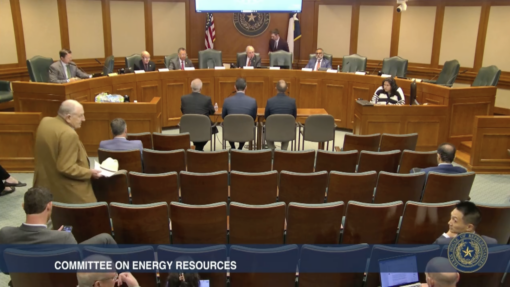
Administrative Law Judges Linda Burgess and Linda Brite, who presided over last week’s hearing, will make a recommendation to the PUCT commissioners on whether to approve the project. The commissioners will make the final decision regarding this line and the other four segments of the three proposed 765-kV lines.
PUCT will decide on the first segment at its June 17 hearing. PUCT did not respond to a request for comment before publication.