Texas’ top oil and gas associations are urging state leaders to stay the course on a massive new transmission buildout into the Permian Basin, pushing back on a recent Texas Public Policy Foundation study that called for a pause on the project after connecting it with industrial companies’ “net zero” goals.
In a June 10 memo to Gov. Greg Abbott, Lt. Gov. Dan Patrick, House Speaker Dustin Burrows, and lawmakers, groups including the Texas Oil & Gas Association and Permian Basin Petroleum Association argued that data shows load growth in far West Texas already outpacing the grid.
They cite assessments from the Electric Reliability Council of Texas (ERCOT) warning that, under stressed conditions, transmission import limits in the region could be exceeded, requiring pre‑emptive load shedding to prevent wider outages.
The fight centers on the Permian Basin Reliability Plan and ERCOT’s 765‑kV Strategic Transmission Expansion Plan (STEP)—a web of extra‑high‑voltage lines for moving power from East Texas into the energy‑rich Permian.
What began as a targeted reliability fix has morphed, through agency actions, into a multibillion‑dollar statewide network of 765‑kV lines, with lifetime costs approaching $100 billion.
Critics—including property‑rights groups and TPPF—say state bureaucrats and utilities expanded the plan beyond state lawmakers’ original intent with minimal public input, threatening landowners with thousands of miles of new right‑of‑way with little time to respond, raising power bills, and helping large industrial customers and renewable developers meet “net‑zero” targets without adding reliable generation in West Texas.
Because of the abundance of natural gas in the Permian Basin, one critic has equated the proposed transmission lines to “hauling water to the sea.” They argue that adding 4–5 gigawatts of new gas generation in the region could address reliability needs without building all three 765‑kV import paths.
The oil and gas groups’ memo claimed “relying solely on localized generation … requires unfounded assumptions detached from market realities.” They contend that both new generation and new long‑distance lines are needed, and warn that further delays in transmission construction will prolong interconnection backlogs, increase the risk of localized outages in the Permian, and make it harder to attract industrial investment.
The Texas Public Policy Foundation and a state lawmaker pushed back on the associations’ claims.
TPPF disputed the Oil & Gas memo on X. “Whoever wrote the letter either didn’t read @TPPF’s report or doesn’t understand it. The report correctly and unequivocally demonstrates that STEP is unreliable, unaffordable, and unnecessary,” posted Brian Phillips, TPPF’s chief of communications.
“We support local transmission upgrades and more reliable, energy dense generation, especially in the Permian Basin. We oppose statewide transmission that will primarily facilitate more wind and solar on the grid. The memo obscures that important distinction,” Dr. Brent Bennett, the author of the study, wrote to Texas Scorecard.
“The associations that signed the memo have also said they support more gas generation across the state. We would welcome their cooperation with us to help meet that goal and to stop the overbuilding of wind and solar that is causing the need for so much new transmission,” added Bennett.
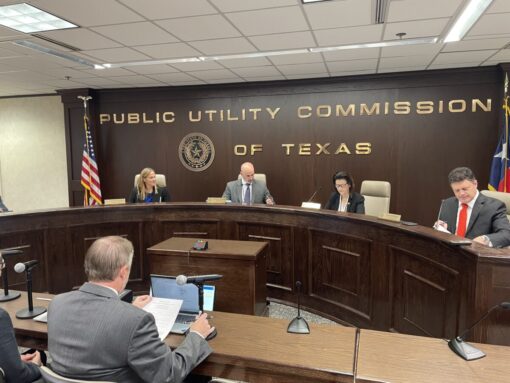
The Public Utility Commission of Texas, whose commissioners Gov. Greg Abbott appointed, will make the final decision on the three proposed 765-kV import paths. They will take up the first of five sections of the lines at their June 17 meeting.
Landowners and a pro-landowner group are fighting for more time to ensure PUCT takes all the facts into consideration before making a decision. Twenty-five state lawmakers have asked for PUCT to pause the project.
State Rep. Brad Buckley (R–Salado) is among them. “A statewide transmission plan deserves an in-depth and thoughtful discussion in the 90th [Legislative Session] when the property rights of thousands of Texans are at stake,” he wrote in response to the oil & gas memo. “Vistra is expanding reliable, local, gas-fueled power generation in the PB. Upgrade local transmission in the region as authorized in the PBRP.”