This article has been updated since publication.
Local officials grilled Oncor on its proposed extra-high-voltage transmission line’s impact on both known and unknown local water supplies, whether the company will inform landowners if it discovers a new well while building on their property, and who would pay for relocating it if needed.
Multiple government water agencies stated that Oncor had not contacted them.
This regards the 765-kV Bell County East to Big Hill transmission line, proposed by utility companies Oncor and the Lower Colorado River Authority (LCRA) Transmission Service Corporation. Spanning about 199 miles from just north of Austin to south of San Angelo, it links with the Big Hill to Sand Lake segment from south of San Angelo to Pecos.
This line is part of the 765-kV Strategic Transmission Expansion Plan (STEP) Permian, a key part of the Permian Basin Reliability Plan (PBRP). STEP Permian proposes three transmission lines spanning more than 1,200 miles to move electricity from East Texas to the natural gas-rich Permian Basin. The Bell County to Sand Lake line forms the center pathway. A pro-landowner group likened the project “to hauling water to the sea.”
Critics have argued that the Public Utility Commission of Texas (PUCT), the Energy Reliability Council of Texas (ERCOT), and Oncor transformed a regional reliability directive into a de facto statewide 765‑kV grid plan without an explicit state lawmakers’ vote.
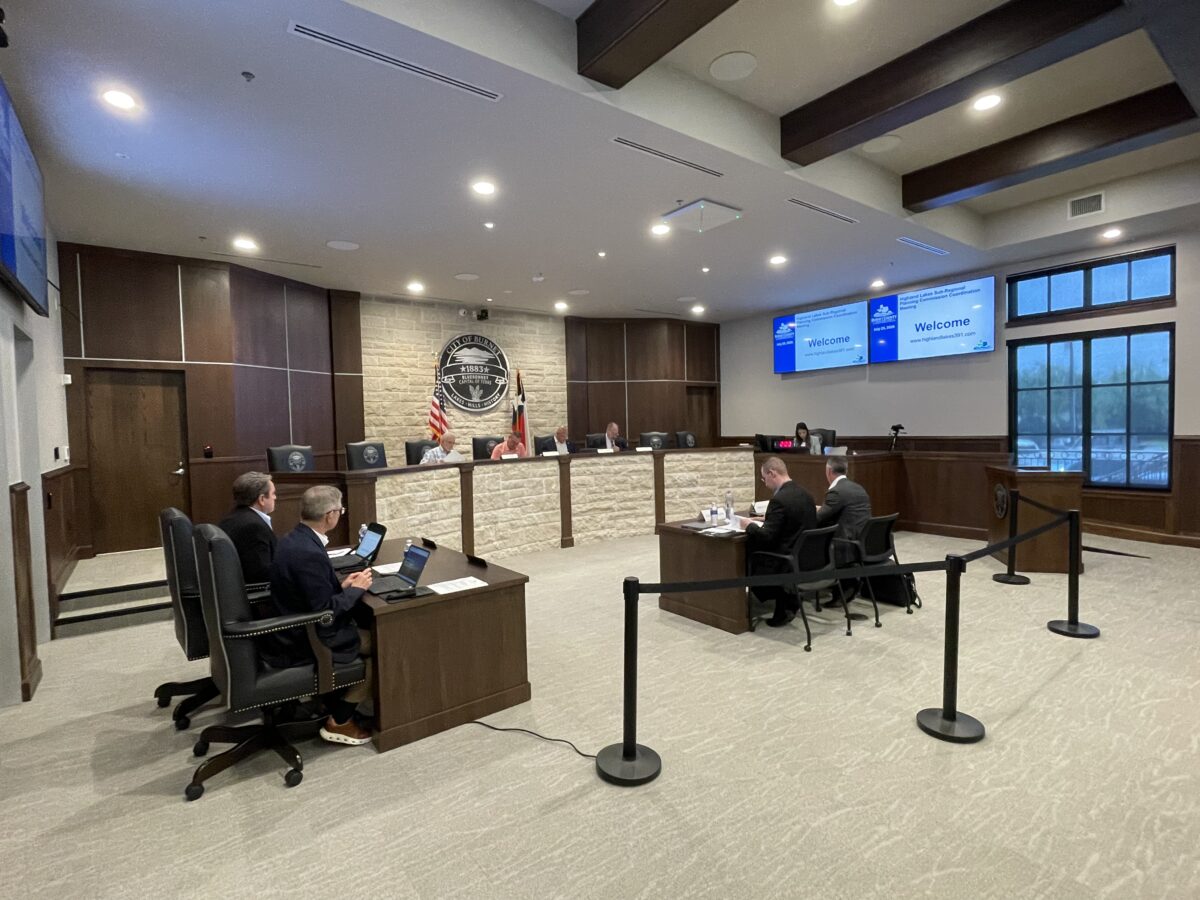
Members of the Highland Lakes Sub-Regional Planning Commission questioned Oncor Director of Regulatory Thomas Yamin and attorney Jaren Taylor at a July 23 meeting. The commission is composed of officials from the City of Marble Falls and Burnet city and county.
Both at the local and state level, Texas has multiple governing bodies when it comes to water. County commissioner Damon Beierle asked Oncor’s representatives if the company had “formally coordinated” with LCRA’s Water Management Division and the Brazos River Authority on Burnet County’s watersheds. Taylor said they were “immensely coordinating” with LCRA but when it came to the BRA, he replied, “I do not know the answer. Apologies.”
Riley Woods, senior staff counsel with BRA, told Texas Scorecard that, except for an 81-page packet received a month ago on the Bell County East to Big Hill project, “we have no communications with Oncor” regarding 765-kV lines.
“The only obligation they would have to talk to us is if they are crossing land that we own,” Woods said. “We can’t force somebody to engage with us, but we usually like to try to get a consent to cross our line agreement or something like that … as far as I’m aware and can find, they’ve not come to us seeking an easement across any of our properties for any of these 765 lines.”
Beierle also asked if Oncor had sent the U.S. Army Corps of Engineers a pre-construction notice to determine whether a nationwide permit or an individual permit would be required under Section 404 of the Clean Water Act. Taylor replied “not at this time” because PUCT commissioners had not yet chosen a final route for the proposed segment.
Water Wells
The commission questioned Oncor more. Beierle asked what procedures the company would follow if construction crews encountered an unreported or abandoned well. Taylor replied that “typically” such wells would be marked, then a determination would be made as to whether or not the well would be avoided and left in place, or would have to be relocated.
Beierle asked how Oncor would notify the landowner and whether it would notify the groundwater conservation district if an unreported or abandoned well was encountered. “I honestly don’t know,” Taylor replied. When asked if Oncor would pay for relocation, Taylor said, “It’s an issue that’s settled within the acquisition of the property.”
In a statement to Texas Scorecard, the Texas Water Development Board (TWDB) advised that, regarding abandoned wells, the Texas Department of Licensing and Regulation has a process for reporting them and that they can be reported to the local groundwater conservation district.
“When the TWDB encounters these types of wells, we coordinate with TDLR or [local groundwater conservation districts] to address the issue,” the TWDB spokesperson wrote. “[T]he TWDB maintains groundwater data and well records that are submitted to the agency but does not regulate construction activities or enforce groundwater protection requirements associated with infrastructure projects.”
Beierle asked if Oncor had coordinated with the Central Texas Groundwater Conservation District (CTGCD), Texas Commission on Environmental Quality (TCEQ) and TWDB regarding well documentation and plugging requirements. Taylor replied, “I do not know.”
CTGCD wrote Texas Scorecard that Oncor had not contacted them. TWDB replied that “Oncor has not directly coordinated with TWDB Groundwater Division staff through our public inquiry channels.” The board also advised that TCEQ is “responsible for water quality standards and enforcing environmental laws and regulations.” A TCEQ spokesperson stated that TDLR has rules on plugging wells.
TDLR did not respond to a request for comment before publication.
Aquifers
Bierele asked if Oncor coordinates with TCEQ or the local water district on aquifer protection. Yamin replied that they do “some TCEQ coordination” but he’d have to check on the specifics.
Ricky Richter, a TCEQ spokesperson, provided a statement to Texas Scorecard.
“To date, the TCEQ’s Edwards Aquifer Protection Program (EAPP) has not been contacted by Oncor to discuss the Bell County East to Big Hill transmission line. It does appear part of the project is planned for Williamson County, portions of which are regulated by EAPP,” he wrote. “If regulated activity occurs within EAPP regulated boundaries, plans may be required for an increase in impervious cover, such as buildings, parking lots, or roads. Installation of electric lines themselves are exempt from EAPP plan requirements under” Section 213.5 of Title 30 of the Texas Administrative Code.
Regarding the Trinity, Hickory, or Ellenberger Aquifers, Beierle asked if Oncor had had any contamination issues in the past, and what engineering measures it would use to prevent contamination.
Yamin replied that he was “not aware of any” contamination issues, and Taylor said that an Oncor engineer had spoken of “various mechanisms” to use “casing foundations for the transmission towers to avoid that contamination.” Yamin added that there are “other tools in the tool belt” on different foundation designs that could be used.
TWDB stated that aquifer protection “is generally not within” its statutory role, and questions on that, as well as potential impacts to local groundwater resources or expectations for construction activities, should be asked of local groundwater conservation districts. Bell County is within the Clearwater Underground Water Conservation District (CUWCD).
CUWCD General Manager Whitney Ingram wrote in a statement that Oncor had not coordinated with them, but “we are aware of the project.”
“Oncor is the largest transmission provider in Texas. Whether they are working in a county with a groundwater district or not, their process for encountering abandoned water wells should have the same core standards set by the TDLR,” Ingram stated. “We know that abandoned and/or deteriorated wells serve as direct conduits to groundwater. It’s the best policy for Oncor to make the District formally aware of construction activities within the county and regarding any water wells that are encountered during construction.” Ingram’s full response may be read here.
TWDB advised that the Bell County East to Big Hill line may go through additional jurisdictions.
Currently, water is a statewide concern. The Texas Water Development Board on July 24 gave initial approval to the $174 billion State Water Plan to address the state’s water needs for the next 50 years. The board had previously warned that if recommended projects in the plan are not built, by 2080 roughly one in four Texans will have less than half the city water stores needed for a record-breaking drought.
TWDB has stated it does not evaluate transmission line impacts on water sources and that each of Texas’ 16 Regional Water Planning (RWP) groups is responsible for its own regional water plan. When board staff “occasionally receive notifications from electric utilities regarding proposed transmission line projects, available maps and project schematics” are reviewed to see if “any recommended water management strategies identified in the state or regional water plans may be affected.” If such a strategy is identified, TWDB communicates that to the utility.
The Burnet County area falls under the Region K Planning Group. This group did not respond to a request for comment before publication.
“Oncor’s and LCRA’s agency coordination and an assessment of potential impacts on groundwater resources are documented in the Environmental Assessment filed with the CCN application,” Oncor spokesman Andrew Clark wrote. “Oncor will determine the need for additional coordination with local and regional governmental entities based on the route selected by the Public Utility Commission of Texas.”
He continued that “Oncor routinely builds transmission lines in proximity to wells, aquifers, and other groundwater resources across the state and will follow its standard practices to identify and avoid impacts to those resources. Oncor will continue to follow all applicable rules and regulations and coordinate with the appropriate stakeholders as this critical project progresses.”
PUCT commissioners, who are appointees of Gov. Greg Abbott, are expected to decide on the Dinosaur Switch to Longshore Switch segment of STEP Permian sometime in August.
If you are a citizen with information regarding bureaucratic overreach, please email scorecardtips@protonmail.com.