Administrative law judges issued a recommendation on a proposed 765-kilovolt transmission line. With lawmakers asking all final decisions be delayed until they take it up themselves, the stage is now set as to whether the appointed members of the Public Utility Commission of Texas will side with landowners or transmission companies.
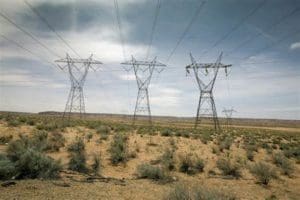
This is in regards to electricity delivery company Oncor’s proposed Dinosaur Switch to Longshore Switch 765-kilovolt transmission line. If approved, it would span 235–270 miles from near Glen Rose to west of Forsan.
This line is part of the 765-kV Strategic Transmission Expansion Plan (STEP) Permian, a key part of the Permian Basin Reliability Plan (PBRP). STEP Permian proposes three transmission lines spanning more than 1,200 miles to move electricity from East Texas to the natural gas-rich Permian Basin, with a lifetime cost estimate reportedly approaching $100 billion. A pro-landowner group likened the project “to hauling water to the sea.”
Dinosaur to Longshore would join with the Longshore to Drill Hole line to form the northernmost line. On June 17, commissioners of the Public Utility Commission of Texas voted to “abate” a decision on the Longshore to Drill line until the Dinosaur to Longshore segment finished its process through the State Office of Administrative Hearings (SOAH).
Critics have argued that the Public Utility Commission of Texas (PUCT), the Energy Reliability Council of Texas (ERCOT), and Oncor transformed a regional reliability directive into a de facto statewide 765‑kV grid plan without authorization from state lawmakers.
On July 24, SOAH administrative law judges Pratibha J. Shenoy and Brent D. McCabe issued a Proposal for Decision with Memorandum, recommending which of the routes for the proposed line PUCT commissioners should choose “to the extent the Commission approves the Application.” The decision is now set for PUCT consideration.
Three days earlier, State Sen. Kevin Sparks (R–Midland) and State Rep. Brad Buckley (R–Salado) requested PUCT delay a decision on “all 765-kV segments” until after the 2027 legislative session. Texans for Responsible Infrastructure Investment (TRII), a pro-transmission coalition whose members include Oncor and other transmission companies that stand to profit from these lines, opposed the request.
A central conflict point is grid stability. As previously reported, transmission service providers admitted that reliance on wind and solar power is driving Permian Basin energy issues. Dr. Brent Bennett of the Texas Public Policy Foundation wrote that “many” industrial consumers want access to wind and solar power to meet net-zero emissions goals, instead of building reliable, on-site natural gas generation.
Furthermore, he wrote that more transmission “does not ensure that enough new reliable generation will be built to meet demand and could even discourage such generation if the transmission provides wind and solar favorable market access.”
State lawmakers and the transmission coalition are divided on the reported growth of reliable natural gas generation in development. Sparks and Buckley wrote that there are now 71 gigawatts of gas generation in the development queue, compared with 22 GW in 2024 when ERCOT completed the PBRP. They wrote that 20 GW is in the queue for West Texas, far outpacing the “roughly 6 GW of transfer capacity” of the proposed 765-kV lines.
TRII, of which Oncor is a founding member, argued that “a queue position” is not a “guarantee” a plant will be built.
This new planned gas generation is one of the parameters Sparks and Buckley asked ERCOT to include in a “full reappraisal” of the 765-kV project. They also requested PUCT to review “market design changes that could bring online the gas generation needed to avoid the 765-kV lines.”
TRII argued that this review “already happened” with the PBRP.
Transmission companies appear to be surging forward despite the letter from Sparks and Buckley. They are holding public meetings in Wharton and Refugio counties on a line that is part of the second phase of the STEP project. One meeting is the day of, and another the day before, the Texas Senate Business & Commerce Committee July 29 public hearing on the state grid and ways to mitigate the 765-kV lines’ impacts on private property rights.
Multiple landowners wrote to PUCT commissioners, asking them to heed Sparks’ and Buckley’s request to delay a final decision.
Meredith McCall, on behalf of Little McMountain Ranch, LLC, and Walter McCullough, wrote that the “over twenty-five letters” from lawmakers “is a signal that the 765 KV Import paths are outside the scope of” House Bill 5066 “and should be delayed or completely denied.”
HB 5066 is the state law transmission companies cite as authorizing the 765-kV projects. Critics argue it only authorized a regional reliability directive.
“I have learned firsthand that the 765-kV CCN applications raise more questions than they provide answers. Legislative measures could be taken to enable the PUC to shift its procedural oversight of our electrical grid away from processes decided by legal wranglings to one of decisions based on collaborative science and engineering that has been thoroughly reviewed by independent, subject matter experts,” landowner Kevin Kennedy wrote in a July 26 letter to the commissioners. “The citizens of Texas can only benefit from greater scrutiny of these proposals.”
In a statement, an Oncor spokesman wrote “As stated previously, Oncor will continue to follow the long-established regulatory process for transmission line projects. We appreciate the Administrative Law Judges’ thoughtful review of the project and look forward to the PUCT’s final decision.”
PUCT did not respond to a request for comment before publication. All five commissioners are appointees of Gov. Greg Abbott.
These segments are part of phase one, called STEP Permian, of a larger project. The ERCOT board endorsed STEP’s two other phases in December 2025. These are the STEP-Western and STEP-Eastern 765-kV transmission lines.
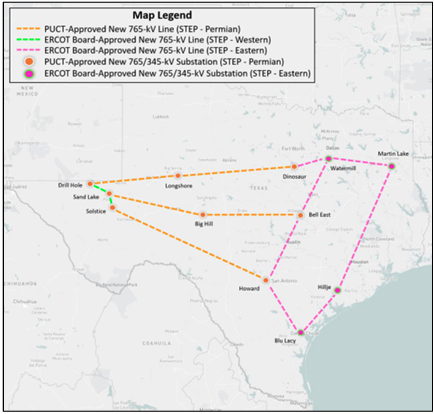
Transmission companies CenterPoint Energy and AEP Texas are holding public meetings this week on one of the STEP-Western lines, with one scheduled the same day as the state senate committee meeting.
If you are a citizen with information regarding bureaucratic overreach, please email scorecardtips@protonmail.com.