This article has been updated with a response from the Lower Colorado River Authority.
Officials in McCulloch County, located roughly 140 miles northwest of Austin, have expressed opposition to all proposed routes for a 765-kilovolt transmission line that would cross through the county. A county commissioner expressed concerns about the line’s potential impacts on the county’s flood control structures and roads, both damaged in the July 2025 flood.
Additional concerns have been raised over the county’s five aquifers, as the companies pushing the line have not confirmed any coordination with the region’s water planning group to avoid impacting them.
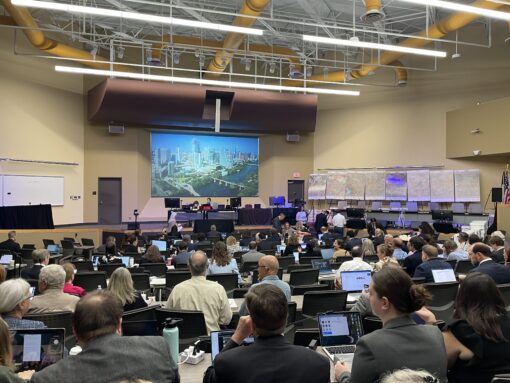
McCulloch County Commissioner Carol Anderson raised these concerns during the administrative law hearing for the 765-kilovolt Bell County East to Big Hill transmission line, proposed by utility companies Oncor and the Lower Colorado River Authority Transmission Service Corporation (LCRA TSC). Spanning about 199 miles from just north of Austin to south of San Angelo, it forms the central 765‑kV import path together with the Big Hill to Sand Lake segment from south of San Angelo to Pecos.
That central path is one of three proposed extra‑high‑voltage lines designed to move large amounts of power across Texas into the energy-rich Permian Basin. Critics have argued that the Public Utility Commission of Texas (PUCT), the Energy Reliability Council of Texas (ERCOT), and Oncor transformed a regional reliability directive into a de facto statewide 765‑kV grid plan without state lawmakers’ authorization.
“The clearing of a 200 foot easement for every 1000 feet for a [transmission] tower would significantly cause more risk for flooding in our county and more erosion to the landscape,” Anderson said June 12 during the hearing.
Damage from the July 2025 flood is still fresh in Anderson’s mind. She said that close to 800,000 cubic yards of tonnage was removed from the San Saba River area and that the flood widened the river banks and threatened the bridges running along it.
“We had extensive road damage, and in such [a] manner that we lost partially over half of our roads to the depth of six to 10 feet. The road base and the sub base were all destroyed,” she said. “We had extensive erosion along the shoulders of our roads. We lost a lot of material that was washed off into the bar beaches and is not reclaimable. We incurred quite a bit of road damage that’s going to take us a while to fix.”
The county’s roads continue to be a concern. Anderson said they have been degraded by growth in heavy equipment traffic. These roads, according to her, are “derived from buggy trails,” were not professionally engineered, and the county commissioners maintain them as best they can.
“Basically, they’re just a crushed limestone base, and over dirt, over dirt roads, dirt road easements. We do have some gravel roads and very few paved roads,” she said.
The recent floods gave Anderson concerns about proposed routes through the county for the 765-kV line. She said they “will negatively impact the soil conservation flood control structures” and that LCRA’s maps, prepared by Kimley-Horn, “do not address flood control structures.”
Oncor and LCRA retained Kimley-Horn and Associates for routing assessment. Kimley-Horn did not respond to a request for comment before publication. Segments of proposed routes the company was linked with in another area of this proposed 765-kV line were criticized for coming into close proximity to an elementary school.
According to Andrews, McCulloch county has a major aquifer, the Edwards Trinity, and five minor ones.
Water is a statewide concern. The Texas Water Development Board has drafted a $174 billion plan for the next 50 years for the state’s future water needs.
TWDB has stated it does not evaluate transmission line impacts on water sources and that each of Texas’ 16 Regional Water Planning (RWP) groups is responsible for its own regional water plan.
McCulloch County is in Region F. Texas Scorecard asked LCRA, Oncor, the PUCT, and the Region F RWP whether they had discussed routes through the county.
Both Oncor and LCRA pointed to the proposed project’s Environmental Assessment and Alternative Route Analysis they filed, with Oncor specifically pointing to Section 3.4 of that document. LCRA asked for it to be read “for information on factors considered in the development of potential routes.”
The rest did not respond to this question before publication.
A spokesperson for the Texas Commission on Environmental Quality told Texas Scorecard, “TCEQ has not been contacted by Oncor or LCRA regarding a transmission line project in McCulloch County.”
McCulloch County’s opposition dates to August 2025, when the commissioners court unanimously passed a resolution in opposition to the line coming “across, alongside, or through the watershed of the San Saba River.”
McCulloch County Attorney Greg Torres told Texas Scorecard that, in multiple ways, this felt like a fight “for all of rural Texas,” not just his county, which he called the heart of Texas. “At some point, our lawmakers need to wake up and realize that we do not want to compromise our history, values, culture, identity, and way of life, simply for more tax revenue.”
LCRA spokesperson Clara Tuma said that “LCRA TSC appreciates McCulloch County participating in the proceeding and providing their feedback to the Applicants throughout this process.”
Oncor spokesperson Andrew Clark stated that “Oncor appreciates all elected officials, landowners and others who have engaged in the regulatory proceeding for the Bell County East–Big Hill 765kV Transmission Line.”
“We recognize that some landowners and communities have strong views about the process and proposed routes, and we expect that those perspectives will be carefully considered as part of the ALJs’ review,” he continued. “The Public Utility Commission of Texas will ultimately evaluate the full record before making a final decision.”
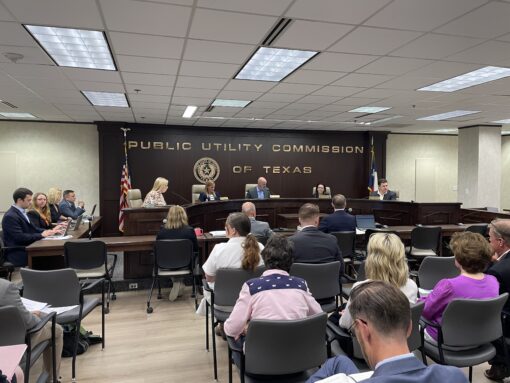
PUCT commissioners, who are appointees of Gov. Greg Abbott, will hold a vote on the application for the first 765-kV line segment on June 18. Forty-Three state lawmakers have joined a push for the project to be paused. “We support any intervenor that is seeking to delay the project in its entirety,” Torres stated to Texas Scorecard.