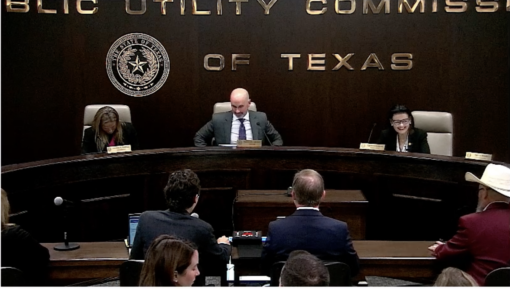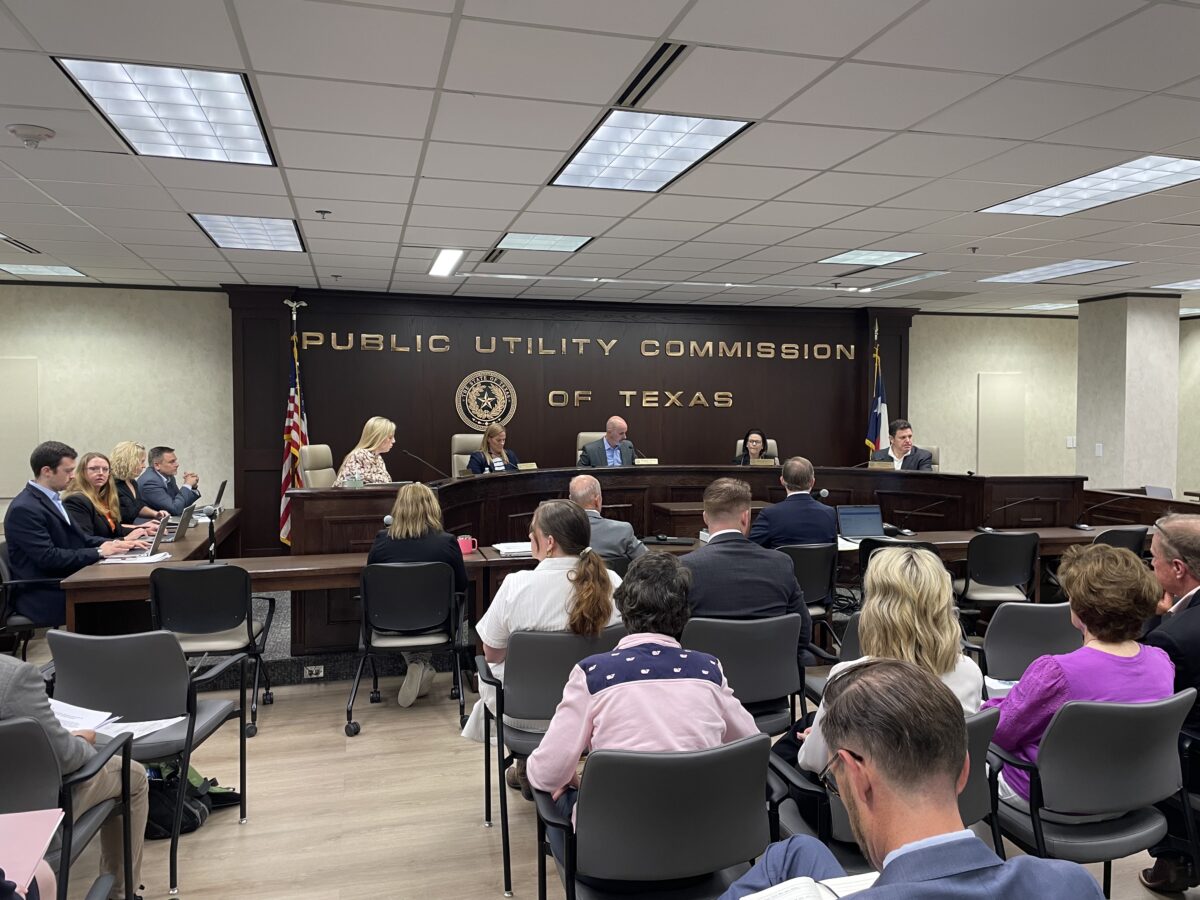
In a unanimous decision Wednesday, Public Utility Commission members voted to “abate” the first segment of a proposed 765-kilovolt transmission project, after raising concerns about public notice and the short timeline.
A commission spokesperson confirmed the decision will be delayed until administrative law judges offer their recommendation on the third of the five segments of the proposed transmission lines.
Commissioners were considering the Longshore Switch-Drill Hole Switch 765-kV transmission line, proposed by electricity delivery company Oncor. This line would run approximately 160 miles, beginning west of Forsan in Howard County and ending near the Culberson–Reeves County line in West Texas. Longshore Switch-Drill Hole Switch is the western part of the Dinosaur to Drill Hole import path, one of three paths to bring power from East Texas into the energy-rich Permian Basin, with lifetime costs reportedly approaching $100 billion. The eastern half of Dinosaur to Drill Hole is the third of the five segments under consideration.
These proposed lines are part of the Permian Basin Reliability Plan, which lawmakers authorized as a limited regional fix. Critics have said PUC, grid operator ERCOT, and Oncor have expanded it into a statewide project without explicit legislative authorization.
The three paths were broken into five segments. Each of these segments has undergone hearings before the State Office of Administrative Hearings, where landowners have raised concerns about transmission lines coming on their property.
American Stewards of Liberty, a pro-landowner group, and 43 state lawmakers asked the PUCT commissioners to defer determining a need for any segment of all paths until the process for the fifth and final segment has been completed.
“A central question remains unresolved: whether the underlying reliability need truly requires large-scale imports of power over long distances, or whether local generation alternatives could satisfy some portion of that need,” ASL attorney Elena Folgueras told commissioners. “Before committing Texas to an unprecedented transmission build-out, the commission should know whether local generation was studied as a potential alternative. The record suggests it did not.”
Oncor attorney Jaren Taylor argued against any delay, claiming that would only increase the cost. He also said the project was separated into five segments and spaced out at PUCT’s request.
“We were asked to put four to six weeks between each of these filings,” he said. “The filing schedule that was filed in the prior docket on the Permian Basin sequencing of these was done intentionally in consultation with your infrastructure division, with your legal division, and the spacing that was placed between these was at their direct request, so the commission’s resources did not have all of these cases fall under that one point at a time.”
PUCT Chairman Thomas Gleeson asked Taylor about the 180-day decision timeline for commissioners to approve or deny a transmission line project. State lawmakers shrank the timeline from one year in 2023 with House Bill 5066, with a bias towards utility companies and the commission.
“The 180 days is very, very fast,” Taylor responded. He believed it’s “perfectly appropriate” for cases concerning shorter lines with less voltage.
Attorney Brad Bayliff, representing the Roye Boys Partnership, shared his perspective on the process based on working on about 100 such cases. “The process is broken,” he told commissioners, noting that there are only 85 days out of the 180 for newly noticed landowners, which he said is “almost impossible” for them. “Landowners’ interests are not being represented.”
Bayliff also criticized the process for the administrative law hearing for the fifth segment of the line, which took place last week. “We got 13 minutes for cross [examin]ing a panel of eight people. We got seven minutes to be able to talk to the staff’s witness, and we got three minutes each to be able to cross any intervenor experts about the case that was before the [administrative law judges],” he said. “I didn’t find out that I got 13 minutes until less than 20 minutes before the cross started at the panel.”
Commissioners asked Taylor about issues with notifying the public. Landowners have repeatedly complained about not being given proper notice by utility companies when a proposed route was to come in proximity with their property.
Taylor said that the notice rules PUCT directs them to use is based on county appraisal district records. He said the problem is that these records are only updated periodically, and they vary from county to county. “The only other option would be pulling deed records,” he said. “If you require deed records for providing notice, you add months and months and months to the preparation of a case like this, and substantial additional cost.”
Commissioner Kathleen Jackson asked Taylor about increasing clarity in maps in their mail notices so landowners can clearly see how the proposed project impacts them.
Taylor responded that, with mail notices, they are required to send a map that shows the entire process. “You’re talking about a 200-plus-mile project. You’ve got to zoom out to make that possible,” he said. “We’ve tried to address that with interactive maps that are available on the company’s web pages, but we’re cognizant of complaints and are looking at what are our options on future cases of this size.”
Gleeson expressed concern about proceeding. “I think the best thing to do for us would be to abate this case,” he said, adding they should wait until the process for the Dinosaur to Longshore line finishes. “Wait for that to get before us, be remanded from SOAH, and then make a decision at that point.”
PUCT voted unanimously to abate. Chairman Gleeson said PUCT will make recommendations to state lawmakers to address issues identified during this process.
Folgueras recognized it as a positive move. “It is great for a position that American Stewards of Liberty has had throughout this proceeding, in terms of taking a closer look at things, and noting that these transmission lines and these dockets are tied together and should be determined together,” Folgueras told Texas Scorecard.
Oncor spokesperson Andrew Clark stated, “Oncor appreciates the Commissioners’ thoughtful review of this critical project, which will support electric reliability for millions of Texans across the ERCOT grid. We will continue to participate in the established regulatory review process and look forward to the Commissioners’ decision.”