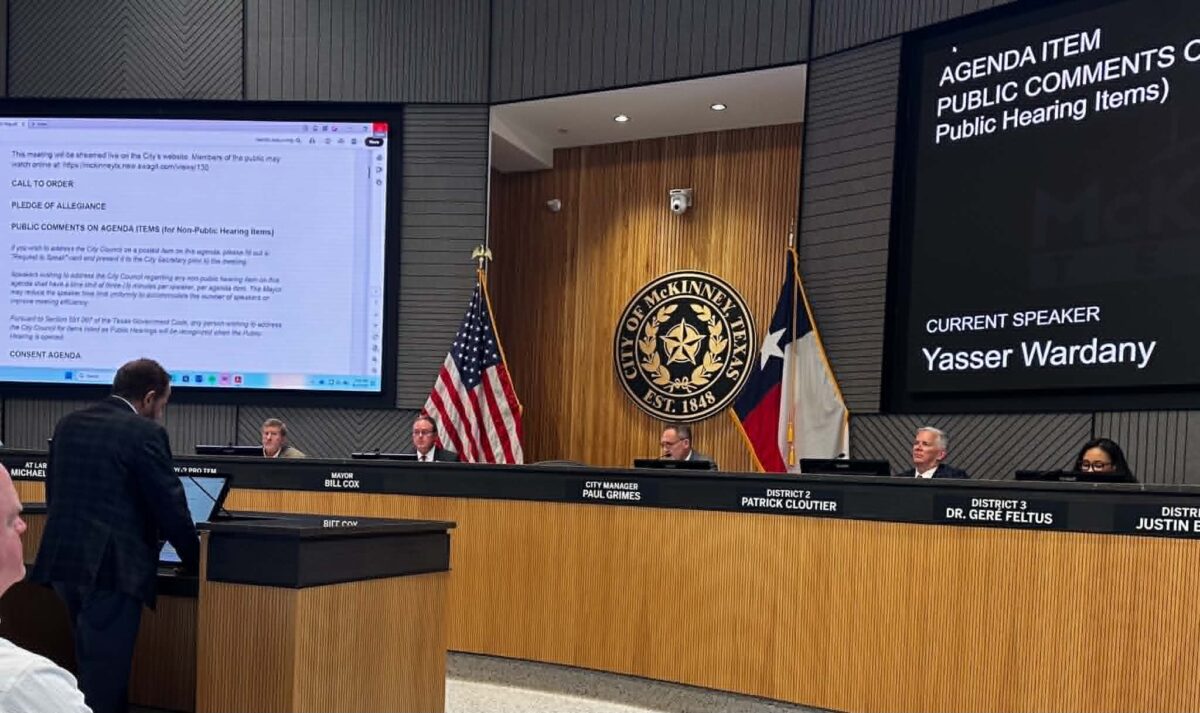
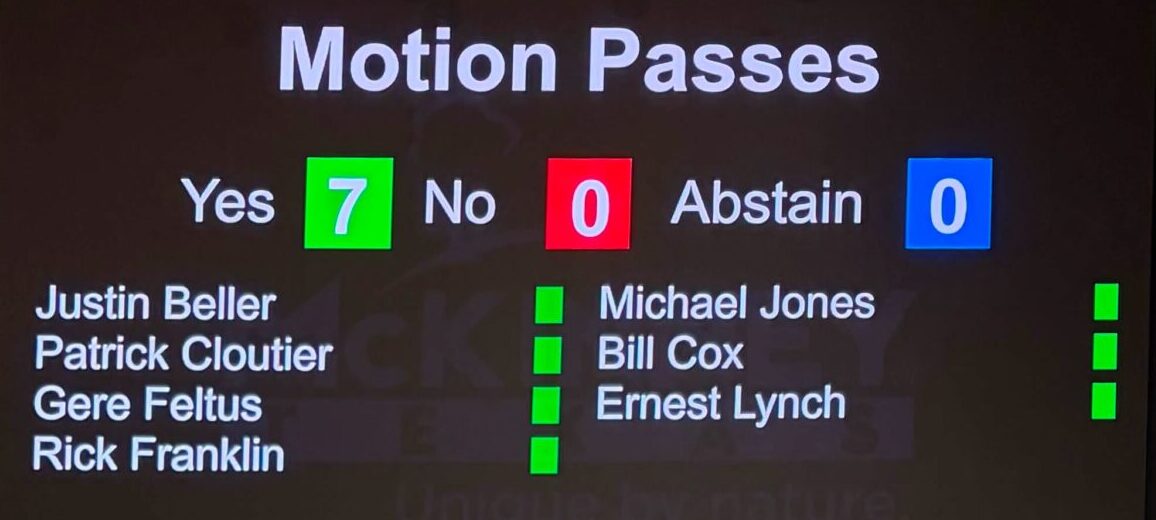
As expected, McKinney City Council members unanimously approved plans for a proposed mosque amid concerns from citizens about the impact of the development on the surrounding community as well as Islamic sharia law practices.
Prior to council’s Tuesday night vote, about 150 people spoke—a mix of supporters and opponents of the mosque plan—during a long and sometimes rowdy meeting that overflowed city hall.
Councilman Patrick Cloutier had previously stated that members would approve the plan, explaining during a July 21 meeting council members’ “ministerial” duty under city law to allow property developments that meet established zoning requirements.
City administrators also spoke Tuesday night, explaining their process for reviewing and approving the submitted mosque plans.
Lucas Raley, McKinney’s director of city planning, said most site plans are administratively approved and do not come before planning and zoning or council for a vote.
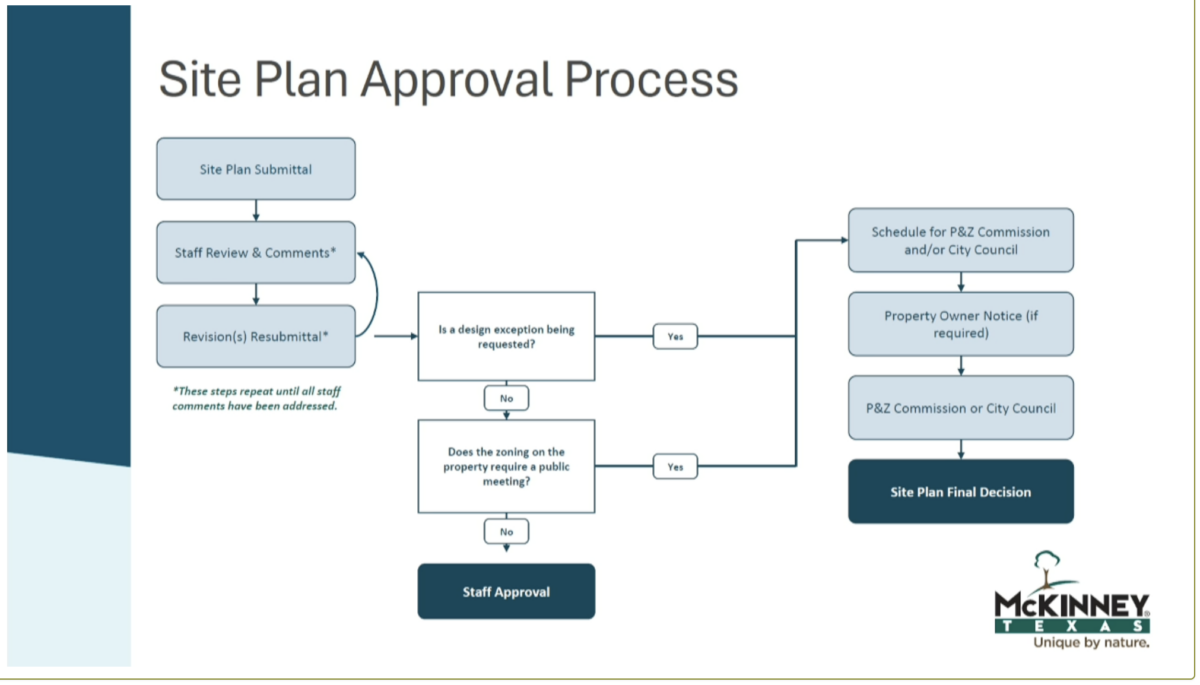
No rezone or design exceptions were requested for the current mosque plan, so no notice to nearby property owners was required, but the property’s older “planned development” zoning designation still required votes of approval from P&Z and council.
Raley and Gary Graham, McKinney’s director of engineering, reviewed details of the submitted plans and revisions made over the past two years—including parking calculations, traffic studies, drainage and erosion issues, and impact on a nearby creek.
The Mosque
The McKinney Islamic Association proposed building a mosque and related facilities on 5.5 acres at the corner of Virginia Parkway and Crutcher Crossing. MIA bought the property in 2022 for the purpose of expanding beyond its current masjid on Eldorado Parkway, which the group has outgrown.
Approved plans include a 15,000 square foot mosque, a 10,000 square foot classroom building, and 7,000 square foot gym.
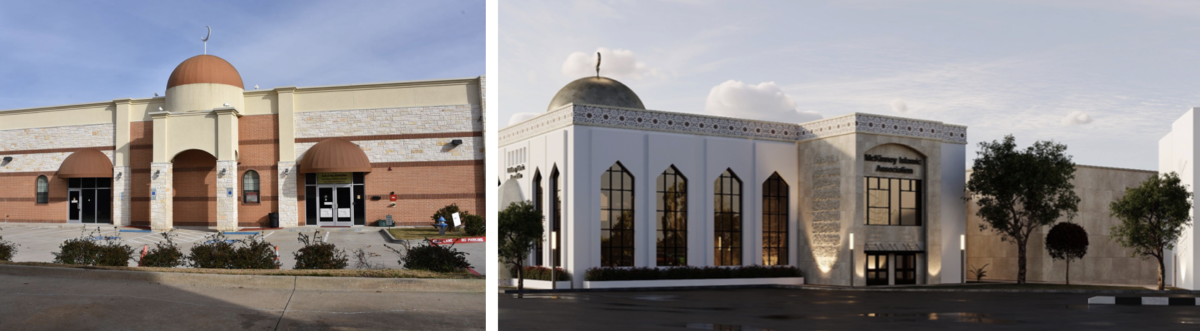
A site plan submitted in 2024 for a 40,000 square foot mosque required a rezoning of the property, which city planners rejected.
City administrators concluded that the new site plan for the mosque is “fully compliant” with the property’s original zoning and the city’s newer Unified Development Code, leaving officials no discretion to reject the project at this stage.
Assistant City Manager Jennifer Arnold noted Tuesday that a site plan “is not the only plan that has to be considered and acted upon as part of the development process.”
“It is the first plan in a commercial project that has to be considered and reviewed. From there, we will receive full civil engineering plans, plat plans, building elevations, and building permits,” said Arnold. “All of those plans, as they are reviewed, are compared against that site plan for conformance.”
Graham reiterated that the council was voting on a preliminary “conditional approval of a site plan that’s before you.”
Councilwoman Geré Feltus, whose district includes the mosque property, said she is “still open to conversations” with her constituents and will “keep looking for solutions.”
“We’re going to look into every possibility that we can to help to alleviate some of the congestion that you’re seeing, and we’ll do as much as we possibly can,” she said.
Public Comment
Although the outcome of the required vote was not in question, citizens from McKinney and beyond packed city hall to speak both for and against the mosque. Hundreds spoke or submitted written comments to the council.
U.S. Rep. Keith Self and State Rep. Keresa Richardson—both Republicans who live in and represent McKinney—focused on the dangers of political Islam.
“Don’t tell me it can’t happen here, because it’s already happened in Texas,” said Self, who co-founded the congressional Sharia-Free America Caucus, citing imams in America who were preaching “open sedition” against the U.S. Constitution.
Richardson asked the council to “pause final action” on the mosque pending the outcome of a state investigation into the Islamic Tribunal of Dallas, a purported “sharia law court” on which MIA Imam Mohamed AlGebaly has held a leadership position.
A number of speakers—some from McKinney, some not—also focused their comments opposing the mosque on the threat of Islamic extremism and sharia law practices.
“This has become a fervent grassroots issue,” said Collin County Republican Party precinct chair Jeff Frye, noting that 95 percent of Texas GOP convention delegates voted to make banning sharia a legislative priority. “We are all here today to defend the U.S Constitution and its laws.”
Many other McKinney residents, especially those who live near to the proposed mosque development, continued to raise questions about quality-of-life issues such as traffic and parking.
Connie Gibson noted that ingress and egress into and out of her neighborhood has already “gotten progressively worse” over the years.
She asked the council to “do what is best for all the people of our community and not just this mosque.”
“I hope this reminds people that local elections matter,” added Windy Gallagher, another resident concerned about the added traffic with multiple schools in the area.
City administrators said that a traffic study showed the proposed facility would have “no significant impacts” on the adjacent streets, and that MIA had voluntarily added more parking spaces than required by the city—206 instead of the minimum 127 spots.
McKinney Islamic Association President Yasser Wardany said his group listened to issues raised by the community in the 2024 P&Z hearing and “completely redesigned” the plan multiple times in coordination with city administrators.
“We are committed to being a good neighbor,” said Wardany.
Dozens of other community members also spoke in support of the proposed mosque, citing MIA’s good works in McKinney for nearly 30 years and religious freedom, as well as the city’s legal duty to approve a zoning-compliant plan.
The Vote
Councilwoman Feltus called for the mosque plan to be pulled off the consent agenda for further discussion, including a presentation from city administrators.
Feltus said city staff had “gone above and beyond” to answer questions and provide clarity about the proposed plan.
“There is not one question that has gone unanswered without thorough vetting and a great response to why we are being presented this site plan the way it is and why it’s compliant with our code,” said Feltus. “And so because of that, it is incumbent on me to move forward, and going ahead to approve this item. It does not mean the conversation stopped.”
“This is a site plan approval, nothing else,” said Councilman Justin Beller, the only other member to comment on the mosque proposal.
Councilman Beller praised the McKinney Islamic Association as “good neighbors.”
Beller said he has “several friends that I know and trust” who attend the current mosque regularly and “undoubtedly are an asset to this community. They have a constitutional right to worship without hindrance.”
With this proposal, they’ve worked with city staff to conform to the existing zoning. They’ve listened to the concerns. They’ve made a request, after they made a request to P&Z a few years ago. I think they’ve earned and deserve a little trust that they’ll do right by you as their neighbors.
Beller also berated speakers who focused on the dangers of radical Islam and accused “partisan politicians” of “election-year fear-mongering.”
“I’m understanding to the neighbors who have practical concerns about traffic, parking, free space, green space … Change is difficult,” added Beller. He blamed traffic issues on state and county officials’ failure to improve regional transportation in the area.
“Be a good neighbor to others,” Beller concluded. “That’s what makes McKinney what it is.”
As expected, the vote was a unanimous 7-0.
McKinney residents with more questions can contact their council members.