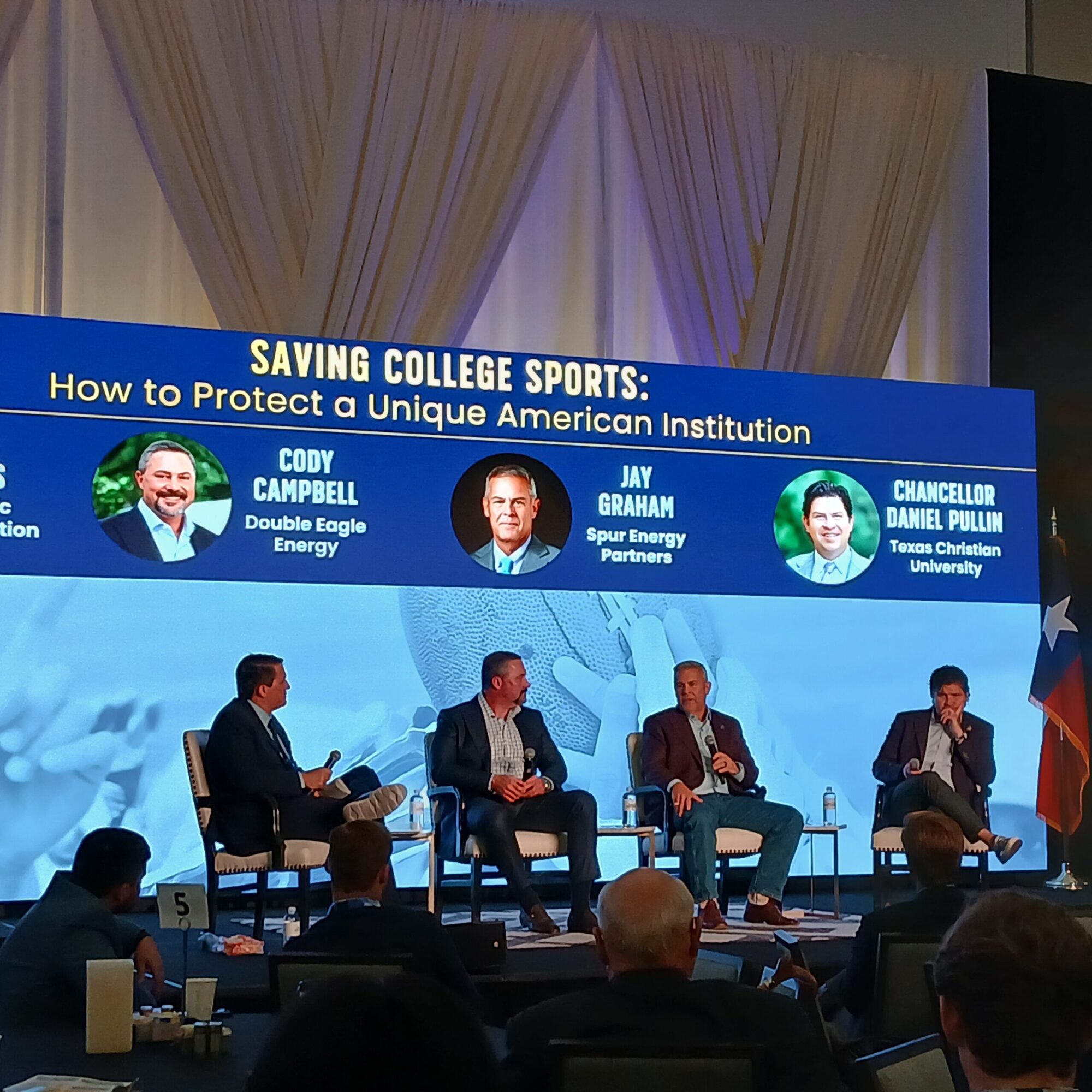
Representatives from several of Texas’ largest universities are discussing how to tackle challenges poised by changes to the economic and governance landscape of college sports.
During a panel discussion at the Texas Public Policy Foundation’s policy summit, Texas Tech University System Regents Chair Cody Campbell explained college sports are currently facing a significant crisis, primarily driven by financial issues.
Jay Graham, acting Regent Chair for the Texas A&M University System, clarified that the problem is not a lack of revenue but excessive expenses. In this landscape, football typically remains the sole profitable sport, with rare exceptions.
The advent of Name, Image, and Likeness (NIL) has severely aggravated this fiscal strain, creating “an even bigger hole” in athletic department budgets.
The increasing financial pressure forces universities to make difficult budgetary decisions, which include either diverting necessary revenue from academic programs or cutting sports.
These cuts disproportionately target Olympic and women’s sports. This situation is particularly critical to the U.S. Olympic teams, which heavily rely on the higher education system to develop its athletes.
Despite the cost challenges, the speakers highlighted the broader value of college sports, noting that 90 percent of women in C-suite positions and 60 percent of American CEOs have a sports background.
For institutions like Texas Christian University, Chancellor Daniel Pullin stated that athletics is a major component of the school’s value proposition and branding.
A primary area of concern is the lack of effective oversight, leading Campbell to advocate for a new authority to be “in charge” of college sports that is separate from the NCAA. Graham echoed this sentiment, asserting that leaders in the business must “step up and lead this thing.”
A recurring theme among several speakers was the need for internal alignment and agreement among schools on universal “rules and referees,” which should be supported by limited federal oversight to ensure consistent guidelines across state borders.
To achieve meaningful, national-level reform, Campbell stressed the necessity of congressional action. While Campbell welcomed President Donald Trump’s recent executive order on this subject, he stressed that the jurisdiction for an executive order is limited.
Campbell also offered a political strategy, advising that any national legislation must “take care of smaller schools” to secure the necessary 60 votes in the U.S. Senate and ensure fairness.
The sustainability of the current model was questioned, with Graham specifically naming schools like Mississippi State and Vanderbilt as unable to endure the current system.
Campbell used Washington State’s enrollment loss after exiting the PAC-12 as a warning against similar outcomes.
To directly tackle the expense problem, Campbell proposed specific financial reforms, including the implementation of coaching salary caps and limits on buyouts. Additionally, he argued for restructuring conferences to reduce operational costs and travel, stating there is “no reason for east coast schools and west coast schools to play in the same conference.”
Despite his criticisms of the current environment, Campbell affirmed his commitment to maximizing Tech’s position within the existing, albeit dysfunctional, rules.
The financial fallout from NIL extends beyond athletic departments.
Pullin noted that the constant fundraising for NIL programs is causing “donor fatigue” that negatively impacts academic fundraising. He also highlighted a revenue imbalance in college football, which draws double the viewership of the NBA but generates only half the revenue.
Finally, Graham addressed the role of agents in the college sports ecosystem, calling them “slime” and warning that agents are trying “to get kids to sign over their rights for life.”
Federal discussions remain ongoing. As chairman of the U.S. Senate’s Commerce, Science, and Transportation Committee, Texas’ Ted Cruz is a key player in these negotiations.