EL PASO—The testimony from Democrat plaintiffs’ expert witnesses in Texas’ 2025 redistricting trial has begun to unravel, as cross-examination revealed glaring flaws in their analyses and conclusions on Friday.
Plaintiffs suing over the congressional maps include the League of United Latin American Citizens (LULAC), the National Association for the Advancement of Colored People (NAACP), the Mexican American Legal Defense and Educational Fund (MALDEF), and the Mexican American Legislative Caucus (MALC).
David Ely, a California-based expert in demographic and map analysis, took the stand at the close of day 2 on Thursday to allege Texas lawmakers considered race while drawing new congressional districts earlier this year.
The new districts include five GOP-opportunity seats, which Republicans could pick up in the 2026 midterm elections if the map stands.
According to Ely, several of the newly drawn districts included a roughly 51 percent Hispanic or black Citizen Voting Age Population (CVAP)—a level he claimed could not have been reached without deliberate racial targeting.
Friday morning, Ely returned to the stand to face continued cross-examination. State attorneys wasted no time exposing weaknesses in his argument.
The Partisan vs. Race Distinction
One of the State’s attorneys, Will Thompson, presented a striking counterexample: a series of maps created and used by Ely himself in another case—which Ely testified were drawn “blind” to race. These “race-neutral” maps nonetheless produced districts with around 50 percent black CVAP, and one with a precisely 51 percent black CVAP, undermining two key elements of plaintiffs’ case:
- First, that racial percentages at or near 51 percent strongly imply intentional racial gerrymandering.
- Second, that the outcome could only be explained by conscious racial targeting.
Thompson also pressed the issue of partisan data—a factor conspicuously absent from Ely’s analysis.
While Ely accused the Legislature of “racially” designing districts, he admitted he never accounted for partisan voting behavior, even though race and partisanship often overlap in Texas.
To make their case, Plaintiffs must show that district lines correlate more closely to race than to party affiliation in order to prove unconstitutional racial gerrymandering.
So far, Plaintiffs have not presented the kind of partisan overlay evidence that would strengthen their case.
The “Dangly Thing” Argument
During questioning, Plaintiffs displayed what they called a suspicious “dangly thing” in the new Congressional District 18, suggesting it purposely scooped up black voters. But the State countered with a partisan overlay map showing the same appendage captured a dense cluster of Democrat voters from the surrounding district that was more moderate.
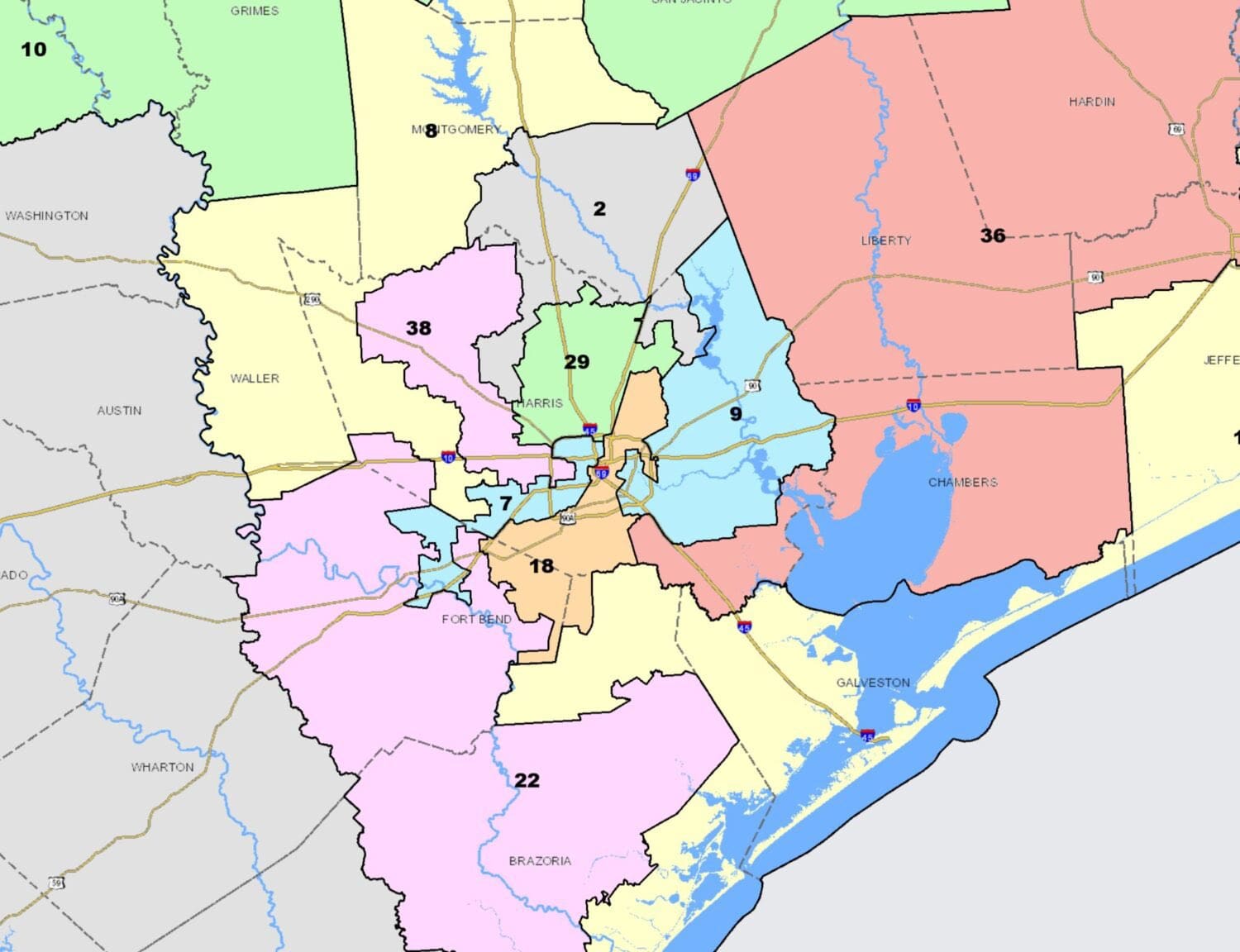
Confronted with this evidence, Ely admitted it was possible the mapmakers were packing Democrats into CD 18 for political—not racial—reasons.
He further acknowledged that political gerrymandering can appear to mimic racial gerrymandering when race and partisan preference correlate.
This concession undercut one of the Plaintiffs’ arguments.
The Plaintiffs followed Ely’s testimony with two additional expert witnesses—Harvard political scientist Stephen Ansolabehere and University of New Mexico political scientist Loren Collingwood—who similarly abstained from using partisan data in their assessments.
Both characterized Texas’ 2025 congressional map as diminishing minority electoral opportunity, but their analyses fail to separate racial considerations from political ones, leaving their conclusions vulnerable.
In one exchange, Ansolabehere claimed certain minority-preferred candidates would no longer win in dozens of past election scenarios under the new maps.
Yet evidence introduced by the State showed that in an alternative model—also created by Ansolabehere—minority-preferred candidates prevailed around half the time. He ignored data from this model when providing his analysis to the court.
Under cross-examination, he admitted those candidates were all Democrats, reinforcing the State’s argument that election outcomes are driven primarily by party preference, not racial discrimination.
Dr. Collingwood, despite being called on as an expert witness in the trial, had recently been criticized as an unreliable witness in a separate case.
In March, during North Carolina’s redistricting litigation, U.S. District Judge James Dever III found Collingwood’s credibility lacking, noting that he “cherry-picked” data and modified his CV partway through the trial. Judge Dever III’s list of grievances against Collingwood was extensive.
In this case, Collingwood’s analysis focused on voting behaviors within certain Hispanic communities and their likelihood of electing Hispanic candidates. However, his data omitted significant elections, such as the 2024 presidential race where President Donald Trump received historic Hispanic support.
He instead included only Hispanic candidates who belong to the two major parties. He also did not include primary elections, and said that if he did, he would “exclude” the Republican primary, arguing there are “not enough” Hispanic voters for an appropriate sample size.
Collingwood also conceded that he did not analyze partisanship in a meaningful way—undercutting his testimony.
Only one other significant witness took the stand today: State Rep. Barbara Gervin-Hawkins (D–San Antonio). She asserted that the “substantial movement” of racial groups between districts made racial discrimination “obvious.”
However, the State characterized this argument as fundamentally flawed. The State pointed out that the U.S. Supreme Court’s 2019 decision in Rucho v. Common Cause clearly holds that partisan gerrymandering—redrawing districts for political advantage rather than racial reasons—is not illegal under federal law.
When confronted with this precedent, Hawkins responded, “Rucho Bucho Mucho…,” drawing a rebuke from the State for dismissing the authority of a Supreme Court ruling in such a manner.
An Uphill Battle for Plaintiffs
Texas has faced redistricting lawsuits for decades, but these cases hinge on whether maps were crafted with racial intent—or simply reflect partisan hardball, which courts have deemed legal.
Day 3 of the trial reveals that Plaintiffs may struggle to meet their high burden of proof.
The expert testimony has so far provided openings for the State to show race was not the primary factor behind district lines. Instead, political advantage—long a feature of redistricting in Texas and across the nation—is being shown as the more plausible explanation—and one that is legal.
Regardless of the decision of the three federal judges in this case, it is expected to be appealed to the U.S. Supreme Court.
Day 2 Trial Coverage
Day 1 Trial Coverage